

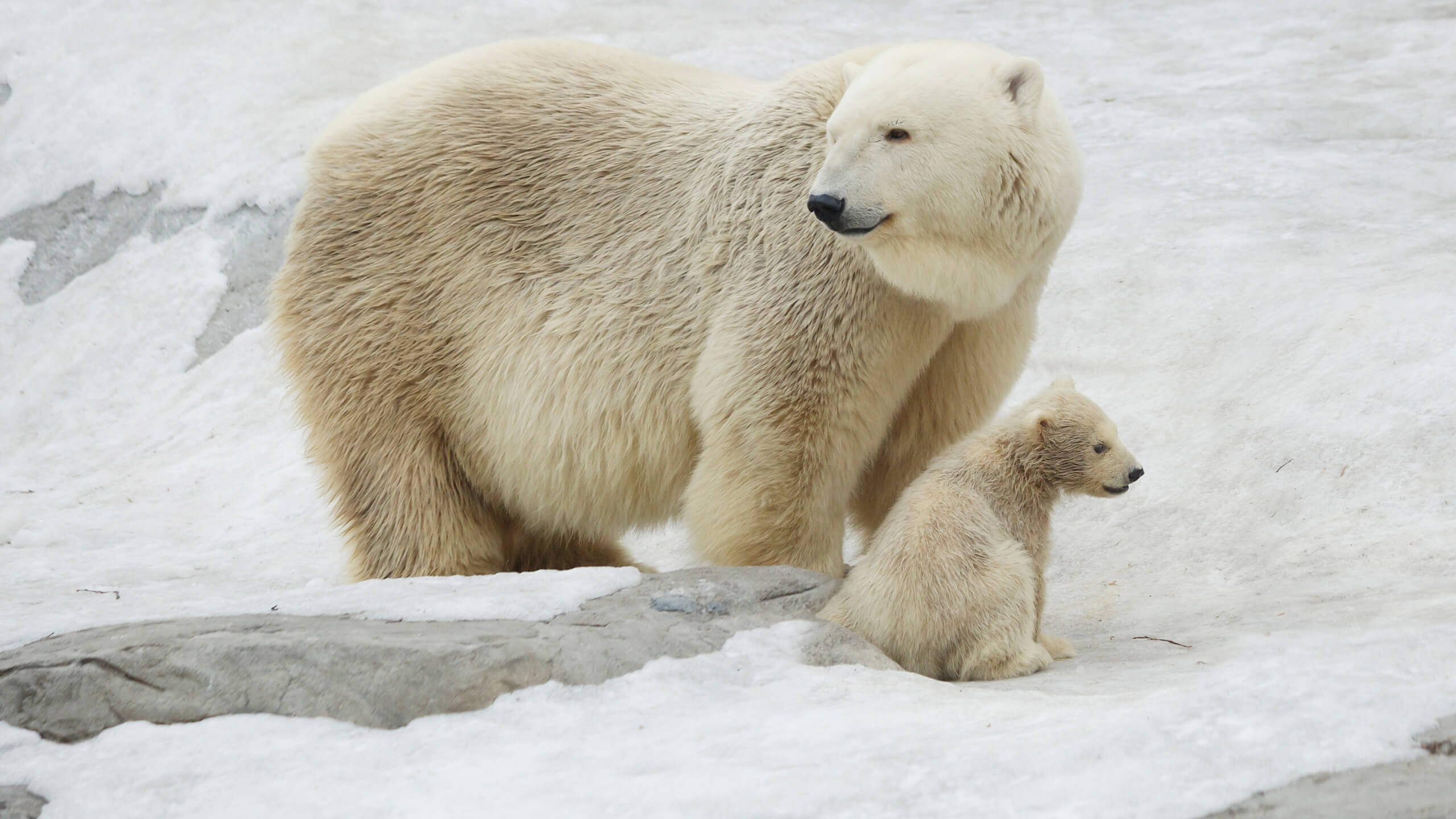
Adult male polar bears usually weigh about 350–590 kg (770–1,300 lb), roughly four to six and a half times the weight of an average American man; adult females usually weigh about 150–295 kg (330–650 lb). That is the range given by Polar Bears International. Large males can stand about 3 m (10 ft) tall on their hind legs and up to about 1.7 m (5.6 ft) at the shoulder on all fours.
There is no single “average” polar bear. Males can be about twice the size of females, and one bear’s weight can swing widely between a good spring of seal hunting and the end of a long fast.
Key polar bear size facts
- Adult male weight: usually 350–590 kg (770–1,300 lb); very large males can exceed 800 kg (1,760 lb).
- Adult female weight: usually 150–295 kg (330–650 lb), heavier in some regions.
- Head-and-body length: about 2.4–2.6 m (7.9–8.5 ft) for males and 1.9–2.1 m (6.2–6.9 ft) for females.
- Height: up to about 1.7 m (5.6 ft) at the shoulder; about 3 m (10 ft) standing upright for the largest bears.
- Newborn cub: little more than 0.5 kg (1 lb) and about 30–35 cm long.
- Status: Vulnerable on the IUCN Red List (2015 assessment); about 26,000 bears worldwide (2016 estimate, 95% range 22,000–31,000).
How much does a polar bear weigh?
Reputable sources give slightly different ranges because they draw on different populations, seasons and studies. The table puts them side by side so you can see where they agree.
| Source | Adult male weight | Adult female weight |
|---|---|---|
| Polar Bears International (usual range) | 350–590 kg (772–1,300 lb) | 150–295 kg (331–650 lb) |
| San Diego Zoo Wildlife Alliance (range) | 350–650 kg (770–1,430 lb); very large males up to 800 kg (1,760 lb) | 150–350 kg (330–770 lb) |
| Alaska Department of Fish and Game (Alaska bears) | Average 600–1,200 lb (about 270–545 kg); largest over 1,700 lb (about 770 kg) | 400–700 lb (about 180–320 kg) |
Sources: Polar Bears International, Polar Bear Facts; San Diego Zoo Wildlife Alliance Library, Polar Bear Fact Sheet (updated March 2026); Alaska Department of Fish and Game, Polar Bear species profile. Metric conversions of the Alaska figures are ours (1 kg = 2.2046 lb).
The sources agree on the shape of the answer: most adult males fall between about 350 and 600 kg, most adult females between about 150 and 300 kg, and a few exceptional males go far higher. The often-quoted “average of 408–725 kg” describes large males, not polar bears in general.
How tall is a polar bear?
Height depends on posture. On all fours, polar bears reach up to about 1.7 m (5.6 ft) at the shoulder, according to the San Diego Zoo Wildlife Alliance. Standing upright on their hind legs, the largest bears reach about 3 m (10 ft), as Polar Bears International notes.
Length is a separate measurement. Adult males measure about 2.4–2.6 m (95–102 in) from nose to the base of the tail, and adult females about 1.9–2.1 m (75–83 in). Alaska’s wildlife agency gives a male length of 8–10 ft (2.4–3.0 m).
How big is a polar bear compared with a human?
For a like-for-like comparison, we use the average US adult man, measured by the CDC in 2021–2023: 175 cm (68.9 in) tall and 90.3 kg (199.0 lb).
- Weight: 350 kg ÷ 90.3 kg ≈ 3.9 and 590 kg ÷ 90.3 kg ≈ 6.5, so a typical adult male polar bear weighs about 4 to 6.5 times as much as the average man. A typical adult female (150–295 kg) weighs about 1.7 to 3.3 times as much.
- Standing height: 3.0 m ÷ 1.75 m ≈ 1.7, so a large male standing upright is about 1.7 times as tall as the average man.
- On all fours: the largest bears, at up to 1.7 m at the shoulder, are nearly as tall as the average man is from head to toe.
These comparisons use US averages; average adult height and weight differ between countries.
Is a polar bear bigger than a grizzly bear?
Usually, yes. Polar bears are the largest living bear species, according to the San Diego Zoo Wildlife Alliance, although the biggest coastal Alaskan brown bears overlap with them. Inland grizzlies are much smaller.
| Bear | Adult male weight | Adult female weight | Source |
|---|---|---|---|
| Polar bear | Usually 350–590 kg (772–1,300 lb) | Usually 150–295 kg (331–650 lb) | Polar Bears International |
| Grizzly bear, Greater Yellowstone | Average 187 kg (413 lb); heaviest known 324 kg (715 lb) | Average 122 kg (269 lb); heaviest known 198 kg (436 lb) | US National Park Service |
| Brown bear, Alaska (including coastal bears) | Up to 1,500 lb (about 680 kg); coastal bears grow larger than inland grizzlies | Alaska Department of Fish and Game | |
Weights vary by season. Kodiak bears, often named as the largest brown bears, are a subspecies found only on the islands of the Kodiak Archipelago, Alaska.
Worked comparison: a 350–590 kg adult male polar bear is about 1.9 to 3.2 times the 187 kg average adult male grizzly in Yellowstone (350 ÷ 187 ≈ 1.9; 590 ÷ 187 ≈ 3.2). At the shoulder, the San Diego Zoo Wildlife Alliance notes that Alaskan brown bears are nearly the same height as polar bears.
What is the biggest polar bear ever recorded?
Guinness World Records lists a polar bear shot in 1960 on the sea ice of the Chukchi Sea, west of Kotzebue, Alaska, with an estimated weight of around 900 kg (1,984 lb). Guinness itself notes that the figures have been disputed. A widely repeated weight of 1,002 kg (2,209 lb) for this bear could not be traced to a verified measurement, so treat it with caution.
How big are polar bear cubs?
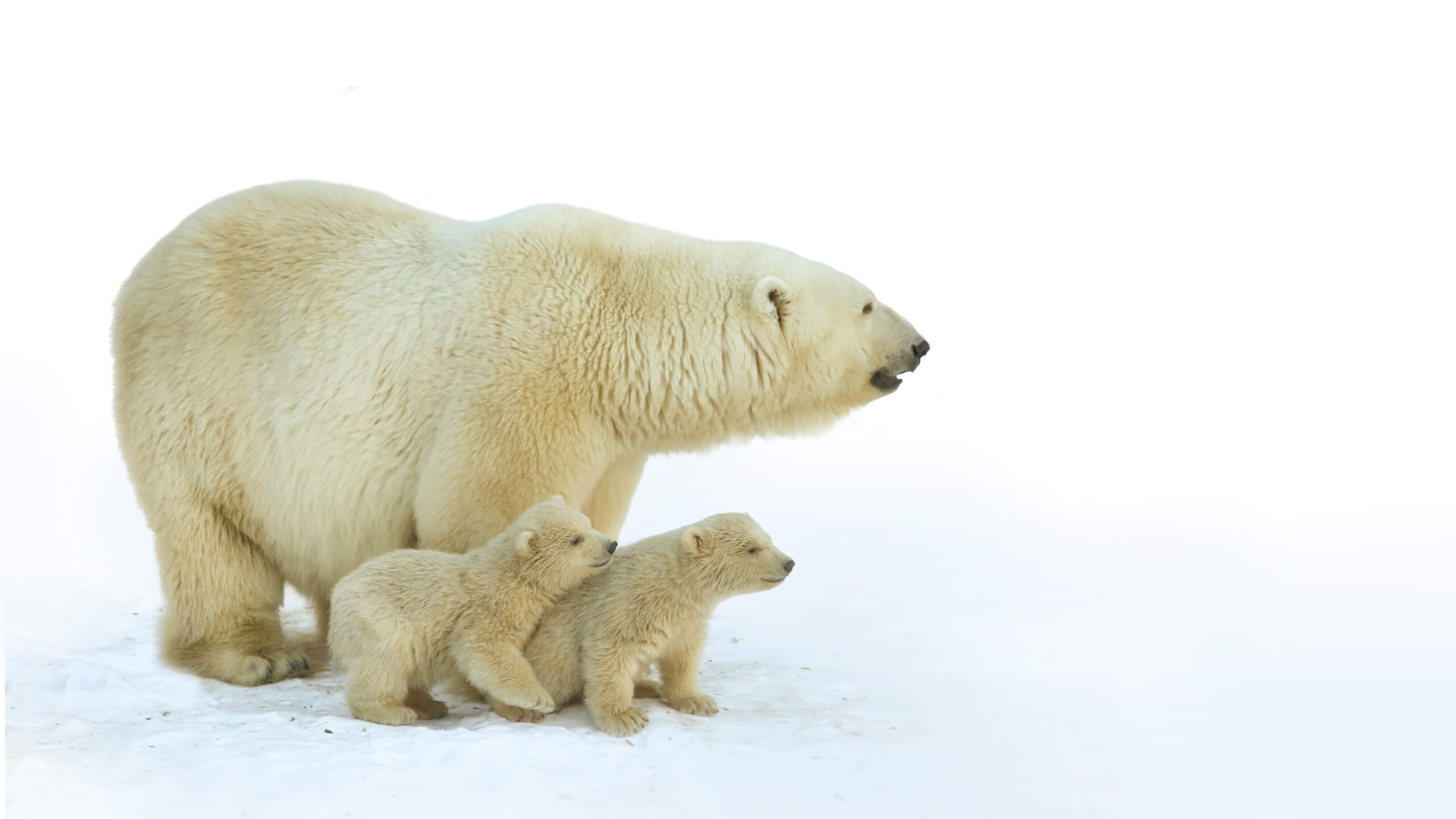
Cubs are tiny at birth: little more than half a kilogram (1 lb) and about 30–35 cm long, and born blind and toothless. By the time they leave the den in late March or early April, they weigh about 20–25 lb (9–11 kg), according to Alaska’s wildlife agency.
Why does a polar bear’s weight change through the year?
Polar bears build fat when seals are easiest to catch from the sea ice, then live off it. In seasonal-ice regions such as Hudson Bay, the ice melts completely in summer, forcing bears ashore where there is little to eat, and they live largely on their fat reserves until the sea freezes in autumn, the IUCN Polar Bear Specialist Group explains. When hunting is good, a bear may eat only a seal’s energy-rich blubber and skin, according to Polar Bears International.
This is why measured weights differ so much. The same bear can be far heavier after a good hunting season than at the end of its fast; the San Diego Zoo Wildlife Alliance notes that weight varies substantially through the annual cycle.
Is sea-ice loss making polar bears smaller?
In some places, there is evidence of declining body condition. In Western Hudson Bay, the Polar Bear Specialist Group’s 2024 status report states that the body mass of solitary adult females has declined over the past 40 years, which has likely contributed to lower reproductive success. Across the seasonal-ice region, ice is melting earlier and freezing later, so bears go without food for longer.
The picture is not uniform. In Kane Basin, between Greenland and Ellesmere Island, the same report notes that multi-year ice is giving way to annual ice, body condition appeared to improve slightly between the 1990s and 2010s and the subpopulation appears to have grown. More on why the species matters is in our article on why polar bears are important.
Are polar bears endangered?
Polar bears are listed as Vulnerable on the IUCN Red List, in an assessment published in 2015. They have been listed as Threatened under the US Endangered Species Act since 2008. The most recent global estimate, published in 2016 and still used in the Specialist Group’s October 2024 report, is about 26,000 bears (95% confidence interval 22,000–31,000) across 20 subpopulations.
That number comes with a caution: several subpopulations, particularly in the Russian Arctic, lack reliable estimates, so the global figure partly reflects how much is known. For a fuller breakdown, see how many polar bears are left in the world.
What scientists don’t know yet
- How many polar bears live in subpopulations for which the Specialist Group has never provided an abundance estimate, such as East Greenland and the Arctic Basin.
- How body size will change region by region as the ice-free season lengthens.
- The true weight of the largest polar bear ever killed, since historical records were not verified.
Related reading
- How many polar bears are left in the world?
- Why do polar bears have black skin?
- How long do beluga whales live? (belugas are among polar bear prey)
Update note: This article was substantially revised on October 12, 2026, to replace the incorrect single “average” weight with sourced male and female ranges, correct the height on all fours (up to about 1.7 m at the shoulder, not 5–9 ft) and a kg-to-lb conversion error, add sourced comparisons with humans and brown bears, label the 1960 record bear as an estimate, and add IUCN status and a dated population estimate. A link to an external sister site was removed. It was drafted with AI assistance and checked against the sources listed below.
Sources
- Polar Bears International, Polar Bear Facts
- San Diego Zoo Wildlife Alliance Library, Polar Bear Fact Sheet: Physical Characteristics and Population & Conservation Status
- Alaska Department of Fish and Game, Polar Bear species profile and Brown Bear species profile
- IUCN/SSC Polar Bear Specialist Group, 2024 Status Report on the World’s Polar Bear Subpopulations (October 2024)
- IUCN Red List, Wiig et al. (2015), Ursus maritimus (category confirmed via the GBIF copy of the Red List dataset, July 2026 version)
- US National Park Service, Yellowstone Grizzly Bear Facts and Brown Bears
- CDC National Center for Health Statistics, Body Measurements (data August 2021–August 2023)
- Guinness World Records, Heaviest carnivore on land
Discover more from SciQuest
Subscribe to get the latest posts sent to your email.
Leave a comment