
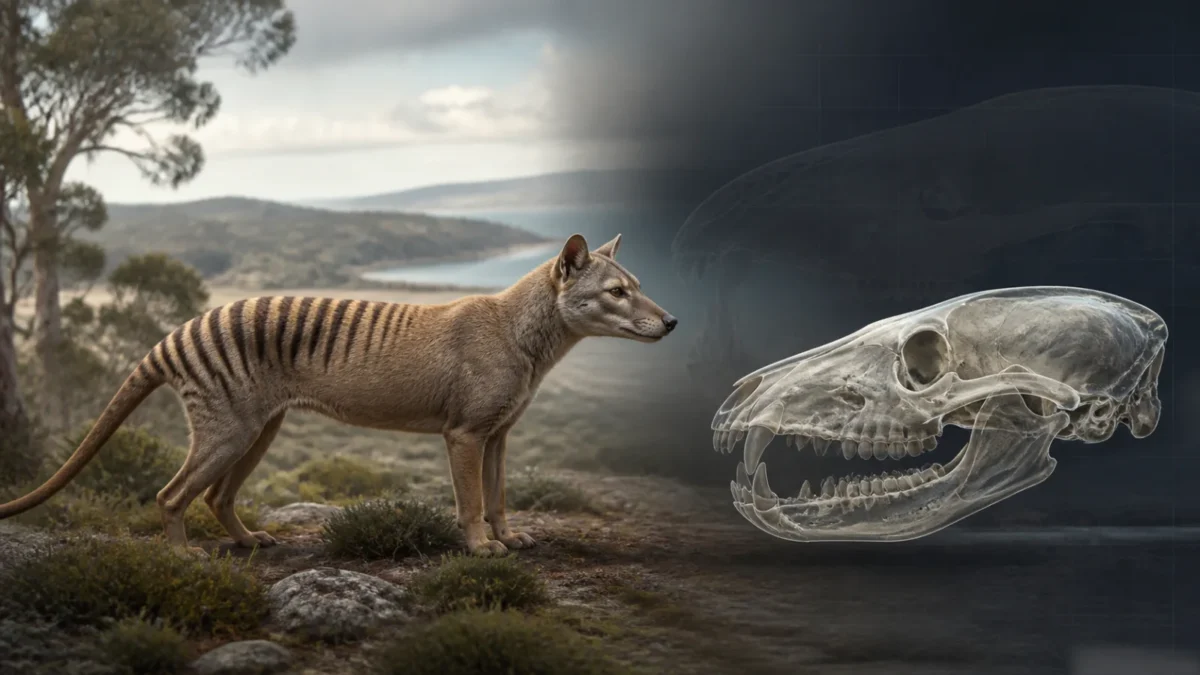
A new analysis of the extinct thylacine’s oversized yet slender skull suggests it caught small, agile prey with fast snapping bites—an anatomy poorly suited to wrestling down large struggling animals such as sheep.
Published: August 31, 2026, 10:20 p.m. PKT · Reporting cutoff: August 31, 2026, 9:45 p.m. PKT
What you need to know
- Researchers compared thylacine skull shape with 60 living and extinct meat-eating mammal species.
- The thylacine combined an unusually large skull with a long, tall and relatively delicate snout.
- That combination is consistent with fast, high-impact snapping at small or medium prey.
- The result further weakens the historical portrayal of thylacines as wolf-like sheep killers.
- Skull form can constrain likely feeding mechanics, but it cannot provide a complete menu of what thylacines ate.
The Tasmanian tiger looked enough like a dog for Europeans to call it a wolf. Its skull tells a stranger story. Researchers report that the thylacine carried a head almost as large as a grey wolf’s despite weighing roughly half as much, but the animal’s long snout lacked the robust construction expected in a predator that regularly restrained large, struggling prey.
Instead, the skull appears built for speed at the tip of the jaw. The proposed result is a rapid, forceful snap at agile prey such as bandicoots—not a prolonged grapple with a sheep. That distinction matters because accusations of livestock killing helped justify the government-backed persecution that preceded the species’ extinction.
A skull with no close living equivalent
Vera Weisbecker of Flinders University and colleagues compared cranial measurements across 60 species from 14 families of meat-eating mammals. Their analysis placed the thylacine between canids and other marsupials in some dimensions, but not as a simple marsupial copy of a wolf.
The animal combined a disproportionately large cranium, a long and gracile face, a tall upper jaw and a widened region around the canine teeth. No living mammalian predator in the comparison displayed the same full package.
A longer jaw moves its tip through a larger arc, increasing speed during a bite. A bigger skull can also carry more muscle and spread forces through more bone. The researchers interpret this combination as an adaptation for high-impact snapping, a strategy with parallels among some crocodilians, predatory fishes and extinct vertebrates.
Why the sheep-killer label was biologically doubtful
Large-prey specialists must tolerate twisting and bending forces when quarry fights back. Wolves have comparatively robust snouts for that job. The thylacine’s slender rostrum was less resistant to those stresses, consistent with earlier biomechanical work questioning whether it routinely subdued animals close to its own size.
The new paper does not prove that thylacines never scavenged a carcass or attacked livestock. Wild predators can behave opportunistically. It does show that their skulls were not shaped like those of living mammals specialized for restraining large prey.
That makes the old agricultural narrative look even less secure. A bounty system treated the animal as a major sheep predator before its ecology had been studied with modern methods. The last confirmed captive thylacine died in Hobart in 1936.
How other headlines framed it
- Nature Communications foregrounded the animal’s unique skull morphology and proposed biting style.
- Flinders University’s release emphasized that the thylacine was neither tiger nor wolf and connected the anatomy to extinction-era myths.
- ABC News Australia led with the challenge to previously held ideas and explained the skull analysis in a conservation context.
What the evidence cannot reconstruct
Bone preserves mechanical possibilities, not a filmed hunt. Diet can also be studied through tooth wear, stable isotopes, preserved stomach contents and historical observations, each with different biases. A confident reconstruction should combine those records rather than ask skull shape to answer everything.
Bottom line: the thylacine was not simply a marsupial wolf. Its extraordinary skull points to a fast-snapping predator with no close living mammalian counterpart—and adds anatomical weight to the case that fear of a specialist sheep killer was misplaced.
Sources
- Weisbecker et al., Nature Communications, August 31, 2026.
- Flinders University research release and study details.
- Tasmanian Museum and Art Gallery thylacine skull collection.
Editorial disclosure: The lead image is an original concept illustration combining a reconstructed thylacine with a skull visualization; it is not a historical photograph or study figure. SciQuest received no payment for this coverage. To report a possible error, contact SciQuest.