
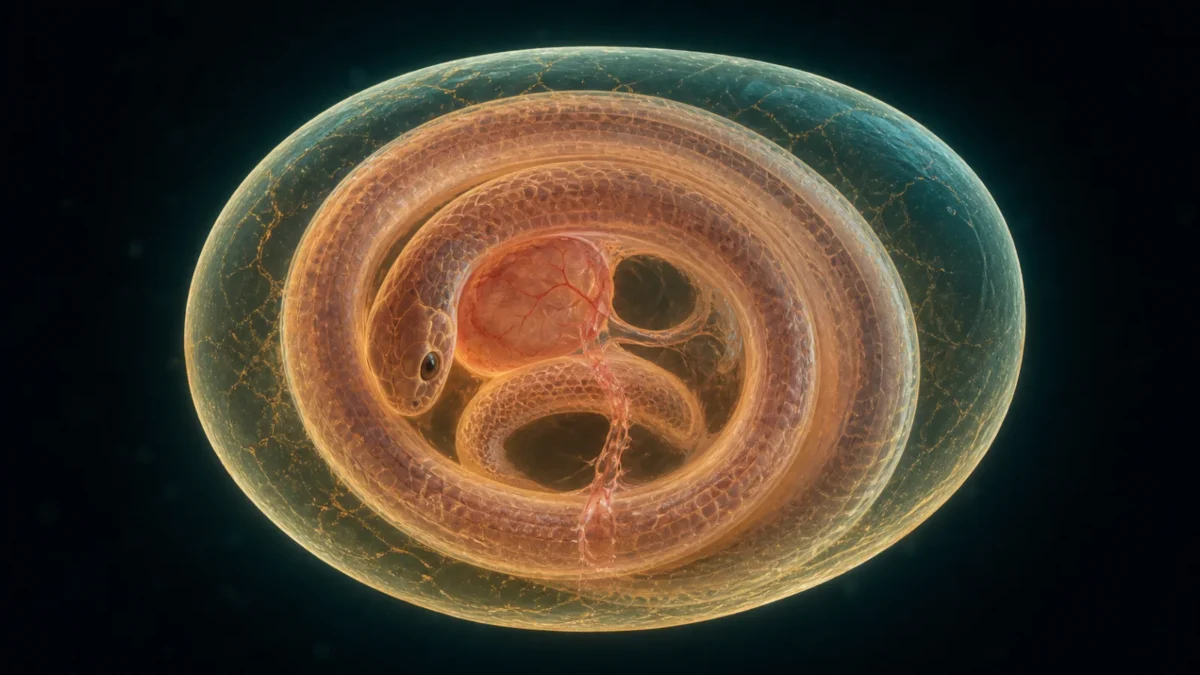
After examining more than 800 embryo images, researchers found that snakes almost always form a right-handed spiral in the egg and propose that rapid spinal growth around a gut tether supplies the twist.
Published: August 31, 2026, 10:20 p.m. PKT · Reporting cutoff: August 31, 2026, 9:45 p.m. PKT
What you need to know
- The team examined images representing more than 800 snake embryos.
- The embryos overwhelmingly coiled in a right-handed, or clockwise, direction.
- CT imaging revealed a pillar of gut tissue extending through the body’s spiral.
- The researchers propose that the spine grows faster than the tethered gut, causing the body to buckle and twist.
- The mechanism is a developmental model, not evidence that adult snakes possess behavioral handedness.
A snake begins solving its longest-body problem before it ever hatches. Instead of growing straight through the limited space inside an egg, the embryo wraps itself into a compact spiral. The surprising part is that the spiral is not random: across hundreds of images, nearly every embryo turned the same way.
An international team led by Tetsuto Miyashita of the Canadian Museum of Nature argues that the twist emerges from a simple mechanical mismatch. The spine lengthens rapidly, while a section of the gut remains anchored across the developing coil. Like one side of a looped strap growing longer than the other, the body buckles into a consistent right-handed spiral.
The pattern appeared across hundreds of embryos
The project began with image comparison rather than a gene screen. Researchers assembled an album of more than 800 snake embryos and recorded the direction of their coils. That broad survey turned an anatomical curiosity into a repeatable pattern.
Computed-tomography scans then exposed the internal geometry. A detached-looking gut pillar crossed the open center of the spiral and tethered different regions of the embryo. The researchers used that anatomy to build a physical explanation for how unequal growth could force the body to twist.
Right-handed here describes the geometry of the helix. It does not mean that a snake prefers its right side when striking, turning or exploring after hatching.
Why coiling matters to the snake body plan
Snakes have more vertebrae and longer trunks than other living vertebrates. Packing that length into an egg requires the embryo to occupy three-dimensional space efficiently without tangling organs or preventing normal development.
The study suggests that coiling is not merely a consequence of confinement. It may be an organized physical solution produced by the relationship between the elongating axial skeleton and internal tissues that grow or remain attached at different rates.
Spiral forms appear throughout biology, from shells to plant tendrils. Some arise through gene-directed asymmetry; others emerge because materials grow unevenly while constrained. Snake embryos may offer an unusually visible example of the second route.
How other headlines framed it
- Current Biology used the direct technical question: how snake embryos coil.
- The Canadian Museum of Nature framed the result as a “caught right-handed” developmental mystery.
- The University of British Columbia emphasized that embryos coil in the same direction and connected the twist to unequal growth.
The experiment that would strengthen the explanation
The strongest next test would alter the tether, tissue growth or mechanical constraint during development and ask whether the direction or tightness of the spiral changes. Such work must distinguish a force-producing structure from one that merely occupies the same location after coiling has started.
Bottom line: snake embryos appear to share a directional twist, and the best current explanation is mechanical: a rapidly lengthening body buckles around an internal tether. The pattern is clear; the causal chain remains a model to test.
Sources
- Weber et al., “How Snake Embryos Coil,” Current Biology, August 31, 2026.
- Canadian Museum of Nature research release.
- University of British Columbia explanation.
Editorial disclosure: The lead image is an original scientific concept illustration of a coiled snake embryo, not a microscopy image or study figure. SciQuest received no payment for this coverage. To report a possible error, contact SciQuest.