

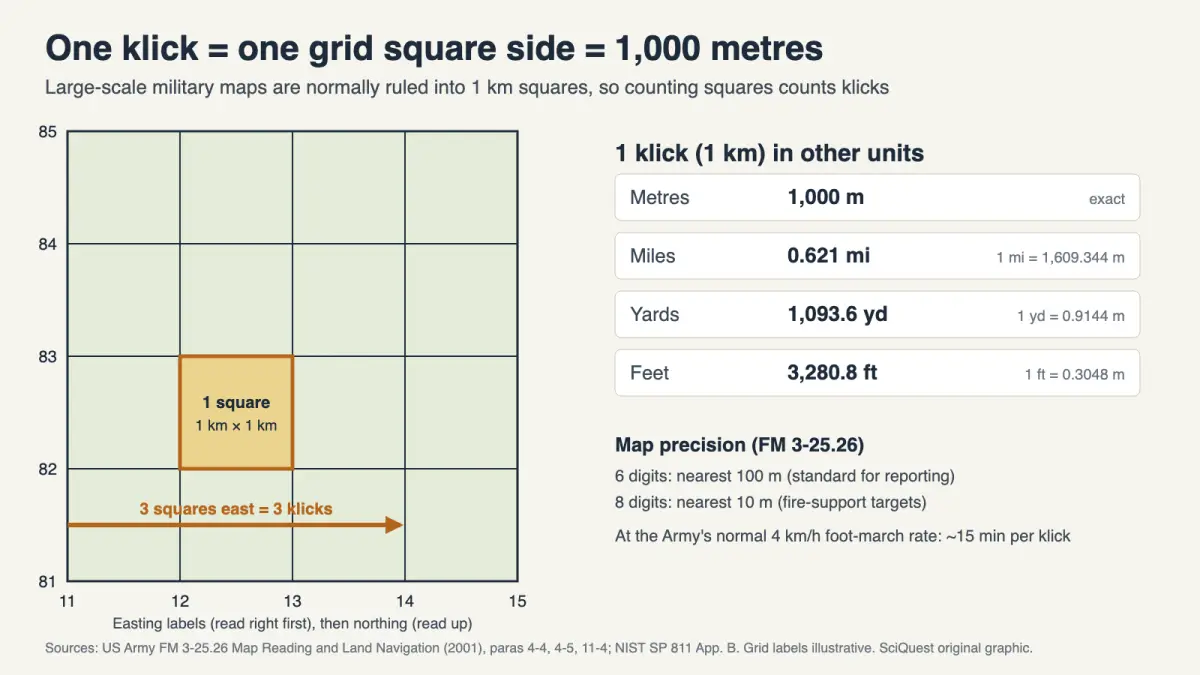
Military slang turns the kilometre, which is defined through the speed of light, into a single syllable, and the 1,000-metre squares on Army maps are why the shortcut works.
A click (also spelled “klick”) is one kilometre: 1,000 metres, or about 0.62 miles. Dictionary.com lists it as slang for “a kilometer” and dates its first recorded use to 1950–55, originally as US military slang. So “the objective is three klicks north” means it is 3 km, a little under 1.9 miles, away.
In feet, one klick is about 3,281 ft; in yards, about 1,094 yd. On foot, the US Army gives 4 km per hour as the normal rate for an 8-hour march, which works out to roughly 15 minutes per klick.
Explain it like I’m busy:
- 1 klick = 1 km = 1,000 m ≈ 0.621 miles.
- “Click” and “klick” are two spellings of the same slang word.
- It is handy because standard military maps are normally divided into 1 km grid squares.
Key facts
- One klick equals one kilometre exactly; it is a nickname, not a separate unit.
- One international mile is exactly 1,609.344 m, so 1 km is about 0.6214 mi (NIST).
- On large-scale military maps, one grid square is normally 1,000 m on a side (US Army FM 3-25.26).
- Army six-digit grid coordinates locate a point to the nearest 100 m; eight digits to the nearest 10 m.
- The word’s deeper origin is not settled; Dictionary.com calls it “unclear.”
| Klicks | Metres (m) | Miles (mi) | Yards (yd) | Feet (ft) | Time at 4 km/h |
|---|---|---|---|---|---|
| 1 | 1,000 | 0.621 | 1,093.6 | 3,280.8 | 15 min |
| 3 | 3,000 | 1.864 | 3,280.8 | 9,842.5 | 45 min |
| 5 | 5,000 | 3.107 | 5,468.1 | 16,404.2 | 1 h 15 min |
| 10 | 10,000 | 6.214 | 10,936.1 | 32,808.4 | 2 h 30 min |
Calculated by SciQuest from the exact NIST factors 1 mi = 1,609.344 m, 1 yd = 0.9144 m and 1 ft = 0.3048 m (NIST SP 811, Appendix B). Times use the 4 km/h “normal rate for an 8-hour foot march” in US Army FM 3-25.26, para. 11-4; real pace varies with terrain, load and fitness.
What it means
A klick is just a kilometre with a nickname. Nothing about the distance changes; only the word does. That matters because the word turns up in films, novels, games and veterans’ stories, and it is easy to confuse with a mile. It is shorter than a mile: about 62% of one.
A useful mental shortcut: 8 klicks is close to 5 miles (8 × 0.6214 = 4.97 mi). The shortcut breaks down over long distances, where the small error grows, so use the 0.6214 factor when precision matters.
Click or klick: which spelling is right?
Both spellings refer to the same thing. Dictionary.com files the kilometre sense under “click” and gives “klick” as a variant spelling. The “k” spelling has a practical advantage: it keeps the word visibly separate from a mouse click or a camera shutter. If you are writing for a general audience, “klick” plus a short gloss (“a kilometre”) is the clearest choice.
How the military uses it: 1 km map grid squares
US Army maps carry a grid of north–south and east–west lines that cross at right angles. The Army’s map-reading manual, FM 3-25.26, says that “normally, the size of one of these grid squares on large-scale maps is 1,000 meters (1 kilometer).” That one design choice explains why the kilometre became everyday speech for soldiers: distances can be estimated by counting squares, and every square is one klick wide.
The same manual describes how coordinates are always read to the right and then up: first the easting (left to right), then the northing (bottom to top). Six-digit coordinates locate a point to the nearest 100 m, which the manual calls normal for reporting locations. Eight digits narrow it to the nearest 10 m, used for fire-support targets. In other words, each extra pair of digits divides the klick-wide square by ten again.
FM 3-25.26 presents this grid as part of the US Army Military Grid Reference System (MGRS), and it requires reported coordinates to include the letters of the 100,000-metre square they sit in, so a reference is never ambiguous.
How long is a kilometre, scientifically?
A klick is only as precise as the metre underneath it. Since 1983, the metre has been defined by the speed of light. NIST states that the metre is “the length of the path traveled by light in a vacuum in 1/299,792,458 of a second.” The International Bureau of Weights and Measures (BIPM) frames it the same way: the speed of light in vacuum is fixed at exactly 299,792,458 m/s, and the metre follows from that and the definition of the second.
So one klick is exactly the distance light travels in vacuum in 1,000/299,792,458 of a second, about 3.34 microseconds (calculated). The imperial units have been tied to the metre too: the international foot is exactly 0.3048 m and the mile exactly 1,609.344 m. Every number in the table above therefore comes from exact definitions, rounded only for display.
What changes the answer
- Map distance versus ground distance. A klick on a map is horizontal distance. Climbing hills adds walking distance; FM 3-25.26 tells navigators to add 20% to map distance when converting to a pace count for cross-country movement.
- Grid size. The 1 km square is normal on large-scale maps, not universal. Always check the grid interval printed on the map you are using.
- Walking time. The 15-minute figure assumes the Army’s 4 km/h normal march rate. Load, terrain, weather and darkness all change it.
Where does the word come from?
Here the honest answer is: nobody has pinned it down. Dictionary.com says the word was first recorded in 1950–55 as US military slang and that its further origin is “unclear.” We could not find an authoritative source that documents exactly where or how it began.
Two popular explanations circulate online. One says “klick” is simply a clipped way of saying “kilometre.” Another says it comes from a mechanical click, such as a sound made by equipment for every 1,000 m travelled. Neither is confirmed by the dictionary sources we checked, so treat both as unverified folk etymology.
Why it matters to you
If you read a war memoir, watch a film or play a game where someone is “two klicks out,” you now know they mean 2 km, about 1.24 miles, or roughly a 30-minute walk at a steady march pace. If you hike or run with metric maps, thinking in klicks is a quick way to judge distance on a 1 km grid.
“But wait…”
Isn’t a click a mile? No. Dictionary definitions give a kilometre, and the Army’s 1 km grid squares are the reason the word is useful. A mile is about 1.61 klicks.
Related questions
How many klicks are in a mile? About 1.609 (1,609.344 m ÷ 1,000 m).
How far is a light-year in klicks? Trillions of them. Our explainer on how long it takes to travel one light-year shows why that distance is so hard to cross.
How many klicks away is Mars? Tens of millions, and the number changes constantly; see how far away Mars is from Earth.
In one sentence
A klick is one kilometre (1,000 m, about 0.62 miles), a military nickname made practical by 1 km map grid squares, though its exact origin remains unclear.
Quick check: did it click?
- How many metres is “four klicks”? 4,000 m, about 2.49 miles.
- Why is the klick convenient on military maps? Grid squares on large-scale maps are normally 1 km on a side.
- What is the metre ultimately defined by? The fixed speed of light in vacuum, 299,792,458 m/s.
Read next
- How long does it take to travel one light-year?
- How fast can we travel in space with current technology?
Sources
- Dictionary.com, “click” (entry click², slang: a kilometer; variant klick; origin 1950–55, US military slang, further origin unclear). Accessed 12 Oct 2026.
- US Department of the Army, FM 3-25.26, Map Reading and Land Navigation (20 July 2001), paras 4-4, 4-5, 11-4 and 12-4 (archived copy).
- NIST, Meter: SI redefinition.
- BIPM, SI base unit: metre.
- NIST, NIST Guide to the SI (SP 811), Appendix B.9, factors for units listed by kind of quantity.
Disclosure: This article was drafted with AI assistance and checked against the sources above. Conversions and walking times were calculated by SciQuest from exact NIST factors and the Army’s stated 4 km/h march rate; the grid diagram is a SciQuest original graphic with illustrative labels. Spotted an error? See our corrections policy.
Discover more from SciQuest
Subscribe to get the latest posts sent to your email.
Leave a comment