

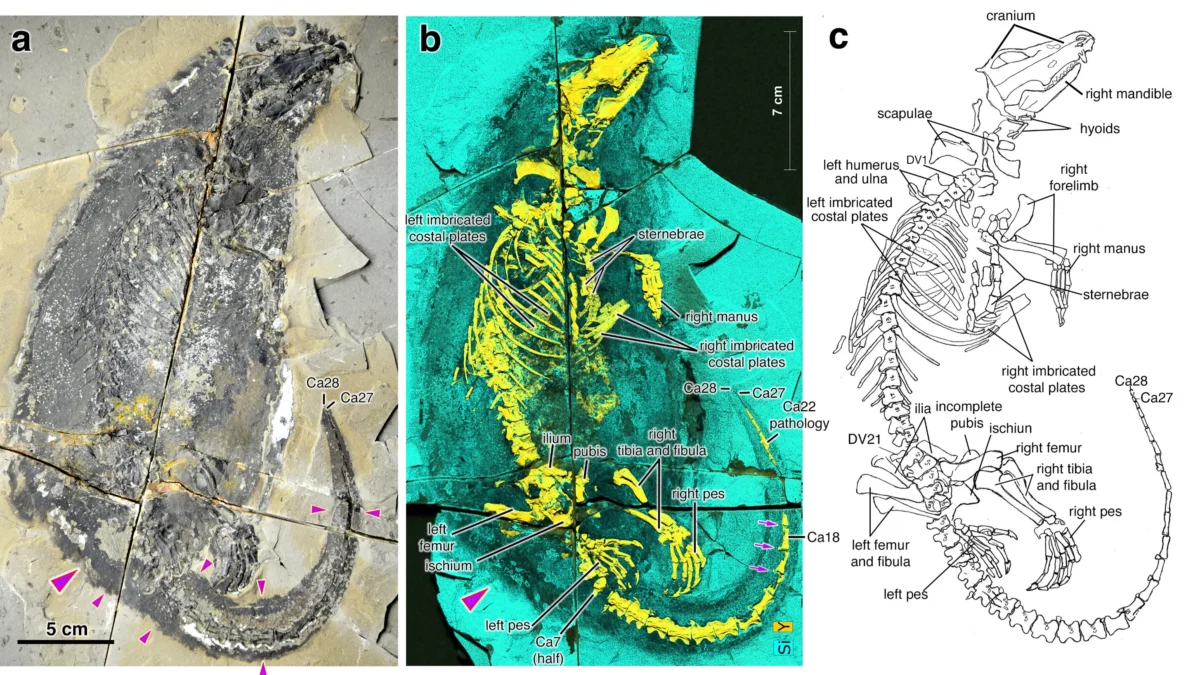
A half-metre swimming relative of mammals from about 165 million years ago kept palate and throat bones arranged like a marsupial’s or a placental’s, hinting that the anatomy for suckling predates mammals, though the evidence is one skeleton.
Peer reviewed · Single fossil specimen · Behaviour inferred from anatomy
A crocodile swallows by jerking its head up and letting gravity slide the food down. Mammals can swallow against gravity, and a fossil from Inner Mongolia, China, suggests our relatives had the anatomy for it about 165 million years ago. In Nature (7 October 2026), researchers in China, Germany and the US describe Megacauda sungei, a swimming relative of mammals whose throat bones resemble those of living marsupials and placentals. The catch: it is one skeleton, and the soft palate and throat muscles were not preserved. The team reconstructed them from the bones they attach to.
What you need to know
- Finding: Megacauda sungei, a docodont (an extinct branch of mammal relatives), had a palate and hyoid (throat) bones arranged like those of living therian mammals, and a body built for swimming.
- Method: The team imaged one skeleton with CT scanning and X-ray fluorescence, compared its bones with opossums, platypuses and other fossils, and placed its rock layer by field mapping.
- Source: Li, Li, Neander, Zhang, Zhou, Martin and Luo, Nature, published online 7 October 2026, with its free Supplementary Information and Peer Review File.
- Why it matters: It traces the anatomy behind suckling and mammal-style swallowing back to the common ancestor of docodonts and mammals, long before modern mammals.
- Limitation: Swallowing, suckling and a platypus-like life in water are the authors’ interpretations of bones from a single animal.
Evidence at a glance
| Item | Assessment |
|---|---|
| Evidence status | Peer reviewed; description of a single fossil specimen (holotype PMOL-AM00026, in two matching slabs) |
| Primary source | “A Jurassic mammaliaform swimmer and transformation of the mammalian pharynx”, Nature, received 3 June 2026, accepted 26 August 2026, published online 7 October 2026, DOI 10.1038/s41586-026-11107-0. SciQuest read the abstract, figure captions, the 129-page Supplementary Information and the Peer Review File. |
| Evidence strength | Moderate for the bone anatomy, which is well preserved and CT scanned; limited for behaviour, because swallowing, suckling and swimming are inferred from one animal’s skeleton |
| Principal limitation | The soft palate and throat muscles did not fossilise; they are reconstructed from bony attachment points by comparison with living mammals |
| Coverage at a glance | 8 distinct credible publishers found (NPR, Reuters, Live Science, ABC News Australia, IFLScience, Discover Magazine, BBC Discover Wildlife, Sci.News) as of 13 October 2026, 14:53 UTC. Counted: outlets with their own article on this paper that SciQuest opened. Excluded: university releases and their reposts, syndicated copies and aggregators. |
Sources: Nature article page, Supplementary Information and Peer Review File; University of Bonn and Ohio University news releases, 7 October 2026.
Is this a big deal?
It is a solid step on one question, which is when the mammal throat took its modern shape. Throat bones and palates rarely survive in fossils, so a clear Middle Jurassic example fills a real gap. One of the paper’s own peer reviewers argued that much of the message was already known from earlier fossils, and it rests on one skeleton.
What scientists found
Megacauda means “big tail”; the species honours Sun Ge of the Paleontological Museum of Liaoning in Shenyang, which holds the fossil. The Supplementary Information gives a length of about 510 to 520 mm from snout to tail tip. The team estimated body mass two ways, from jaw length (60 mm) and skull length (80 mm), using published scaling equations: 652 g to 1,491 g. That range overlaps adult male platypuses, which the authors put at about 0.8 to 3 kg. The abstract calls it the largest Jurassic mammaliaform known.
The headline result is in the throat. The skull has a pair of hook-shaped bony projections on the roof of the mouth, called pterygoid hamuli, set back from the teeth and away from the jaw. In living therian mammals (marsupials and placentals), these hooks anchor muscles of the soft palate and of the upper throat wall. The fossil also keeps its hyoid bones in a saddle-shaped arrangement. From these parts, the authors infer that “critical soft-tissue anatomy for therian-like swallowing, drinking and suckling” had evolved in the common ancestor of docodonts and mammals.
The rest of the body points to water. The paper describes a broad, flattened tail, overlapping rib plates like a platypus’s, sturdy forelimbs of the kind diggers also have, and hind feet with long outer toes. The authors judge forelimb paddling “probable”. They think the hind limbs were held alongside the tail during swimming, with the soles turned upward, the posture in which both feet were fossilised. Its blade-like cheek teeth suggest a meat eater, and the Supplementary Information names small salamanders, common in the same rocks, as likely prey.
How they found it
The Liaoning museum acquired the fossil from a third party. In 2015 Chang-Fu Zhou and a museum team traced it to an abandoned excavation at the Xiayingzi site, near Daohugou village in Ningcheng County, Inner Mongolia. X-ray fluorescence, which maps elements such as silicon and yttrium, made the dark bones stand out from the dark rock, and CT scans rebuilt the skull, teeth and hyoids in 3D.
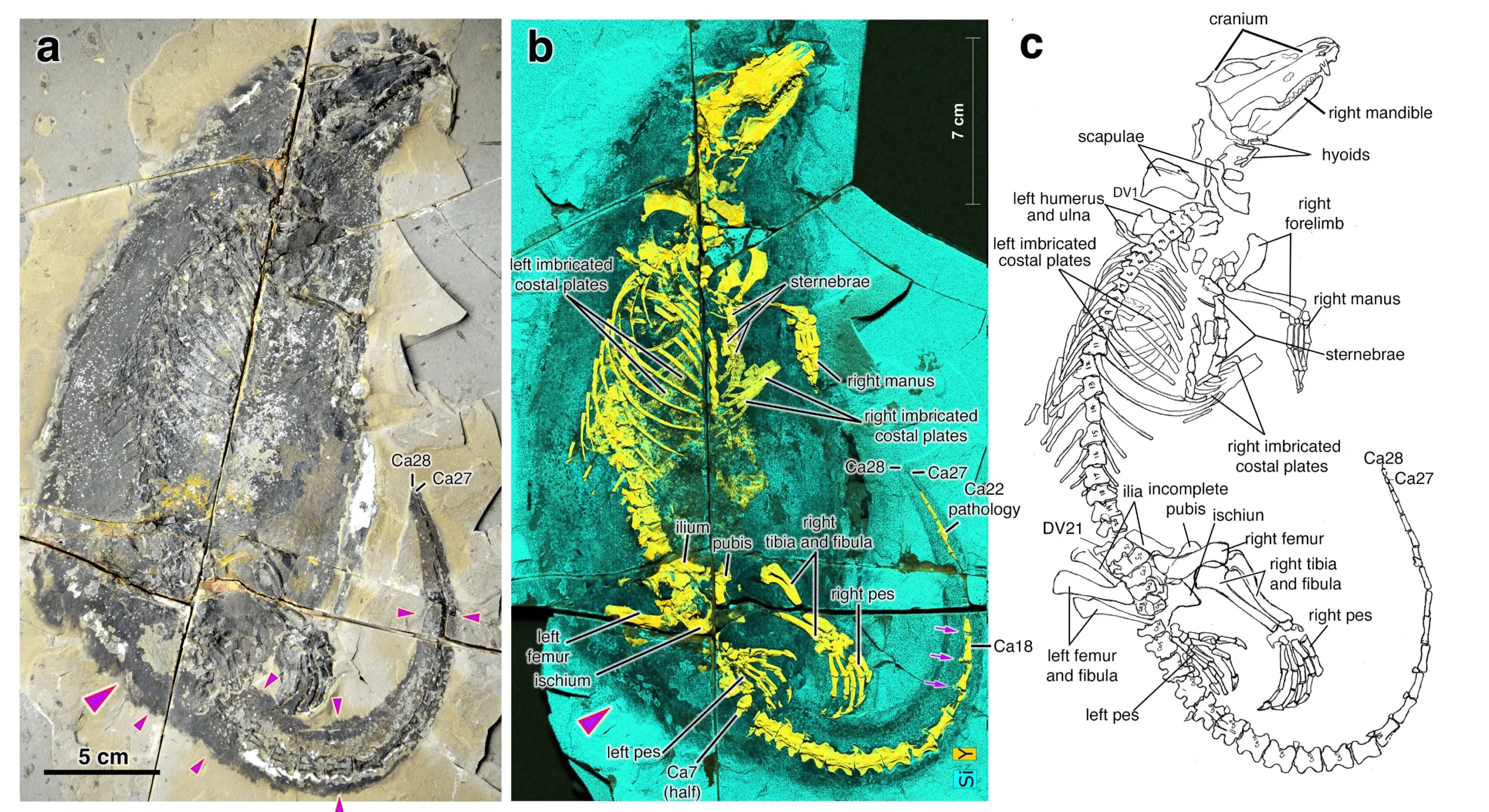
They then compared the palate with a living opossum (Didelphis) scanned with a contrast stain that shows muscles, and the hips and feet with the platypus and echidna. A family-tree analysis grouped Megacauda with Castorocauda in a new family, Megacaudidae, with Dsungarodon from Xinjiang as its closest relative.
Why it matters to you
This won’t change your daily life, but it touches something every person did as a baby. A soft palate separates the mouth from the throat, which lets a mammal take in milk and swallow it without it going up the nose. University of Bonn palaeontologist Thomas Martin described the crocodile method this way: “This is achieved with the aid of gravity.” He added: “The soft palate and the shaping of the oral cavity and pharynx are directly linked to the evolution of mammals.”
If the authors are right, the anatomy for nursing was in place roughly 100 million years before the asteroid impact that ended the age of dinosaurs about 66 million years ago.
What the evidence does not show
It does not show that Megacauda suckled. Milk and nursing leave no direct trace in a skeleton. The paper’s case is that the bones sit where living mammals anchor the muscles for suckling and swallowing. The tongue, also needed for suckling, did not fossilise.
With one animal, nobody can say how much these features varied. The swimming case has limits too: the authors write that its features are “incomplete convergences” with living swimmers, so Megacauda is not an exact match for any of them. And its body mass is an estimate from skull and jaw size, which is why the range is wide.
How this fits what we already knew
This is not the first swimming docodont. In 2006, a team including Luo described Castorocauda lutrasimilis, a beaver-tailed docodont about 42 cm long. The new paper re-estimates its mass at 380 to 518 g, using the same two methods.
Both come from the Haifanggou Formation (also called the Jiulongshan Formation), whose beds are dated to 164 to 168 million years ago. According to the Supplementary Information, Megacauda comes from Bed 4 and Castorocauda from Bed 9, 1.7 km away and more than 60 m higher in a formation about 90 m thick. That makes Megacauda the older of the two, by the authors’ field mapping rather than a separate date, and it supports the outlets that called it the oldest known semiaquatic mammal relative. Saying “mammal”, as some coverage did, overstates it: Megacauda is a mammaliaform, a close relative outside the group of true mammals.
The hyoid finding also builds on earlier work. In 2019, Zhou, Martin, Luo and colleagues described Microdocodon, another Jurassic docodont with mobile, saddle-shaped hyoid bones like a mammal’s. What Megacauda adds is the palate side of the system: the hooks that anchor the soft-palate muscles.
Independent views on the fossil
SciQuest has not interviewed an outside expert, but Nature published the peer reviews, which include disagreement. Rebecca German and a co-reviewer, who study mammal feeding anatomy, wrote: “We agree that these structures support the hypothesis that suckling could have evolved in this lineage.”
An anonymous referee was more sceptical. Pointing to earlier fossils, including Microdocodon‘s hyoids and Castorocauda itself, the referee wrote that “a lot of the message here is not new.” After revisions, the same referee was “still not entirely convinced that this is a new genus (rather, a new species of Castorocauda).”
Jessica Theodor of the University of Calgary told NPR the setup looks like that of modern mammals but that she would like to see some images in more detail. Sue Hand of the University of New South Wales, who praised the study to Live Science, was one of its named peer reviewers.
The study’s senior author, Zhe-Xi Luo of the University of Chicago, said in Ohio University’s release: “Megacauda provides some of the clearest evidence yet that many of these innovations emerged well before the rise of modern mammals.”
How other headlines framed it
- NPR led with chewing, swallowing and suckling.
- Reuters (via TimesLive) called it the oldest-known semiaquatic lifestyle “in mammalian evolutionary history” and gave a weight of 1 to 2 kg.
- Discover Magazine ran with Bonn’s “top predator” angle.
- Sci.News put the throat first.
Most reports, and Bonn’s release (“around two kilos”), give a weight above the paper’s own upper estimate of 1.49 kg.
What happens next
A second Megacauda skeleton would test whether the throat features are typical, and whether it truly differs from Castorocauda at genus level. There is also a puzzle in living animals: according to Ohio University, platypuses and echidnas lack some of these structures, and the authors suggest monotremes lost parts of the ancestral suckling setup. For another skull that changed how scientists picture an animal’s feeding, see what the Tasmanian tiger’s skull reveals about its hunting style.
In one sentence
A 165-million-year-old swimmer kept throat and palate bones like ours, so the machinery for suckling and mammal-style swallowing probably came before mammals did, though that rests on one skeleton.
Quick check: test yourself
- Which preserved bones suggest Megacauda could swallow like a mammal? Hook-shaped projections on the roof of the mouth (pterygoid hamuli) and saddle-shaped hyoid bones.
- How do the authors know it is older than Castorocauda? It comes from a rock layer more than 60 m lower in the same formation.
- Did the soft palate itself fossilise? No. It was reconstructed from the bones its muscles attach to.
Read next
- Brontosaurus facts: the giants of the Jurassic, giants from later in the same period
- What was the asteroid that killed the dinosaurs?, the event that later opened the way for mammals
Sources and disclosure
- Li Y, Li P, Neander AI, Zhang H, Zhou C-F, Martin T, Luo Z-X. “A Jurassic mammaliaform swimmer and transformation of the mammalian pharynx.” Nature, published online 7 October 2026. doi:10.1038/s41586-026-11107-0. Abstract, figure captions, Supplementary Information and Peer Review File (CC BY 4.0) read; main text paywalled.
- University of Bonn. “‘Top predator’ from the Jurassic measures just half a meter”, 7 October 2026.
- Ohio University. “Professor Peishu Li coauthors Nature study uncovering ancient origins of mammalian suckling and swallowing”, October 2026.
- Ji Q, Luo Z-X, Yuan C-X, Tabrum AR. “A swimming mammaliaform from the Middle Jurassic and ecomorphological diversification of early mammals.” Science 311:1123–1127, 2006. doi:10.1126/science.1123026
- Zhou C-F, Bhullar B-AS, Neander AI, Martin T, Luo Z-X. “New Jurassic mammaliaform sheds light on early evolution of mammal-like hyoid bones.” Science 365:276–279, 2019. doi:10.1126/science.aau9345
Disclosure: This article was drafted with AI assistance and checked against the sources above. The graphic is a SciQuest original built from the cited sources. The fossil image is a figure from Li et al. (2026) supplied by the University of Bonn for use in reporting with credit. Peer-review quotes come from Nature’s published Peer Review File; other outside comments are paraphrased from the outlets named, not from SciQuest interviews. SciQuest has no conflicts of interest. Spotted an error? See our corrections policy.
Discover more from SciQuest
Subscribe to get the latest posts sent to your email.
Leave a comment