

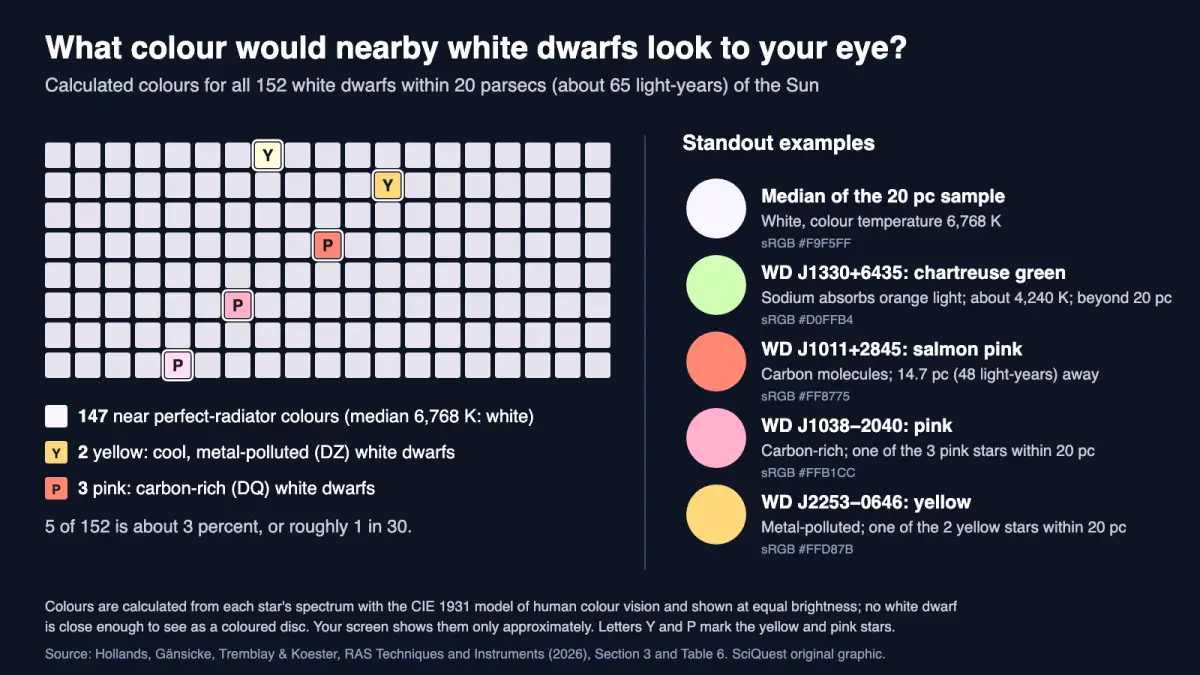
Run through a standard model of human colour vision, the light of the 152 white dwarfs within 20 parsecs gives a median colour temperature of 6,768 K, plain white, with just five yellow or pink outliers.
Peer reviewed · Calculated colours from existing spectra and models · No new observations
White dwarfs really are white, on average, but a few would look green, pink, yellow or purple if you could see their discs up close. A University of Warwick team led by Mark Hollands reached that result by calculating colours from spectra and atmosphere models, in a paper published on 15 October 2026 in RAS Techniques and Instruments. Five of the 152 white dwarfs nearest the Sun come out yellow or pink, and a sodium-rich star, WD J1330+6435, comes out green. The catch: nobody has seen these colours, and the green one rests on a noisy spectrum.
What you need to know
- Finding: The median white dwarf within 20 parsecs has a colour temperature of 6,768 K, close to standard daylight white, while 5 of 152 (2 yellow, 3 pink) sit clearly off the normal star-colour track.
- Method: Spectra and fitted atmosphere models were converted into perceived colour using the CIE 1931 colour-matching functions, the standard description of how human eyes respond to light.
- Source: Hollands, Gänsicke, Tremblay and Koester, RAS Techniques and Instruments, 15 October 2026 (open access).
- Why it matters: It corrects the common picture of white dwarfs as bluish, and shows that very dense atmospheres can produce star colours, such as green, that normal stars cannot.
- Limitation: No white dwarf can be seen as a coloured disc, so every colour here is calculated, and the green star’s spectrum is noisy enough that its exact shade could differ.
Evidence at a glance
| Item | Assessment |
|---|---|
| Evidence status | Peer reviewed; computational analysis of previously published spectra and atmosphere models. Preprint posted on arXiv on 13 October 2026. |
| Primary source | “Any colour you like: the diverse chromaticities of white dwarfs”, RAS Techniques and Instruments 5, rzag069, published 15 October 2026. Open access. |
| Evidence strength | Moderate. The colour method is standard colour science and the 20-parsec sample is complete and unbiased, so the “white on average” result is solid. The striking colours come from a handful of stars, and the green one depends on a single noisy spectrum. |
| Principal limitation | These are calculated colours, displayed at equal brightness. Real white dwarfs are far brighter per unit area than any screen, and none is close enough for anyone to see its disc. |
| Coverage at a glance | 2 distinct credible publishers with their own write-ups (Discover Magazine, Courthouse News Service) as of 15 October 2026, 04:46 UTC. Excluded: Phys.org and Mirage News, which republished the University of Warwick release, and one aggregator that copied it. |
Sources: the journal paper (Sections 2, 3.5 and Table 6), the arXiv preprint record, and a SciQuest search of news coverage.
Is this a big deal?
It is a careful, useful result, not a shift in astrophysics. Nothing about how white dwarfs work has changed. What is new is a sourced answer to a question that space artwork often gets wrong, plus the first systematic map of which white dwarf chemistries produce unusual colours. The green star is the eye-catching part, and the authors attach their own caveat to it.
What scientists found
A white dwarf is the dense, Earth-sized core left behind when a star like the Sun runs out of fuel (the final stage of a Sun-like star’s life cycle). Most stars, and most white dwarfs, glow much like a perfect radiator, which physicists call a blackbody. Their colour is set by temperature alone, running from orange through white to pale blue.
The Warwick team checked every white dwarf within 20 parsecs (about 65 light-years) of the Sun. For the 147 that stay close to the blackbody track, colour temperatures span 3,000 to 25,000 K, and 95 percent fall between 3,800 and 18,700 K. The middle value is 6,768 K. That is very near the 6,504 K white point used to define “daylight white” on screens, so the typical white dwarf looks white.
The other five are the oddballs. Two metal-polluted white dwarfs, WD J0842−1347 and WD J2253−0646, come out yellow. Three carbon-rich ones, WD J1011+2845, WD J1038−2040 and WD J2157−5100, come out pink. The authors put the share of clearly non-blackbody colours at 3.4 percent (uncertainty +1.7/−1.3 percentage points). The Warwick release rounds this to about 1 in 30.
The green star and the salmon-pink one
WD J1330+6435 lies outside the 20-parsec sample but is the most unusual result. It is about 4,240 K (roughly 3,970 °C) and has swallowed rocky debris, leaving sodium, calcium and lithium in its atmosphere. Sodium absorbs orange light and calcium absorbs violet, so its light peaks near 500 nanometres. The calculated result is chartreuse green. “To our knowledge, no other stars of any kind have been claimed to exhibit a green hue,” the authors write.
At the other end, WD J1011+2845 (also called LHS 2229) sits 14.73 parsecs, or 48 light-years, away. Carbon molecules in its atmosphere suppress light from 400 to 600 nanometres, so most of its visible light emerges above 600 nanometres. The paper describes a deep salmon-pink and calls it “likely the reddest star known in terms of perceived colour.”
Elsewhere in the paper, some carbon-rich white dwarfs come out pale purple, and cool stars with mixed hydrogen and helium atmospheres lean cyan.
How they found it
No telescope can show a white dwarf as a coloured disc. The team worked from spectra, which record how much light a star gives off at each wavelength. They multiplied each spectrum by the three CIE 1931 colour-matching curves, which describe how the eye’s colour response varies with wavelength, and converted the result to screen colours in the sRGB standard.
Think of a coloured filter over a white lamp. Remove orange light and what is left looks green; remove the middle of the spectrum and what is left looks pink. In these stars the “filter” is the atmosphere itself. The coolest white dwarf atmospheres reach about 1 gram per cubic centimetre, roughly the density of water. At that density, absorption by carbon, calcium or sodium smears across far more wavelengths than usual. The analogy has a limit: a filter only removes light, while a star’s temperature also sets how much light is there to begin with.
Not every colour comes straight from a telescope spectrum. For most of the 20-parsec stars, the team used atmosphere models with parameters from published fits. Carbon-rich stars were handled with observed spectra, their calibration adjusted using Pan-STARRS survey data. Hollands framed the starting question in the Warwick release: “But nobody had really looked into what else might be possible for white dwarfs.”
Why it matters to you
This won’t change anything in your daily life. It is about wonder: a truer picture of the stars nearest us, and of the dim remnant the Sun is expected to become. For anyone who makes space images, it also shows how to get colours from spectra instead of guessing.
What the evidence does not show
It does not show anyone seeing a green star. The colours are calculated, and the paper notes that WD J1330+6435’s spectrum “is somewhat noisy”. An older model of the same star gave a similar hue, which gives the authors confidence, but the precise shade could shift with better data.
Nor would a white dwarf look like a swatch on your screen. The paper scales all colours to equal brightness, because real stellar surfaces are far brighter than any monitor.
One number differs between sources. The Warwick release and some coverage say the 20-parsec sample has 151 white dwarfs and 146 normal ones. The published paper, both on arXiv and in the journal, says 152 and 147. We use the paper’s figures; the five outliers and the median are the same either way.
How this fits what we already knew
Earlier studies of ordinary stars found their colours stay close to the blackbody track. Brown dwarfs, which are too small to sustain hydrogen fusion, are predicted to look magenta or violet because of broad sodium absorption. According to the authors, nobody had systematically studied white dwarf colours before.
The common picture of blue white dwarfs has a simple cause, the paper argues. Hot white dwarfs are brighter and can be seen farther away, so surveys limited by brightness over-count them. A sample limited by distance, like the 20-parsec one, avoids that bias.
Independent perspective
SciQuest found no published comment from an astronomer outside the team by 04:46 UTC on 15 October, and has not yet interviewed one. Co-author Boris Gänsicke of Warwick’s Department of Physics summed up the sample result in the release: “Yet if we take the median across a representative population of white dwarfs, we found that the average white dwarf really is white.”
How other headlines framed it
- Phys.org, carrying the University of Warwick release, led with green, pink and purple as the “true colors” of white dwarfs.
- Discover Magazine hedged the green claim, presenting WD J1330+6435 as possibly the first green star and noting the colours were calculated.
- Courthouse News Service stressed the rarity, reporting five unusual stars out of 151 and about one in 30 overall.
None of the three led with the paper’s main statistical result: the average nearby white dwarf is white.
What happens next
The authors expect more colourful white dwarfs to turn up. Between the green WD J1330+6435 and a vivid blue sodium-rich star, WD J2356−2054, they argue a continuum of stars probably exists, and future surveys may find green, cyan and blue examples. Better spectra of WD J1330+6435 would pin down its exact shade.
In one sentence
Calculated from their light, the white dwarfs nearest the Sun look white on average, but about 1 in 30 would look yellow or pink, and one known star would look green.
Why it matters to you: it replaces the familiar blue-white artwork with a better picture of what the Sun’s future remnant and its neighbours would really look like.
Quick check: did it click?
- What is the median colour temperature of white dwarfs within 20 parsecs? 6,768 K, which looks white.
- Why would WD J1330+6435 look green? Sodium in its dense atmosphere absorbs orange light and calcium absorbs violet, leaving light that peaks near 500 nm.
- Has anyone seen a green white dwarf? No. The colour is calculated from its spectrum.
Read next
- Life cycle of a star, for how stars like the Sun end up as white dwarfs.
- How does colour blindness work? The same eye response this study modelled, from the other side.
- How long does it take to travel one light-year? For a sense of the 48 light-years to the salmon-pink star.
Sources and disclosure
- Hollands MA, Gänsicke BT, Tremblay P-E, Koester D. “Any colour you like: the diverse chromaticities of white dwarfs.” RAS Techniques and Instruments 5, rzag069 (2026), published 15 October 2026. doi:10.1093/rasti/rzag069
- Same paper, preprint: arXiv:2610.18966, submitted 13 October 2026.
- University of Warwick. “Green, pink and purple: Astronomers reveal the surprising true colors of white dwarf stars.” News release, as published by Phys.org, 14 October 2026.
Disclosure: This article was drafted with AI assistance and checked against the sources above, including the full open-access paper and its Table 6. The light-year and Celsius conversions are SciQuest calculations (1 parsec = 3.2616 light-years; K − 273.15). Quotes are verbatim from the paper and the University of Warwick release. The graphic is a SciQuest original drawn from the paper’s Table 6 colour values. SciQuest has no conflicts of interest. Spotted an error? See our corrections policy.
Discover more from SciQuest
Subscribe to get the latest posts sent to your email.
Leave a comment