

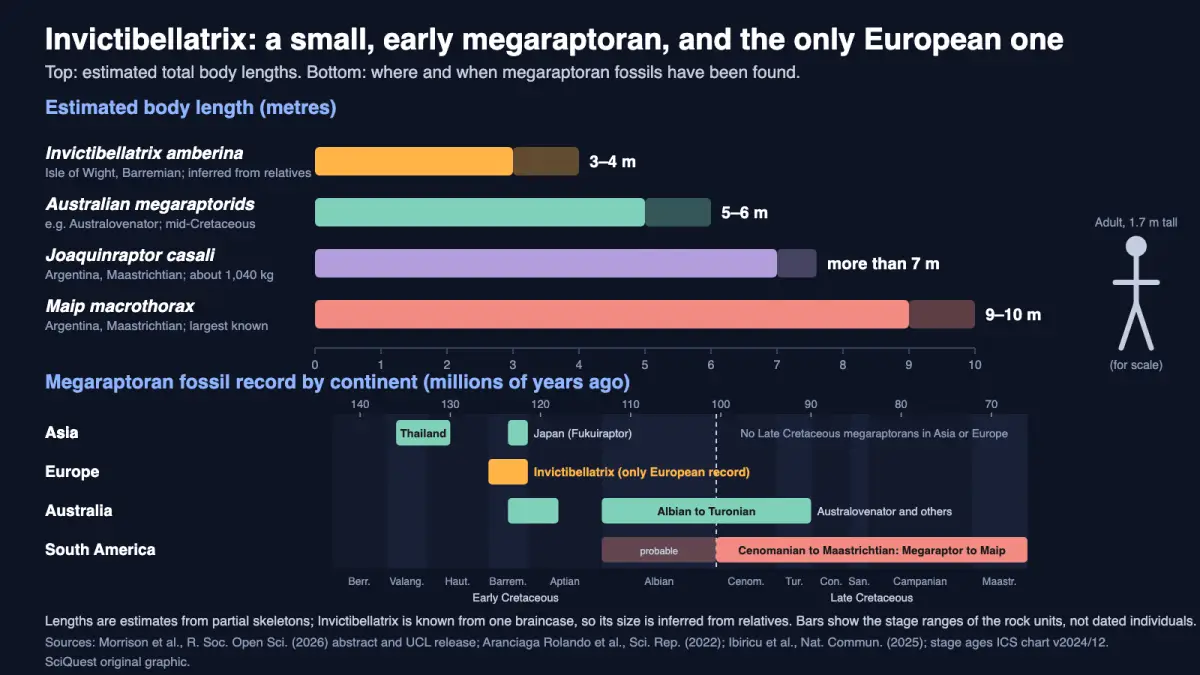
One beach-worn braincase, NHMUK PV R6775, is all there is, and its size points to an animal of roughly 200–300 kg and no more than 4 m, which the authors say makes it among the smallest megaraptorans known.
Peer reviewed · Single specimen · Size inferred from relatives
A chunk from the back of a dinosaur skull that London’s Natural History Museum acquired in 1924 has turned out to be the first megaraptoran identified in Europe. A team led by Cassius Morrison of University College London named it Invictibellatrix amberina on 14 October 2026 in Royal Society Open Science. Megaraptorans were long-armed, big-clawed predators known until now from Asia, Australia and South America, and this find supports the idea that they spread from Asia through Europe to the southern continents. Everything beyond the braincase, including the estimated 3–4 m length, is inferred by comparison with other species.
What you need to know
- Finding: A braincase from the Wessex Formation of the Isle of Wight belongs to a new genus and species of megaraptoran, Invictibellatrix amberina, the first member of the group described from Europe and, at roughly 200–300 kg and 4 m or less, likely the smallest known.
- Method: Micro-CT scans of the braincase, comparison with other theropod skulls, phylogenetic analyses in three separate character datasets (all placed it inside Megaraptora), and a biogeographic model of where its ancestors lived.
- Source: Morrison, Scherer, Mannion, Porro, Clark, Folkes and Barrett, Royal Society Open Science, 14 October 2026 (open access).
- Why it matters: It fills the European gap in the proposed route of megaraptorans from Asia to Gondwana, and it shows that a braincase, often dismissed as uninformative, can place a theropod on the family tree.
- Limitation: One partial braincase, with no teeth, limbs or claws: body size is read off a similar-sized braincase of another species, claws and feathers come from relatives, and the two family trees the authors built disagree on where exactly the animal sits and where its ancestors came from.
Evidence at a glance
| Item | Assessment |
|---|---|
| Evidence status | Peer reviewed; single specimen (holotype NHMUK PV R6775, a beach-rolled partial braincase); comparative anatomy plus phylogenetic and biogeographic analysis of an existing museum fossil, with no new fieldwork. |
| Primary source | “A new megaraptoran dinosaur from the Lower Cretaceous Wessex Formation, UK, and its implications for theropod evolution and biogeography”, Royal Society Open Science 13(10): 260937, published 14 October 2026, CC BY. Supplementary information on figshare. |
| Evidence strength | Moderate for the identification: three independent character datasets, run under equal and implied weighting, all place the braincase inside Megaraptora, though they disagree on its exact branch. Limited for everything about the living animal, and limited for the migration story, which the authors themselves describe as ambiguous between their two main family trees. |
| Principal limitation | A single partial braincase. Body size is inferred from a braincase of similar size in another species; height, claws, diet and feathers come from relatives, not from this animal. |
| Coverage at a glance | 3 distinct credible publishers with their own write-ups (CBS News, Sci.News, bluewin) as of 16 October 2026, 06:14 UTC. Excluded: Phys.org and ScienceDaily, which republished the UCL release; news aggregators; and GB News, which is paywalled and was not read. The Independent reportedly interviewed Morrison but blocks our reader, so it is not counted. |
Sources: the full paper and its supplementary information, the UCL and Natural History Museum releases, the authors’ 2024 conference abstract, and a SciQuest search of news coverage.
Is this a big deal?
A solid step for dinosaur geography, not a rewrite of it. Megaraptorans were already suspected in Europe, and the same team flagged this braincase as a probable megaraptoran at a conference in 2024. What is new is a formal name, a list of distinguishing features, a size estimate at the bottom of the megaraptoran range, and a model that treats the group’s later disappearance from the north as a regional extinction. The “more dangerous than a T. rex” line in much of the coverage is a thought experiment from the lead author, not a finding.
What scientists found
Megaraptorans were two-legged meat-eaters with long, low skulls and oversized claws on the first two fingers. Until this week their undisputed fossils came from Cretaceous rocks in Thailand, Japan, Australia and, above all, Argentina. The new analyses put them inside Tyrannosauroidea, the wider tyrannosaur group, but the authors keep calling them megaraptorans rather than tyrannosauroids, because other studies still place them elsewhere on the tree.
The fossil preserves the back of the skull. Three features mark it out, according to the paper’s abstract: a near-circular occipital condyle (the knob that joins skull to neck), a slightly oval foramen magnum (the hole where the spinal cord enters), and a sagittal nuchal crest, a ridge along the midline of the skull’s rear that is pinched into an hourglass shape when seen from behind. Only two other megaraptoran braincases are known, from Megaraptor and Murusraptor, both Argentine, and the new one resembles them in the condyle, the hole and the deep pockets below them. The foramen magnum is 30 mm wide and the condyle 37 mm, a ratio of 0.8 that sits in the megaraptoran range (0.68–0.88) and far from tyrannosaurids (0.27–0.59).
Where it sits within Megaraptora depends on the dataset. In one, it pairs with Murusraptor inside the later, giant branch, Megaraptoridae. In the other, which the authors prefer because it samples more megaraptorans, it branches off early, beside the Japanese Fukuiraptor and outside Megaraptoridae. The braincase is about the size of the same region in Timurlengia, a tyrannosauroid from Uzbekistan, which is how the authors arrive at roughly 200–300 kg and 4 m or less. Other megaraptorans run 6 to more than 10 m and likely over 2,000 kg, so this is “among the smallest, if not the smallest, megaraptoran discovered so far”, in the paper’s words. The fused skull bones show it was not a juvenile.
The Wessex Formation dates to the Barremian stage of the Early Cretaceous, roughly 126 to 121 million years ago on the international timescale; the UCL release rounds this to about 120 million years. The exact bed is unknown, but the paper argues for the lower plant debris beds (L1 to L5) that crop out at Sudmoor Point.
The name translates as “unconquered female warrior”, honouring, the paper says, the group’s later role as Gondwanan apex predators after small beginnings; amberina refers to amber in the Wessex plant debris beds (the UCL release adds that it is also a female given name). The authors write that the name is “to give hope and strength to all those who are bullied, discriminated, victimized and oppressed that tomorrow will be theirs and not to give up in the face of such odds”.
How they found it
The bone was picked up at the foot of the cliff at Sudmoor Point, near Brook, and the Natural History Museum bought it in May 1924 from the collection of the Rev. Reginald Walter Hooley, an amateur collector whose more than 1,000 specimens came to the museum, the releases say, after his death. (The paper and the museum’s release spell the surname Hooley; the UCL release and the reports copied from it have “Tooley”.) Someone did look at it early on: a physical cast of the brain cavity was made in the 1920s, and it matches the new digital one. After that the piece went undescribed for a century.
Morrison’s team micro-CT scanned it at the museum at a resolution of 0.0665 mm, producing a 3D model of the bone and a digital cast of the brain cavity, the same kind of scanning that recently read a hunting style from a Tasmanian tiger skull. They compared it with the braincases of tyrannosauroids, spinosaurids, carcharodontosaurids, abelisaurids and others, ruling each out in turn. Then they scored the fossil into a 1,760-character theropod dataset, adding a new character: the ratio of the hole’s width to the condyle’s width, which they found varies between theropod groups.
Think of identifying a shoe brand from a footprint in wet sand. The tread is distinctive enough to name the maker, but it says nothing about the colour of the laces. The braincase works the same way: its proportions can be diagnostic, while body length and claws stay out of view. The analogy has a limit, because a footprint at least gives the size of the foot, and a braincase gives only the size of the back of the head.
As a check, they ran it through a second dataset built for megaraptoran relationships and a third, published in 2025 by Lucio Ibiricu and colleagues. All three nested Invictibellatrix within Megaraptora. The trees were then fed into a biogeographic model (BioGeoBEARS) with eight regions, time-sliced land connections and an allowance for gaps in the rock record. The result, in the abstract’s words, is that early megaraptorans “likely had a cosmopolitan distribution in the Early Cretaceous”, and that their absence from the Late Cretaceous of the northern supercontinent Laurasia “is best explained by regional extinction”. On the authors’ preferred tree, Invictibellatrix “likely evolved from an Asian megaraptoran population that dispersed into Europe approximately 130 Mya”, with later dispersal through Europe into Africa and the rest of Gondwana.
Why it matters to you
Nothing here changes your week. The appeal is wonder, and a reminder about what sits in museum storerooms: this animal was found a hundred years ago, and it was the scanning and the comparison, not the digging, that made it a new species.
What the evidence does not show
It does not show what the animal looked like. “Based on what we know about its closest relatives, Invictibellatrix would have been three to four metres long and just over a metre and a half in height – about as tall as a human. It would likely have had feathers and its claws might have been about 10cm to 20cm long,” Morrison said in the UCL release. Every one of those numbers comes from other species; the paper’s own size estimate rests on the braincase being about as big as that of Timurlengia, which is not even a megaraptoran. The 35 cm claws mentioned in the same release belong to much later South American relatives.
The T. rex comparison comes from the release, not from any measurement. Morrison’s remark that “for humans this dinosaur would have been more dangerous than a T. rex” rests on the idea that a hyena-sized hunter would treat a person as prey, while a giant would not bother. T. rex lived roughly 55 to 60 million years later in North America, so no human, and no T. rex, ever met this animal. It is a vivid way to convey body size, nothing more.
The migration story is also provisional. Co-author Charlie Scherer called the fossil “the first proof we have that megaraptorans were also present in Europe and that they reached Gondwana this way rather than island-hopping further south”. The paper is more guarded. Its two main trees disagree: one has megaraptorans already spread across Asia, Africa and western North America around 145–138 million years ago; the other, which the authors prefer, starts the group in Asia and brings it to Europe by the Barremian, then through Europe into Africa. The authors call the results “ambiguous as to the biogeographic origins of Invictibellatrix” before choosing the second. One braincase confirms presence in Europe; the route is a model-dependent inference that one new fossil from Africa or North America would change. The release states that the study does not explain why the group died out in the north.
How this fits what we already knew
The oldest megaraptorans, Phuwiangvenator and Vayuraptor from Thailand, are older than Invictibellatrix; Fukuiraptor from Japan is roughly the same age. Australia’s record starts in the late Barremian and runs to about the Turonian, and South America’s runs from a probable Albian fossil in Brazil through to Maip and Joaquinraptor in the last few million years before the asteroid impact that ended the Cretaceous.
Size grew along that path. Ibiricu and colleagues estimate that megaraptorids went from roughly 5 m and 300 kg in Australia to more than 7 m and 1,000 kg after reaching South America, and Alexis Aranciaga Rolando’s team put Maip at nine to ten metres. A 4 m Invictibellatrix near the base of the tree fits that pattern, and the new paper says so. It disagrees with Ibiricu’s team on direction, though: its preferred model has Megaraptoridae arise in western Gondwana (South America plus Africa) and spread to Australia, not the reverse.
On the Isle of Wight itself, the Wessex Formation already had the tyrannosauroid Eotyrannus, the allosauroid Neovenator, two spinosaurids and the dromaeosaurid Vectiraptor; its coelurosaurs, the authors note, now span tyrannosauroids, maniraptoriforms and megaraptorans.
Independent perspective
SciQuest found no published comment from a palaeontologist outside the research team by 06:14 UTC on 16 October, and has not yet interviewed one. The senior author, Paul Barrett of the Natural History Museum, said in the release: “Despite over 200 years of collecting, the Isle of Wight continues to surprise us with new dinosaur species, and finds of carnivorous dinosaurs, such as Invictibellatrix, have been particularly elusive.”
How other headlines framed it
- CBS News led with the human angle, calling it a T. rex cousin that “would have chased us”, and gave the size in feet.
- ScienceDaily, carrying the UCL release, framed it as a “fearsome” clawed dinosaur forgotten in a museum.
- Phys.org, also from the UCL release, chose the most literal line: Europe’s first known long-clawed megaraptoran.
- Sci.News stayed closest to the paper, reporting the Sudmoor Point locality, the May 1924 purchase and the 200–300 kg estimate.
- bluewin focused on the century in a drawer and stated that the body reconstruction relies on related species.
Only bluewin, among the five, made the single-braincase limitation part of its main story; none reported that the authors’ two trees disagree on the animal’s origins.
What happens next
Two things would firm up the picture. A megaraptoran from Africa, or from the Early Cretaceous of North America, would test whether the route really ran through Europe. And more Wessex Formation theropod bones, many collected a century ago and still undescribed, could be rescanned the same way. Barrett pointed to that in the release: “Work like this shows the exceptional value of working with historical museum collections where there are still many discoveries to be made.” Why megaraptorans disappeared from the north while their southern cousins grew into apex predators remains open.
In one sentence
A braincase overlooked in London since 1924 is the first megaraptoran known from Europe, a small, early member of a group that later produced ten-metre predators in South America, though its body, claws and feathers are all inferred from other species.
Why it matters to you: it is a reminder that new dinosaurs can come from a museum drawer as easily as from a cliff, and it adds a missing step to the story of how one predator lineage crossed the world.
Quick check: did it click?
- What has actually been found? A single partial braincase from the back of the skull, catalogued NHMUK PV R6775 in London.
- Where does the size estimate come from? From comparing the braincase with the similar-sized one of Timurlengia, a tyrannosauroid of roughly 200–300 kg; the fossil has no body bones.
- Why does a European megaraptoran matter? It supports the idea that the group spread from Asia through Europe to the southern continents, where it later grew large.
Read next
- Tasmanian tiger skull reveals a fast-snapping hunter, another case of reading hunting style from a skull.
- Jurassic swimming mammal relative hints suckling anatomy evolved early, for how much a small fossil can carry.
- What was the asteroid that killed the dinosaurs? The end of the Cretaceous, when the last megaraptorans were still alive in Patagonia.
Sources and disclosure
- Morrison C, Scherer CR, Mannion P, Porro LB, Clark B, Folkes DD, Barrett PM. “A new megaraptoran dinosaur from the Lower Cretaceous Wessex Formation, UK, and its implications for theropod evolution and biogeography.” Royal Society Open Science 13(10): 260937, published 14 October 2026. doi:10.1098/rsos.260937
- Same paper, Supplementary materials 1 (character changes, phylogenetic trees, stratigraphic log), Royal Society figshare. CT scans of NHMUK PV R6775 are on MorphoSource.
- University College London. “UK dinosaur fossil identified as new long-clawed predator.” News release, October 2026.
- Natural History Museum, London. “UK dinosaur fossil identified as new long-clawed predator.” Press release, 14 October 2026.
- Morrison CDI, Perkins J, Scherer C, Mannion PD, Porro LB, Clark B, Barrett PM. “The first reported megaraptoran theropod dinosaur from Europe and the implications for megaraptoran origins.” Abstracts, 21st EAVP meeting (2024), pp. 37–38.
- Aranciaga Rolando AM, Motta MJ, Agnolín FL, Manabe M, Tsuihiji T, Novas FE. “A large Megaraptoridae (Theropoda: Coelurosauria) from Upper Cretaceous (Maastrichtian) of Patagonia, Argentina.” Scientific Reports 12 (2022). doi:10.1038/s41598-022-09272-z
- Ibiricu LM, Lamanna MC, Alvarez BN, et al. “Latest Cretaceous megaraptorid theropod dinosaur sheds light on megaraptoran evolution and palaeobiology.” Nature Communications 16 (2025). doi:10.1038/s41467-025-63793-5
- International Commission on Stratigraphy. International Chronostratigraphic Chart v2024/12 (Barremian 125.77–121.4 Ma; Maastrichtian 72.2–66.0 Ma).
Disclosure: This article was drafted with AI assistance and checked against the sources above, including the full open-access paper, its supplementary file, the authors’ 2024 conference abstract and the UCL and Natural History Museum releases. The authors declare no competing interests and no use of AI in writing the paper; the work was funded by the Palaeontographical Society, the Royal Society and UKRI. The graphic is a SciQuest original built from the sizes and ages in sources 1, 3, 6, 7 and 8; the 1.7 m human is an illustrative reference height. Quotes are verbatim from the paper and the two releases. Spotted an error? See our corrections policy.
Discover more from SciQuest
Subscribe to get the latest posts sent to your email.
Leave a comment