

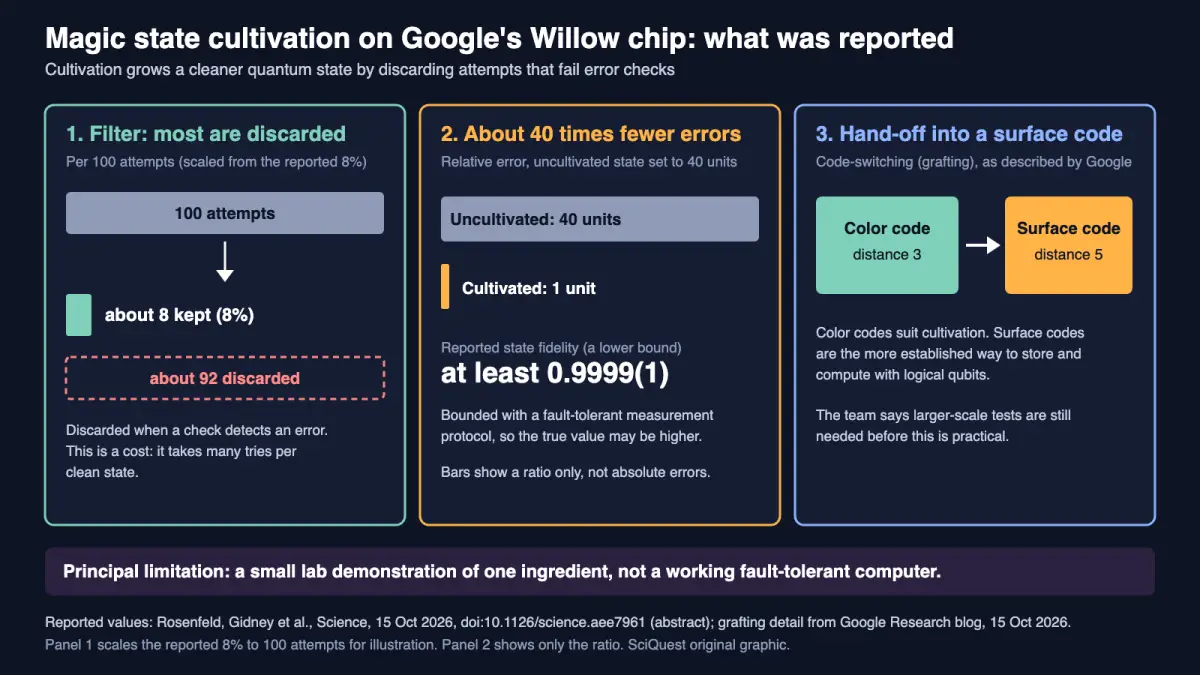
Google’s team reports about 40 times fewer errors in a quantum “magic state” and a fidelity of at least 0.9999, but the cleanest results come from keeping only 8% of attempts, on one lab chip.
Peer reviewed · Experiment on a superconducting quantum processor · Lab demonstration
Google Quantum AI has published an experimental test of “magic state cultivation,” a way to make the special quantum states that error-corrected computers need for their hardest operations. In Science on 15 October 2026, the team reports that cultivation cut errors about 40-fold compared with uncultivated states on its Willow chip. The measured state fidelity was at least 0.9999. The catch is the price: only 8% of attempts passed the error checks and were kept, and the work is a small demonstration of one ingredient.
What you need to know
- Finding: Cultivation reduced the error in a prepared magic state by a factor of 40, to a fidelity of at least 0.9999(1), while retaining 8% of attempts.
- Method: The team ran cultivation on a superconducting processor, switched the result into a surface code, and built a fault-tolerant measurement protocol to bound the fidelity from below.
- Source: Rosenfeld, Gidney and colleagues, Science, 15 October 2026 (abstract read; full text is paywalled).
- Why it matters: Magic states are a major resource cost in planned quantum computers, so a cheaper way to make them could shrink future machines.
- Limitation: Larger-scale demonstrations are still needed, and the lead authors are Google researchers testing their own hardware, with no independent assessment yet.
Evidence at a glance
| Item | Assessment |
|---|---|
| Evidence status | Peer reviewed; hardware experiment. Results are post-selected (failed attempts are discarded) and the fidelity is a lower bound. |
| Primary source | “Magic state cultivation on a superconducting quantum processor”, Science, published online 15 October 2026, doi:10.1126/science.aee7961. Context from the Google Research blog of the same date. |
| Evidence strength | Moderate for the reported numbers on this chip: the paper is peer reviewed and the authors built a measurement method designed to avoid overstating quality. Limited for what it means at scale, because one device was tested and the lead authors work at Google. |
| Principal limitation | Cultivation keeps only 8% of attempts, and the demonstration is small. Practical use needs larger tests, which the Google authors say remain to be done. |
| Coverage at a glance | 3 distinct credible publishers with their own reports (The Quantum Insider, ScienceAlert, Decrypt) as of 19 October 2026, 13:26 UTC. Not counted: Google’s own blog, aggregator pages and rewrites of other outlets’ stories. |
Sources: the paper abstract and Crossref record, the Google Research blog, and a SciQuest search of news coverage.
Is this a big deal?
A solid step for one narrow problem, not a working quantum computer. Cultivation was proposed in 2024, and Decrypt reports it had been tested only in theory and simulation before this paper. Seeing it work on real hardware, with a careful measurement, answers a real question. It says nothing yet about running useful programs, and nothing about breaking encryption.
What scientists found
Quantum computers store information in qubits, which are fragile. Error correction spreads one “logical” qubit across many physical ones. Most of the operations on a logical qubit are easy in this scheme, but a few essential ones are not, and they need a prepared helper called a magic state. Each magic state can be used only once, so a big computation eats through them.
Cultivation prepares a rough state in a small patch of the chip, runs checks, throws the attempt away if a check flags an error, and grows the survivors into a cleaner state. The authors report that this reduced the error by a factor of 40, with a fidelity of at least 0.9999(1), keeping 8% of attempts. The “(1)” is the uncertainty in the last digit. Fidelity of 0.9999 means the state matches the target with an error of about one in 10,000.
How they found it
The experiment ran on Willow, Google’s superconducting processor. The Quantum Insider reports that Willow has 105 qubits and that the experiment used up to 54 of them; Decrypt gives the same maximum. The team also used reinforcement learning to calibrate the chip, according to The Quantum Insider, running about four hours before data collection.
Measuring the result was a puzzle of its own. Google’s blog says early data looked as if it broke physical laws. After months of work, the researchers traced it to a wrong assumption in their benchmarking method: drifting electrical equipment and temperature changes in the lab were corrupting the measurement. They reduced that noise and built a benchmark that uses cultivation to measure itself. The paper’s abstract describes a fault-tolerant measurement protocol that puts a bound on the fidelity, which is why the headline number reads “at least.”
The team also moved a state from a distance-3 color code into a distance-5 surface code, a step Google calls grafting. Color codes suit cultivation, while surface codes are the more established way to store and compute with logical qubits. Distance is a measure of how many errors a code can catch.
A useful picture is a factory line that tests every part and bins any that fail. The output is clean, but the line wastes most of what it makes, which is the 8% yield here. The picture breaks down in one way: in the chip, the “parts” are quantum states that cannot be inspected without disturbing them, so the checks are cleverly indirect.
Why it matters to you
Nothing changes for you this year. This result does not make quantum computers useful for everyday tasks. It matters over a longer horizon. Google’s blog notes that some estimates put the cost of making magic states at up to 95% of a quantum computer’s capacity. That figure is an estimate, not a measurement on Willow. If cultivation scales, it could free much of that capacity for actual computation.
What the evidence does not show
The 40-fold figure compares cultivated states with uncultivated ones, not with the older method, distillation. ScienceAlert reports that the quality is comparable to distillation, with fewer resources, rather than better. The result is also post-selected, so the cost is spread across the many attempts that were thrown away.
Storage is a second gap. The Quantum Insider reports that after grafting, extended error-correction cycles produced a logical error rate about seven times higher than simulations predicted, with leakage (qubits straying outside their two working states) the likely cause. That comes from secondary coverage of the supplement, which SciQuest could not open. Finally, Decrypt reports that breaking RSA-2048 encryption would need magic states with errors near one in 10 billion, about a million times cleaner than this result. Arithmetic check: 1 in 10,000 against 1 in 10 billion is a ratio of one million. This experiment is not a threat to encryption.
How this fits what we already knew
Google’s blog says researchers identified the magic state bottleneck in 2004, and that the field has spent about 20 years lowering its cost. Cultivation was developed in 2024 by Craig Gidney, Noah Shutty and Cody Jones, building on an existing idea. The new paper puts that proposal on real hardware. For background on the field, see what quantum computing is useful for and what quantum superposition means.
Independent perspective
SciQuest found no on-record comment from a quantum error-correction researcher outside Google as of 13:26 UTC on 19 October 2026, and none of the three outlets we read quoted one. The paper’s own conclusion is confident: the authors write that the results “experimentally establish magic state cultivation as a viable solution.” That is the team’s judgment, and independent assessment would come as other groups try to reproduce it.
How other headlines framed it
- The Quantum Insider used a measured, technical frame: a method to cut errors, with the postselection and lower-bound caveats spelled out.
- ScienceAlert went with a breakthrough frame and playful tone, while noting the cost of discarding attempts and the added errors in the larger code.
- Decrypt framed it as a cracked bottleneck and tied it to the security of bank logins and Bitcoin wallets, then noted that nobody can drain wallets with this result.
All three relied on Google’s own paper and blog. The “cracked” and “breakthrough” wording runs ahead of the authors’ own caution about scale.
What happens next
The open question is scale. The team needs to repeat cultivation on larger codes, keep the states alive in storage, and use them in real computations. The Quantum Insider reports Google expects better calibration, leakage removal and simpler circuits to help. Whether the 8% yield improves as hardware noise falls is the number to watch in the next papers.
In one sentence
Google’s chip made magic states with about 40 times fewer errors by discarding most attempts, a promising lab result that still has to be scaled up and tested by others.
Quick check: did it click?
- What does cultivation do with an attempt that fails a check? It discards it; only about 8% of attempts were kept.
- What is the 40-fold comparison against? Uncultivated states, not the older distillation method.
- Does this result threaten encryption? No. Decrypt reports that breaking RSA-2048 needs errors about a million times lower.
Read next
- What is quantum computing useful for? The jobs these machines are being built for, and which are still hypothetical.
- What is quantum superposition in simple terms? Qubits.
- How much energy does a quantum computer use? Power.
Sources and disclosure
- Rosenfeld E, Gidney C, Roberts G, Morvan A, Lacroix N, Kafri D, Marshall J, Li M, Sivak V, Abanin D and Google Quantum AI colleagues. “Magic state cultivation on a superconducting quantum processor.” Science, published online 15 October 2026. doi:10.1126/science.aee7961 (abstract and author list via Crossref).
- Rosenfeld E, Gidney C. “Bringing the magic: Google breaks open a bottleneck in quantum computing.” Google Research blog, 15 October 2026.
- Swayne M. “Google Demonstrates Method to Cut Errors in Quantum Computing’s ‘Magic States’.” The Quantum Insider, 16 October 2026 (qubit counts, calibration time, storage discrepancy).
- Starr M. “Google’s Quantum Computer Just Achieved a Major Breakthrough With ‘Magic States’.” ScienceAlert, 16 October 2026.
- Lanz JA. “Google Says It Just Cracked One of Quantum Computing’s Biggest Bottlenecks.” Decrypt, 15 October 2026 (RSA-2048 comparison).
Disclosure: This article was drafted with AI assistance and checked against the sources above. The full Science paper is paywalled. SciQuest read its abstract and author list through Crossref, and took further detail from Google’s blog and the named news outlets, attributing each. Several authors work at Google, which makes Willow. Calculations by SciQuest: 100 attempts at an 8% yield keep about 8 and discard about 92, and 1 in 10 billion against 1 in 10,000 is a factor of one million. The graphic is a SciQuest original built from the reported values. Spotted an error? See our corrections policy.
Discover more from SciQuest
Subscribe to get the latest posts sent to your email.
Leave a comment