

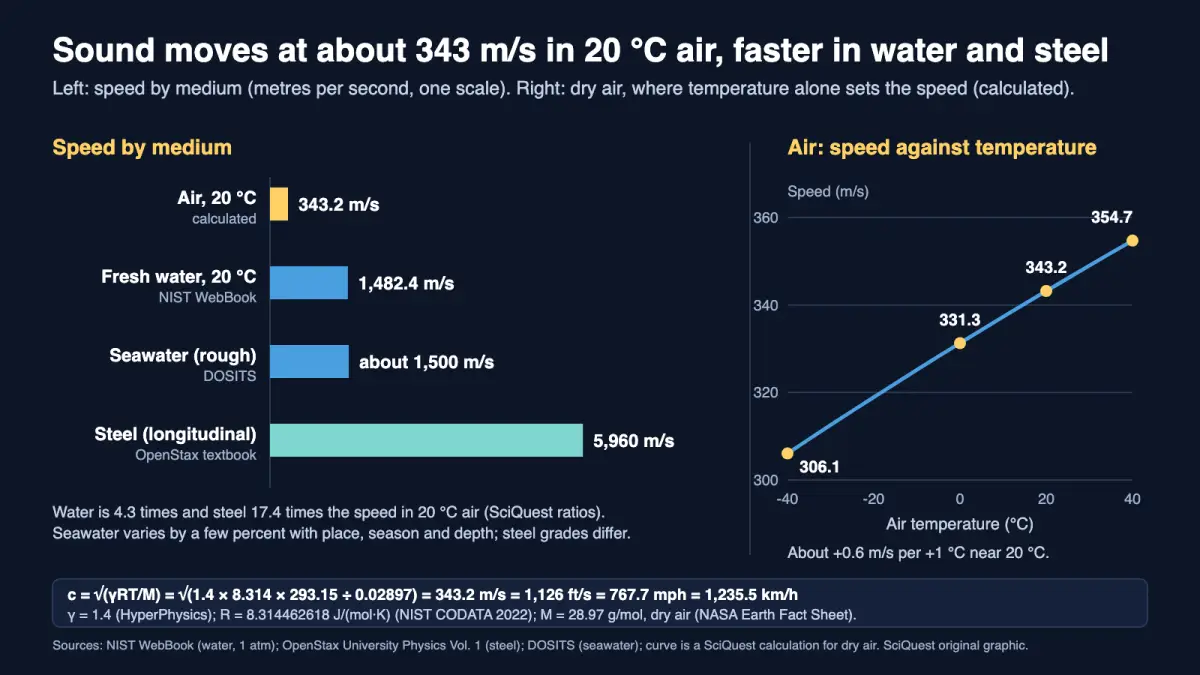
The speed of sound is set by the medium and its temperature, so the familiar 767 mph is one point on a curve: about 761 mph at 15 °C near sea level, 741 mph at 0 °C and 660 mph in the cold air at 11 km.
Sound travels at about 343 metres per second in dry air at 20 °C, which is 768 miles per hour, 1,236 kilometres per hour or 1,126 feet per second. That value is calculated from the formula c = √(γRT/M), where T is the absolute temperature, and it matches published reference values within a few tenths of a metre per second. Rounding 343 m/s straight to units gives the 767 mph and 1,235 km/h seen in many places, so those are the same answer, not a different one.
Warm the air and sound speeds up, cool it and it slows. In liquid water at 20 °C it is 1,482.4 m/s (NIST), about 4.3 times faster than in air, and in steel the textbook value is 5,960 m/s.
Explain it like I’m busy:
- In 20 °C air: 343.2 m/s, 767.7 mph, 1,235.5 km/h, 1,126 ft/s. At 15 °C (“standard” sea level) it is 340.3 m/s, 761 mph (NASA gives 761 mph).
- Air temperature is the main thing that changes it: roughly 0.6 m/s per °C. Altitude matters only because the air gets colder as you climb.
- Water is about 4 times and steel about 17 times faster than air, because those materials are far stiffer.
Key facts about the speed of sound
- Air, 20 °C: 343.2 m/s (SciQuest calculation; the HyperPhysics page gives 343 m/s).
- Air, 0 °C: 331.3 m/s calculated, against 331.39 m/s on HyperPhysics and 331 m/s in the OpenStax textbook.
- What sets it in a gas: temperature only, in the ideal-gas formula. Pressure does not appear in it.
- Water, 20 °C (1 atm): 1,482.4 m/s, from the NIST Chemistry WebBook.
- Mach 1: the local speed of sound, about 340 m/s at sea level on a 15 °C day and about 295 m/s in the 11 km stratosphere of NASA’s atmosphere model.
Speed of sound in mph, km/h, m/s and ft/s by air temperature
| Air temperature | Metres per second (m/s) | Miles per hour (mph) | Kilometres per hour (km/h) | Feet per second (ft/s) |
|---|---|---|---|---|
| −40 °C | 306.1 | 684.7 | 1,101.9 | 1,004.2 |
| −20 °C | 318.9 | 713.4 | 1,148.1 | 1,046.4 |
| 0 °C | 331.3 | 741.1 | 1,192.6 | 1,086.9 |
| 10 °C | 337.3 | 754.5 | 1,214.3 | 1,106.6 |
| 15 °C (standard sea level) | 340.3 | 761.1 | 1,225.0 | 1,116.4 |
| 20 °C | 343.2 | 767.7 | 1,235.5 | 1,126.0 |
| 30 °C | 349.0 | 780.7 | 1,256.4 | 1,145.0 |
| 40 °C | 354.7 | 793.5 | 1,277.0 | 1,163.8 |
Calculated by SciQuest for dry air with γ = 1.4, R = 8.314462618 J/(mol·K) and M = 0.02897 kg/mol, then converted with 1 m/s = 3.6 km/h = 2.2369 mph = 3.2808 ft/s. Cross-checks: NASA Glenn gives about 761 mph at sea level on a standard day; HyperPhysics gives 331.39 m/s at 0 °C and 343 m/s at 20 °C.
What it means in everyday terms
At 343 m/s, sound covers one kilometre in about 2.9 seconds and one mile in about 4.7 seconds. Light covers the same distance in microseconds: with the exact SI value of 299,792,458 m/s (NIST), light is about 873,500 times faster than sound in 20 °C air. That gap is why you see a distant firework burst before you hear it.
The same gap lets you estimate the distance to a storm. The National Weather Service says it takes sound “about 5 seconds to travel a mile”, so counting the seconds from flash to thunder and dividing by five gives miles. At 20 °C the true figure is 4.7 seconds per mile, so the shortcut overstates the distance by about 7%. That is fine for a storm, and any thunder at all means you are within striking distance.
How scientists know, and how to calculate it
Sound is a pressure disturbance passing from molecule to molecule. HyperPhysics puts the general rule as: the speed “for a uniform medium is determined by its elastic property (bulk modulus) and its density”. Stiffer material passes a push along faster, and heavier material is slower to get moving.
For a gas treated as ideal, NASA Glenn gives the speed of sound as a = √(γRT). Here γ is the ratio of specific heats, R is the gas constant for that particular gas (the universal constant divided by its molar mass), and T must be on an absolute scale such as kelvin. Written with the universal gas constant, it is c = √(γRT/M). There is no pressure term, so squeezing air without changing its temperature does not change the answer in this model.
Worked example for dry air at 20 °C:
- Convert to kelvin: T = 20 + 273.15 = 293.15 K.
- Take γ = 1.4 for air (HyperPhysics), R = 8.314462618 J/(mol·K) (NIST, CODATA 2022) and M = 28.97 g/mol = 0.02897 kg/mol (NASA’s mean molecular weight of Earth’s atmosphere).
- Multiply: γRT = 1.4 × 8.314462618 × 293.15 = 3,412.3 J/mol.
- Divide by M: 3,412.3 ÷ 0.02897 = 117,789 m²/s².
- Take the square root: c = 343.2 m/s.
- Convert: × 3.6 = 1,235.5 km/h; × 2.2369 = 767.7 mph; ÷ 0.3048 = 1,126.0 ft/s.
A handy shortcut falls out of the numbers: c ≈ 331.3 + 0.6 × t (t in °C). It lands within 1.2 m/s of the full calculation from −40 °C to 40 °C. It is a SciQuest rule of thumb, not an official formula, so use the square-root form for anything that matters.
What changes the answer
Temperature. This is the dominant factor in air. The table above spans 48.6 m/s between −40 °C and 40 °C, about 14% of the 20 °C value. Because T sits under the square root, the curve bends slightly, but over everyday weather it is close to a straight line.
Altitude. Height itself does not slow sound. Colder air does. NASA’s atmosphere model gives a troposphere temperature of T = 15.04 − 0.00649 h (°C, h in metres, up to 11,000 m) and a constant −56.46 °C in the lower stratosphere. NASA Glenn also says the speed of sound “decreases with increasing altitude”. Feeding those temperatures into the formula, and assuming the air’s composition stays the same, gives the table below.
| Altitude | Air temperature | Metres per second (m/s) | Kilometres per hour (km/h) | Miles per hour (mph) |
|---|---|---|---|---|
| Sea level (0 m) | 15.04 °C | 340.3 | 1,225 | 761 |
| 5,000 m | −17.4 °C | 320.6 | 1,154 | 717 |
| 11,000 m | −56.46 °C | 295.1 | 1,062 | 660 |
Temperatures from the NASA Glenn Earth atmosphere model page; speeds calculated by SciQuest with γ = 1.4 and M = 28.97 g/mol. Real days differ from the standard model.
Humidity. Moist air is slightly faster. The Engineering ToolBox reports roughly 343.5 to 344.5 m/s at 20 °C across 10% to 90% relative humidity, a spread of about 1 m/s. That is a secondary reference, so treat the figure as approximate.
The medium. Liquids and solids are much faster. The table below uses one source per row, and the rows are not measured under identical conditions.
| Medium and conditions | Speed (m/s) | Times the speed in 20 °C air | Source |
|---|---|---|---|
| Dry air, 20 °C | 343.2 | 1.0 | SciQuest calculation |
| Fresh water, 20 °C, 1.01325 bar | 1,482.4 | 4.3 | NIST Chemistry WebBook |
| Fresh water, 20 °C | 1,480 | 4.3 | OpenStax University Physics Vol. 1 |
| Seawater, typical | about 1,500 | about 4.4 | DOSITS |
| Steel, longitudinal (bulk) wave | 5,960 | 17.4 | OpenStax University Physics Vol. 1 |
Ratios are SciQuest calculations. The steel value is for a compression wave in a bulk solid; steel grades, shape and temperature change it. OpenStax lists no temperature for its solids.
Seawater has its own sensitivities. DOSITS gives roughly 4.0 m/s per °C, 1.4 m/s per salinity unit and 17 m/s per kilometre of depth, and says the speed varies by a few percent with place, season and depth.
Mach 1 and the sound barrier
NASA defines the Mach number as an aircraft’s speed divided by the speed of sound. Mach 1 is therefore not one fixed number: it is the speed of sound in the air the aircraft is flying through. Near sea level on a standard day, NASA Glenn puts it at about 761 mph. At 11 km it is about 660 mph, because the air is colder.
That is why the first supersonic flight shows two figures that look inconsistent until you apply this. The Smithsonian’s National Air and Space Museum says that on 14 October 1947 the Bell X-1 reached 1,127 km/h, Mach 1.06, at 13,000 m. Dividing gives a local speed of sound of about 1,063 km/h, and our standard-atmosphere calculation for the cold stratosphere gives 1,062 km/h. Real air that day will not have matched the model exactly, but the agreement is a useful check.
Why it matters to you
Counting storm distance, judging why an echo returns late, or reading a flight’s Mach number all rest on the same thing: sound is slow compared with light and depends on the air’s temperature. The practical lesson is that “the” speed of sound is a value for stated conditions, so check which temperature a quoted number assumes.
“But wait…”
Why is sound faster in water and steel when they are denser than air? Density slows sound, but stiffness speeds it up by more. Using NIST’s water density of 998.21 kg/m³ and its sound speed of 1,482.4 m/s, the relation c² = K/ρ implies a bulk modulus of about 2.2 GPa (SciQuest calculation). Water resists compression far more than air does, and that outweighs its larger density.
Does loudness or pressure change the speed? Not in the ideal-gas formula above, which has only temperature, a gas constant and a gas-specific ratio. Real gases and extreme conditions add small effects that this simple model leaves out.
Related questions
What is the speed of sound in mph? About 768 mph at 20 °C (767.7 calculated), and 761 mph at 15 °C.
What is the speed of sound in feet per second? About 1,126 ft/s at 20 °C, and 1,116 ft/s at 15 °C. NASA rounds the sea-level figure to 1,100 ft/s.
What is the speed of sound in water? 1,482.4 m/s in fresh water at 20 °C (NIST), and about 1,500 m/s for seawater (DOSITS).
How does it compare with other speeds? Light is far faster; see how long it takes to travel one light year. For spacecraft, our look at how fast we can travel in space puts speeds in context. If you want the length of a kilometre in everyday terms, see how far a click is.
In one sentence
Sound travels about 343 m/s (768 mph, 1,236 km/h, 1,126 ft/s) in 20 °C dry air, slows as the air cools, and is several times faster in water and steel because they are stiffer.
Quick check: did it click?
- What is the speed of sound in 20 °C air in mph? About 768 mph (767.7), or 343 m/s.
- Why is Mach 1 lower at 11 km than at sea level? The air is colder, so the local speed of sound is about 295 m/s instead of 340 m/s.
- Which is faster, sound in fresh water at 20 °C or in air at 20 °C, and by about how much? Water, about 4.3 times (1,482.4 m/s against 343.2 m/s).
Read next
- How long does it take to travel one light year?
- How fast can we travel in space with current technology?
- How far is a click? Klick meaning, conversions and origin
Disclosure: This article was drafted with AI assistance and checked against the sources below. The air values, altitude table, ratios, worked calculation and the rule of thumb are SciQuest calculations, and the chart is an original SciQuest graphic. The OpenStax steel value and the Engineering ToolBox humidity figure are secondary references. Spotted an error? See our corrections policy.
Sources
- NASA Glenn, Speed of Sound (a = √(γRT); about 761 mph or 1,100 ft/s on a standard day at sea level; Mach number)
- NASA Glenn, Earth Atmosphere Model (T = 15.04 − 0.00649 h; −56.46 °C lower stratosphere; speed of sound decreases with altitude)
- NASA NSSDCA, Earth Fact Sheet (mean molecular weight 28.97)
- NIST, Molar gas constant, CODATA 2022 and speed of light in vacuum (299,792,458 m/s)
- NIST, Chemistry WebBook, Thermophysical Properties of Fluid Systems, water isobaric table at 1.01325 bar (sound speed 1,482.4 m/s and density 998.21 kg/m³ at 20.01 °C)
- HyperPhysics (Georgia State University), Speed of sound in air (γ = 1.4; 331.39 m/s at 0 °C; 343 m/s at 20 °C; bulk modulus and density)
- OpenStax, University Physics Volume 1, 17.3 Speed of Sound (water 1,480 m/s at 20 °C; steel 5,960 m/s)
- DOSITS, Discovery of Sound in the Sea, Tutorial: Speed of Sound (about 1,500 m/s in seawater; 4.0 m/s per °C, 1.4 m/s per PSU, 17 m/s per km depth)
- National Weather Service, Lightning science: thunder (“about 5 seconds to travel a mile”)
- National Air and Space Museum, Bell X-1 (14 October 1947; 1,127 km/h; Mach 1.06; 13,000 m)
- Engineering ToolBox, Air: speed of sound vs temperature (humidity effect; secondary source)
Discover more from SciQuest
Subscribe to get the latest posts sent to your email.
Leave a comment