

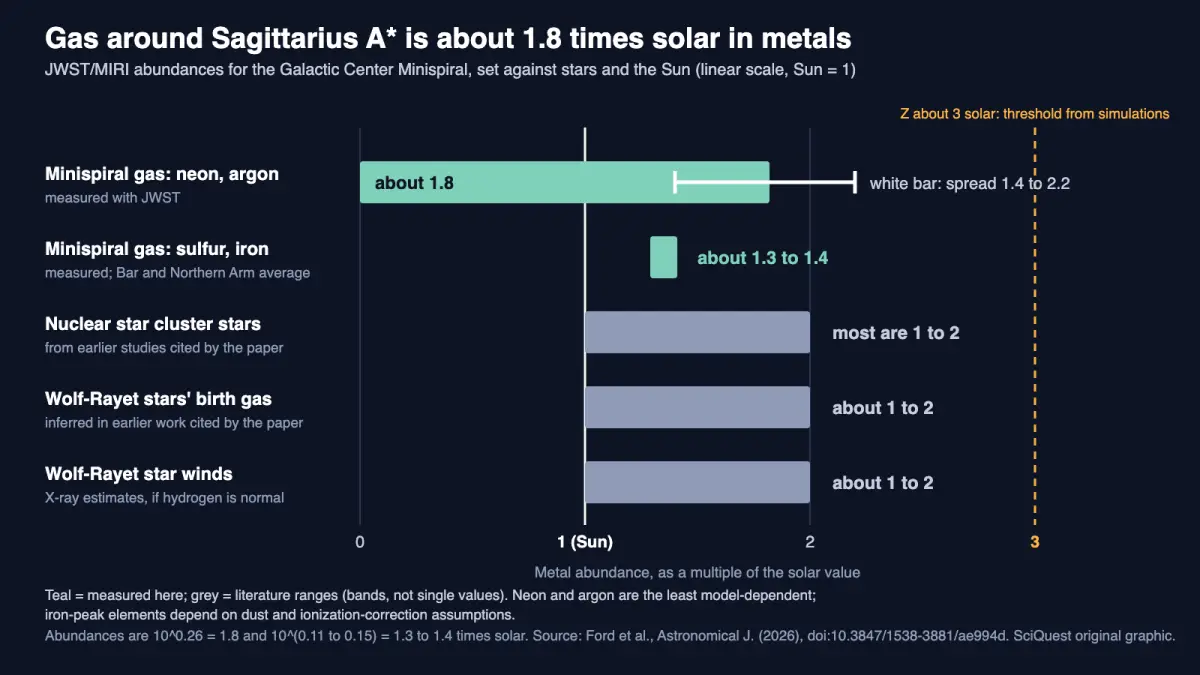
The Minispiral gas near Sagittarius A* carries about 1.8 times the Sun’s proportion of metals, matching the surrounding stars, though the iron and nickel figures depend on dust and modelling assumptions.
Peer reviewed · JWST observations · Model-dependent abundances
A team led by Nicole Ford at McGill University has used the James Webb Space Telescope to read the chemistry of the gas streaming around Sagittarius A*, the Milky Way’s central black hole. In astronomy, “metals” means every element heavier than helium. The gas holds about 1.8 times the Sun’s share, similar to the stars in the same region, which fits the idea that gas and stars formed together. The result comes from modelling infrared emission lines, so the iron-peak elements remain the least certain.
What you need to know
- Finding: Gas in the Galactic Center Minispiral, within the central 0.1 parsec (about 0.33 light-years) of the Galaxy, is mildly metal-rich at about 1.8 times solar, based on neon and argon.
- Method: The team mapped 13 infrared fine-structure emission lines with JWST’s Mid-Infrared Instrument (MIRI) in its medium-resolution spectrograph mode, then converted line strengths into abundances and ionization conditions.
- Source: Ford, Balakrishnan, von Fellenberg, Haggard and ten co-authors, The Astronomical Journal, online 19 October 2026.
- Why it matters: Metal content affects how easily gas cools and clumps, which feeds into models of how gas reaches Sagittarius A*, a black hole the McGill release says takes in less material than other supermassive black holes.
- Limitation: The numbers depend on assumed gas density, temperature and ionization corrections; the co-formation reading is an interpretation, not a measurement.
Evidence at a glance
| Item | Assessment |
|---|---|
| Evidence status | Peer reviewed; new JWST spectroscopic observations (JWST program 4572, observed April and September 2024) with abundances derived from models. An earlier version has been on arXiv since 13 May 2026. |
| Primary source | “Ionization Structure and Metal Enrichment of the Galactic Center Minispiral Observed with JWST”, The Astronomical Journal, online 19 October 2026, doi:10.3847/1538-3881/ae994d; open preprint arXiv:2605.13995 (v2, 12 August 2026). |
| Evidence strength | Moderate for “mildly super-solar” neon and argon, which are the least sensitive to correction assumptions. Limited for iron and nickel, which depend on dust and ionization corrections, and for the co-formation story, which is an interpretation. |
| Principal limitation | Abundances are not read off directly. They rest on assumed gas density and temperature and on ionization correction factors, and the authors caution that mid-infrared metallicity shortcuts are not yet validated for the Galactic Center. |
| Coverage at a glance | 1 credible publisher found (Phys.org, carrying McGill University’s release of 19 October 2026) as of 20 October 2026, 08:40 UTC. Counted: outlets with their own write-up or a named release; not counted: reposts. No independent write-up found yet. |
Sources: the paper (abstract and full text), the McGill release as published on Phys.org, and a SciQuest web search on 20 October 2026.
Is this a big deal?
A solid, specific measurement rather than a rewrite of black-hole physics. Astronomers already expected the central region to be somewhat metal-rich. What is new is a Webb-based, structure-by-structure measurement at sub-parsec scale, plus evidence that fast gas clumps near Sagittarius A* share the composition of the larger streams. The step from “same composition” to “formed together” is plausible and consistent with earlier work, but the paper presents it as consistent with, not proof of, in-situ star formation.
What scientists found
The Minispiral is a three-armed web of warm ionized gas inside the ring of colder gas that circles Sagittarius A*, about 8 kiloparsecs (roughly 26,000 light-years) from Earth. The paper looks at three kinds of gas feature, separated by how fast each moves along our line of sight: the Bar (almost stationary), the Northern Arm (about -270 km/s) and several compact, fast clumps (about -570 km/s, the abstract says 600 km/s or more). Negative speeds mean the gas is moving toward us. (600 km/s is about 2.2 million km/h.)
All three show similar enrichment. For neon and argon, the team finds a mean of about 0.26 dex above solar. A dex is a power of ten, so 0.26 dex is 100.26, or about 1.8 times the Sun’s value, with element-to-element and aperture-to-aperture spread of about 0.1 dex (roughly 1.4 to 2.2 times). Sulfur and iron come out lower, around 0.11 to 0.15 dex (about 1.3 to 1.4 times), and iron scatters by about 0.3 dex.
Dust adds a twist. Nickel and iron lock into dust grains, so gas-phase nickel and iron should come out low if grains are intact. The team finds only weak depletion, which they read as a sign that the dust has been strongly processed, consistent with destruction by shocks. Gas-phase nickel is more enhanced in the Northern Arm and the fast clumps than in the Bar. That is the part the paper treats as an interpretation, and nickel’s atomic data may also add bias.
How they found it
JWST’s MIRI integral field spectrograph records a full spectrum for every pixel, so each spot on the sky becomes its own set of emission lines. The paper’s data cover 4.9 to 27.9 micrometres across four channels, with 13 fine-structure lines (ionization potentials from about 7.9 to 55 eV) detected at peak signal-to-noise of at least 10, plus several hydrogen recombination lines.
Turning lines into abundances takes modelling. Line ratios of one element (for example [Ne III] to [Ne II]) show how strongly the gas is ionized. Ionization-correction factors then estimate the share of each element hiding in stages the telescope did not see. The team compared the ionization with CLOUDY photoionization models built from about 30 Wolf-Rayet stars in the central parsec, and found that those stars can broadly explain the radiation field. The ionization parameter (log U) comes out at about -1.6 for the Bar, -1.6 to -1.2 for the Northern Arm and -1.2 to -0.6 for the fast clumps, so the clumps are more strongly ionized.
| Feature | Line-of-sight speed (measured) | Electron density, cm-3 (assumed in the model) | Ionization parameter, log U (modelled) | Metals, times solar (neon, argon) |
|---|---|---|---|---|
| Bar | about 0 km/s | 105 | about -1.6 | about 1.8 |
| Northern Arm | about -270 km/s | 3 × 10⁴ | -1.6 to -1.2 | about 1.8 |
| Fast compact clumps | about -570 km/s | 4 × 10⁴ (may be 5 to 10 times too high) | -1.2 to -0.6 | about 1.8 |
Source: Ford et al., The Astronomical Journal (2026), Table 3 and Section IV. Speeds are measured; densities and ionization parameters are model outputs; 1.8 is 100.26.
Why it matters to you
Nothing changes in daily life. This is about where we come from: the gas feeding the black hole at the center of our galaxy, and whether it is the same stuff as the stars around it. For related background, see what is in the center of the Milky Way.
Why a quiet black hole makes the composition matter
The paper calls Sagittarius A* the nearest quiescent supermassive black hole. McGill’s release, as published on Phys.org, adds that it eats material more slowly and in smaller amounts than other supermassive black holes, and says metals affect how fast gas cools and so how readily it falls in. The paper itself gives a narrower version: it says gas composition and dust may influence how well clumps cool and fall toward Sagittarius A*, and notes that an earlier simulation study found that gas near 3 times solar metals may mark a threshold for cooling efficiently into an accretion disk. The measured 1.8 times solar is below that value.
Here the evidence stops. The paper does not test why Sagittarius A* accretes so little, and it does not claim the metal level explains it. It recommends that future simulations adopt these abundances and the dust depletion to see what they imply for cooling.
What the evidence does not show
Comparing the gas to nearby stars is a bit like checking whether two loaves came from the same flour batch: matching ingredients point to a shared source, but neighbours can also buy from the same shop, so a match is not a receipt. In the paper, most stars in the central nuclear star cluster have metallicity of about 1 to 2 times solar, and the natal gas of the central Wolf-Rayet stars was inferred at about 1 to 2 times solar, both from earlier literature. The Minispiral values agree with these once the correction factors are included. Similar abundances could also arise if gas and stars formed farther out and migrated inward together, though the authors note that scenario is generally disfavored for the young massive stars.
Specific limits listed in the paper include uncertain ionization corrections (iron needs correction factors of 2.0 to 3.7, depending on the model), the assumed density and temperature, possible bias in nickel atomic data, and instrument artifacts such as a dip in the [Ar II] line, which could affect argon in the fast clumps by up to 25% without correction. Oxygen was too weak to measure. The shock interpretation, that the fast clumps may be hit by localized fast shocks, is also a proposal. The authors suggest higher-signal observations of lines above 41 eV, such as [O IV] or [Ne V], to separate shocks from starlight.
How this fits what we already knew
Earlier work the paper cites had already found mildly super-solar stars in the region. The new part is a structure-by-structure gas measurement from one JWST data set. See also what is the closest supermassive black hole to Earth.
Independent perspective
SciQuest found no published comment from an astronomer outside the team as of 08:40 UTC on 20 October 2026, and has not interviewed one. McGill’s release attributes to Ford the point that understanding why the black hole takes in so little will mean looking at the properties of the material it feeds on, and that comparing observations with simulations of gas evolution over longer timescales will be needed. We paraphrase because we read the quote only on a republished copy.
A companion paper on Sagittarius A* flares
A separate paper by Balakrishnan and colleagues, in The Astrophysical Journal, used JWST/MIRI time-resolved spectroscopy of the central 0.3 arcseconds to look for mid-infrared lines that brighten and fade with Sagittarius A* flares. It found no flare-correlated variability in any mid-infrared line over lags of about 1 to 8 hours, and argues that the extended gas responds too slowly. Its conclusion is that infrared line diagnostics trace a steady radiation field, so they cannot constrain the instantaneous ultraviolet flux of Sagittarius A*. That is a limit on the method, not a measurement of the black hole’s past ultraviolet output, which remains unconstrained because of heavy dust extinction.
How other headlines framed it
Only one credible outlet had covered the result when we checked, so there is no spread of framings to compare. Phys.org carried McGill’s release, written by Kay Pettigrew, and framed it around the finding that the gas is rich in metals and resembles many of the stars orbiting the black hole, with the low-appetite black hole as context. SciQuest will add other outlets if they publish their own reporting.
What happens next
The paper’s own list is short and specific: higher signal-to-noise measurements of high-energy lines to tell shocks from starlight, and simulations that use the measured abundances and dust depletion to test how efficiently gas cools and reaches the black hole. Ford says, per McGill’s release, that this means comparing observations with simulations of gas evolution over longer timescales. For how the telescope works, see how the James Webb Space Telescope works.
In one sentence
JWST shows that gas feeding the Milky Way’s central black hole is about 1.8 times as metal-rich as the Sun, much like the surrounding stars, which supports but does not prove a shared origin.
Quick check: did it click?
- What does “1.8 times solar” mean here? Neon and argon in the gas are about 1.8 times as abundant, relative to hydrogen, as in the Sun (0.26 dex, since 10^0.26 is about 1.8).
- Which part is least certain? Iron and nickel, because they depend on dust and ionization-correction assumptions, and the co-formation idea, which is an interpretation.
- Does the paper explain why Sagittarius A* accretes so little? No. It gives composition inputs for future simulations and notes the measured level is below a cooling threshold proposed in earlier work.
Read next
- What is in the center of the Milky Way? The black hole and its surroundings.
- How does the James Webb Space Telescope work? The instrument behind the measurement.
- How many black holes are there? Where Sagittarius A* sits in the wider census.
Sources and disclosure
- Ford NM, Balakrishnan M, von Fellenberg SD, Haggard D, Michail JM, Cui Y, Hora JL, Neilsen J, Principe G, Roychowdhury T, Sabha NB, Smith HA, Sumners Z, Willner SP. “Ionization Structure and Metal Enrichment of the Galactic Center Minispiral Observed with JWST.” The Astronomical Journal, online 19 October 2026. doi:10.3847/1538-3881/ae994d
- Same paper, preprint: arXiv:2605.13995 (v2, 12 August 2026), read in full text.
- Balakrishnan M, von Fellenberg SD, Haggard D, et al. “Infrared Line Diagnostics Fail to Constrain Sgr A*’s UV Output.” The Astrophysical Journal, 2026. doi:10.3847/1538-4357/ae908b
- McGill University release by Kay Pettigrew, “Webb reveals metal-rich gas around Milky Way’s central black hole,” as published on Phys.org, 19 October 2026.
Disclosure: This article was drafted with AI assistance and checked against the sources above. The journal’s own page blocked automated access, so the abstract was read via Crossref and the full text via the arXiv version; the abstracts match, but wording in the final journal version may differ. Calculations by SciQuest: 10^0.26 is about 1.8; 10^0.11 to 10^0.15 is about 1.3 to 1.4; 0.1 parsec is about 0.33 light-years; 8 kiloparsecs is about 26,000 light-years; 600 km/s is about 2.2 million km/h. The graphic is a SciQuest original built from the paper’s reported values. Spotted an error? See our corrections policy.
Discover more from SciQuest
Subscribe to get the latest posts sent to your email.
Leave a comment