

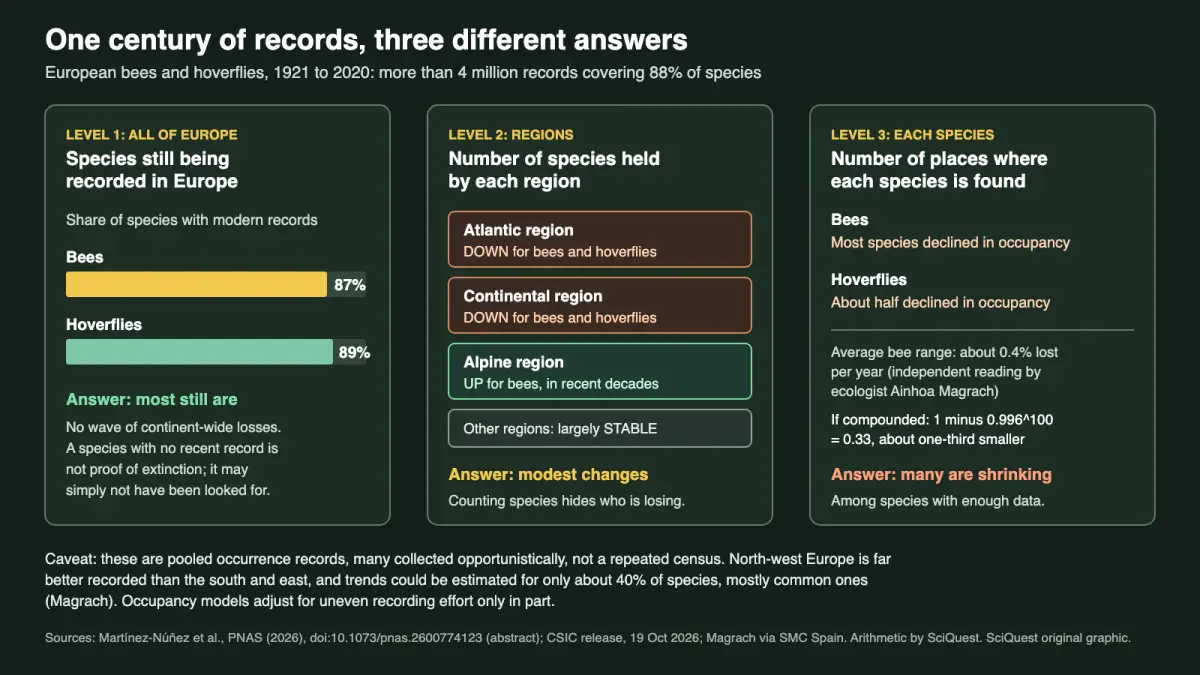
Across more than four million records from 1921 to 2020, most bee species and about half of hoverfly species with enough data now occupy fewer places, yet 87% of bee and 89% of hoverfly species still turn up in modern records.
Peer reviewed · Observational (historical records) · Modelled trends
Most of Europe’s wild bee species that could be tracked are now found in fewer places than they were a century ago, a team led by Carlos Martínez-Núñez at Doñana Biological Station (EBD-CSIC) in Seville reports in PNAS. About half of hoverfly species declined too. Most species still appear in modern records somewhere in Europe, so the authors see room to reverse the losses. The main catch is the data: these are records gathered unevenly over 100 years, so the trends are modelled estimates, not a headcount.
What you need to know
- Finding: Most bee species and about half of hoverfly species declined in occupancy, the share of places where a species is found. Regional species counts changed only modestly.
- Method: The team modelled a curated database of more than four million occurrence records covering 88% of Europe’s living bee and hoverfly species, using occupancy models that partly correct for uneven recording effort.
- Source: Martínez-Núñez, Bartomeus and seven co-authors, PNAS 123(44), published online 19 October 2026.
- Why it matters: It extends a pattern seen mainly in Britain, Belgium and the Netherlands to the whole continent, and it shows that stable species counts can hide shrinking ranges.
- Limitation: Early records are sparse and patchy, north-west Europe is far better recorded than the south and east, and trends could be estimated for only about 40% of species, mostly common ones.
Evidence at a glance
| Item | Assessment |
|---|---|
| Evidence status | Peer reviewed; observational analysis of historical occurrence records with statistical (occupancy) models. No experiment, and no direct test of what caused the declines is described in the abstract. |
| Primary source | “Historical trends show more declining than increasing species among European pollinators”, PNAS 123(44), e2600774123, published online 19 October 2026, doi:10.1073/pnas.2600774123, CC BY-NC-ND. |
| Evidence strength | Moderate. The dataset is large, validated by taxonomists and spans a century, and the authors ran sensitivity analyses. But the records were not collected as a systematic survey, so the trends depend on how well the models correct for changing recording effort. |
| Principal limitation | Recording bias: early 20th-century records are scarce and opportunistic, the south and east of Europe are under-recorded, and trends could be estimated for only about 40% of species. |
| Coverage at a glance | 2 distinct credible publishers with their own reports (Phys.org and the EFE news agency) as of 21 October 2026, 07:40 UTC, found by web search. Not counted: the CSIC press release, the Science Media Centre Spain expert briefing, and sites republishing the EFE wire. |
Sources: the paper’s abstract (PubMed and Crossref), the CSIC release, and expert comments published by Science Media Centre Spain. The 40% figure and the description of the data come from ecologist Ainhoa Magrach’s reading of the paper.
Is this a big deal?
It’s a solid step, not a shock. Smaller studies had already found declining bees in a few well-recorded countries. This one shows the same direction across Europe, with the clearest losses in the Atlantic and Continental regions. Treat the exact size of the decline as an estimate.
What scientists found
The study asked three questions at three scales, and got three different answers.
At the scale of Europe, persistence was fairly high: 87% of bee species and 89% of hoverfly species have modern records. Regionally, species counts (richness) changed modestly. Both groups lost species in the Atlantic and Continental regions, bees gained species in the Alpine region in recent decades, and richness stayed largely stable elsewhere.
At the scale of single species, the picture darkens. Most bee species, and about half of hoverfly species, declined in occupancy. According to the CSIC release, every region had more bee and hoverfly species declining than increasing, except the Alpine region. Ainhoa Magrach, an ecologist at the Basque Centre for Climate Change who was not involved, reads the paper as showing an average loss of about 0.4% of bee range per year. Compounded over 100 years, that is 1 minus 0.996100, or about 0.33: roughly a third smaller.
Think of a chain of shops. The brand can still be trading in every country while closing branch after branch. Persistence counts the brands; occupancy counts the branches. The comparison has a limit: a shop chain knows exactly how many branches it has, while ecologists only know where someone happened to look.
How they found it
The team, from institutions in Spain, France, Belgium, Serbia and Morocco, started from a validated database of wild bee and hoverfly records for 1921 to 2020. Hoverflies are flower-visiting flies, many of them striped like wasps, and they are important pollinators in their own right.
The hard part is that a record means someone found a species in a place. It doesn’t say what was missed. Recording effort has risen and shifted over the century. The team used occupancy models, which estimate the chance that a species is present while allowing for the chance it was overlooked. Magrach notes these models correct for changing effort only in part.
The authors then checked whether species traits, such as climate preference, diet or a parasitic lifestyle, predicted which species declined. Traits explained little. Cold-adapted bees showed a weak tendency to decline more steeply than warm-adapted ones. Some of the steepest-falling genera include parasitic species and diet specialists, though neither trait significantly predicted trends.
Why it matters to you
Wild bees and hoverflies pollinate wild plants and many fruit and vegetable crops, and Magrach points out that these crops still depend on wild pollinators where honeybee hives are used. The study does not measure any effect on harvests or food prices. The longer-term risk Magrach describes is quieter: a few hardier species replacing many vulnerable ones, with fewer pollination roles covered even if species counts barely move. Co-author Ignasi Bartomeus suggests in the CSIC release that people can help by planting native flowers, avoiding pesticides and leaving small shelters for pollinators, including in towns.
What the evidence does not show
It does not show what caused the declines. The CSIC release names habitat loss, fewer flowers, pesticide use tied to intensive farming, and climate change as main threats, and it notes that the Atlantic region saw heavy land-use intensification. Those are the researchers’ interpretation and wider context. Matching a region’s history to its losses is an association, not a test.
The same caution applies to the Alpine gains. The release suggests species moved up from valleys as temperatures rose, and the weak cold-adapted pattern fits that idea. Neither result proves climate drove it.
Data gaps cut both ways. Magrach says some regions could not be analysed at all. The release adds that many hoverfly species were described only recently, so missing old records can hide long-term declines, and that data-poor species of both groups showed negative trends.
How this fits what we already knew
Earlier long-term evidence on wild pollinators came mostly from north-western countries with dense recording, such as Britain, Belgium and the Netherlands. This study covers far more of the continent. Per the release, bee species listed as Critically Endangered by the IUCN showed the sharpest declines, and some species with clear negative trends are not yet in a threatened category.
Independent perspective
Two researchers who were not involved commented through Science Media Centre Spain, in Spanish with an English translation. Magrach rated both the work and its validated database highly. She declared that she has worked with, and is friends with, co-author Bartomeus. Concepción Ornosa, a retired arthropod biologist at Complutense University of Madrid with no declared conflicts, judged the conclusions well supported. She cautioned that continent-scale regions blur diverse areas such as the Iberian Peninsula, and questioned the Alpine increase in so sensitive an area.
How other headlines framed it
- Phys.org led with a worrying century-long picture for bees, at about a third less widespread. It also said hoverflies spread on average, mainly in earlier decades, and that more than 90% of species were recorded recently. SciQuest could not check either point against the full paper. The abstract gives 87% and 89% for persistence, and says about half of hoverfly species declined.
- EFE, as carried by Plano Informativo, headlined that bees are disappearing from Europe, while its text framed the result as a warning rather than a mass extinction.
The difference matters. “Disappearing” suggests extinction, while the study found most species still recorded across Europe. What is shrinking is where species live.
What happens next
The CSIC release says the trends can feed into IUCN Red List reassessments, and Magrach argues for systematic monitoring instead of opportunistic records. Ornosa calls for smaller-scale regional studies. For what plant loss looked like in the deep past, see how fossil pollen tracks plant turnover in extreme warmth.
In one sentence
Europe still has most of its wild bee and hoverfly species, but a century of records suggests many of them, especially bees, now live in fewer places.
Quick check: did it click?
- What is the difference between persistence and occupancy? Persistence asks whether a species is still recorded at all; occupancy asks how many places it is found in.
- Which regions lost species of both groups? The Atlantic and Continental regions.
- Why are the trends estimates rather than counts? The records were collected unevenly over time and space, so models must correct for how hard people looked.
Read next
- Why are mosquitoes important? Another insect group with an overlooked role in pollination and food webs.
- What is organic regenerative agriculture? The farming changes often proposed to bring flowers and insects back.
- What would happen if mosquitoes went extinct? How losing one insect group ripples through an ecosystem.
Sources and disclosure
- Martínez-Núñez C, Duchenne F, de Manincor N, Ghisbain G, Vujic A, Sentil A, Miličić M, Michez D, Bartomeus I. “Historical trends show more declining than increasing species among European pollinators.” PNAS 123(44), e2600774123, published online 19 October 2026. doi:10.1073/pnas.2600774123. Abstract read via PubMed.
- CSIC press release (Spanish), “Cien años de datos revelan un declive generalizado de polinizadores silvestres en Europa”, 19 October 2026.
- Science Media Centre Spain, expert reactions from Ainhoa Magrach and Concepción Ornosa, 19 October 2026.
- Coverage read for framing: Phys.org, EFE via Plano Informativo.
Disclosure: This article was drafted with AI assistance and checked against the sources above. The full PNAS text was blocked by a bot check, so figures come from the paper’s abstract, the institution’s release and named independent experts, and each is attributed. Calculation by SciQuest: 1 minus 0.996100 is about 0.33. The graphic is a SciQuest original. Spotted an error? See our corrections policy.
Discover more from SciQuest
Subscribe to get the latest posts sent to your email.
Leave a comment