

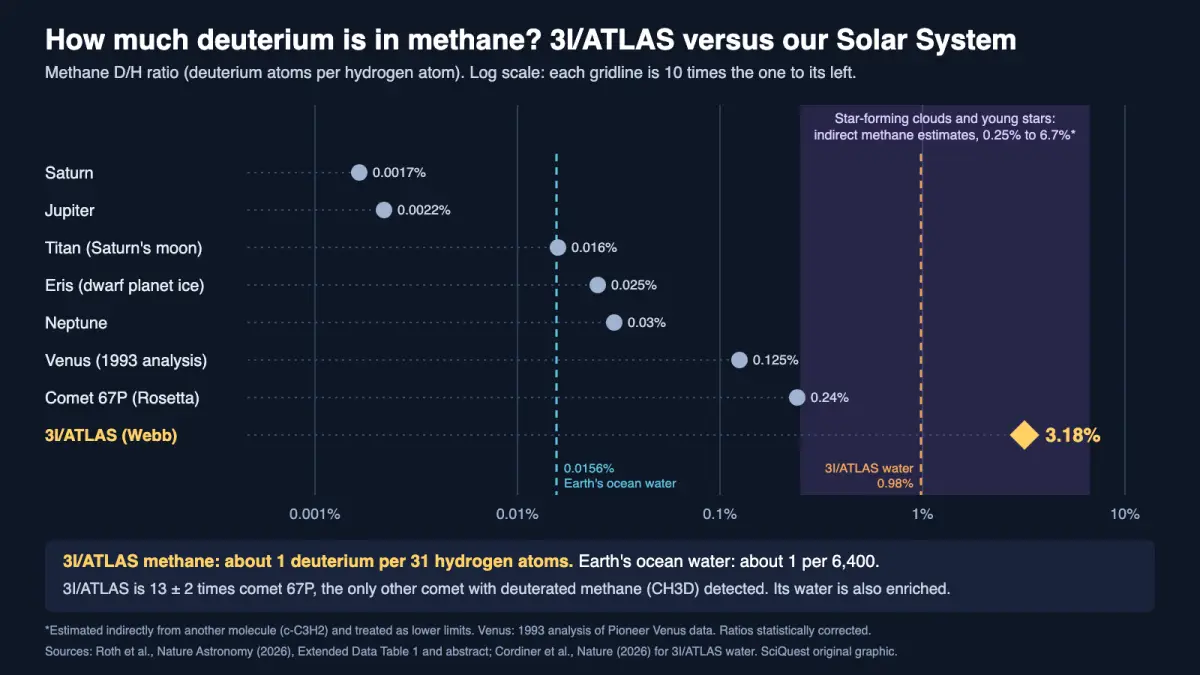
Webb found one deuterium atom for every 31 or so hydrogen atoms in the methane of interstellar comet 3I/ATLAS, a D/H ratio of 3.18%, about 13 times the only other comet measured, though it rests on one object observed over two nights.
Peer reviewed · Telescope spectroscopy · One object, two nights of data
Methane streaming off 3I/ATLAS, the third known object to visit from another star system, carries far more deuterium than any methane measured in the Solar System. A NASA Goddard-led team under Nathan Roth reports a deuterium-to-hydrogen (D/H) ratio of (3.18 ± 0.30)% in Nature Astronomy, from James Webb Space Telescope spectra taken in December 2025. The result fits the idea that the comet’s ices formed somewhere very cold. The catch: no model has yet been shown to reproduce a value this high, and there is only one other comet to compare it with.
What you need to know
- Finding: Methane from 3I/ATLAS has D/H = (3.18 ± 0.30)%, higher than any methane value from the Solar System and 13 ± 2 times that of comet 67P/Churyumov–Gerasimenko.
- Method: Webb’s NIRSpec spectrograph recorded the comet’s gas on 22 and 23 December 2025; the team fitted infrared lines of methane (CH4) and deuterated methane (CH3D).
- Source: Roth, Cordiner, Milam and 15 co-authors, Nature Astronomy, published 23 October 2026.
- Why it matters: Deuterium in an organic molecule from another planetary system is rarely measured, and such ratios record how cold the ices’ birthplace was.
- Limitation: No young star has a direct methane D/H for comparison, and models have not yet been shown to produce a value this high.
Evidence at a glance
| Item | Assessment |
|---|---|
| Evidence status | Peer reviewed; Webb infrared spectroscopy of one interstellar comet. Preprint (arXiv:2603.20445) since March 2026. |
| Primary source | “An enriched methane D/H ratio in the interstellar object 3I/ATLAS”, Nature Astronomy, published online 23 October 2026, doi:10.1038/s41550-026-03002-5. |
| Evidence strength | Moderate for the measurement: CH3D is detected at about ten times its uncertainty. Limited for the origin story, which rests on one comparison comet and indirect young-star estimates. |
| Principal limitation | One object observed on two nights; the authors say it is uncertain whether current models can produce methane this deuterium-rich. |
| Coverage at a glance | 0 distinct credible publishers found reporting the peer-reviewed paper as of 24 October 2026, 13:05 UTC (web search; journal abstract reposts excluded). The March preprint was covered by at least 2 (Futurism and The Debrief). |
Sources: the paper’s abstract, Table 1, figure captions and Extended Data Table 1 on nature.com; the full text of preprint version 2 on arXiv (the published body is paywalled).
Is this a big deal?
A solid measurement with a careful interpretation. Deuterated methane had been detected in only one comet before, by the Rosetta spacecraft flying alongside it. Webb did it from about 270 million km away, on a visitor from another star. What it says about that star’s planet-forming disc is a proposal, not a settled answer.
What scientists found
Hydrogen comes in two stable forms. Ordinary hydrogen has a lone proton in its nucleus; deuterium adds a neutron. The D/H ratio counts how many of a molecule’s hydrogen atoms are the heavy kind.
In 3I/ATLAS methane that ratio is 3.18%, or about 1 deuterium per 31 hydrogen atoms. Earth’s ocean water holds roughly 1 per 6,400. Of the Solar System methane values in the paper’s table, from Jupiter to the dwarf planet Eris, the highest is comet 67P’s, about 0.24%.
How they found it
Webb’s Near Infrared Spectrograph (NIRSpec) observed the comet on 22 and 23 December 2025, when it was about 2.4 au (360 million km) from the Sun, per the preprint. It had passed closest to the Sun around 30 October 2025, according to NASA.
The hard part was a crowded spectrum. Using light from a small circle centred on the nucleus, the team subtracted models of methanol, formaldehyde, ethane and hydroxyl emission, fitted ordinary methane, then subtracted that too. What remained held the faint CH3D lines.
The comet was releasing about 1.86 × 1026 methane molecules a second, roughly 5 kg of gas, and about 2.36 × 1025 CH3D molecules a second. Each methane molecule has four hydrogen sites, so the ratio of the two is divided by four: 2.36 ÷ 18.56 ÷ 4 = 0.0318, or 3.18%.
Why it matters to you
This changes nothing in daily life. It speaks to how planets form around other stars. Deuterium ratios are also a main tool for asking where Earth’s own water came from, and 3I/ATLAS adds a sample from another system.
What the evidence does not show
Think of the deuterium level as a postmark. Very cold gas, ionised by cosmic rays, tends to load deuterium into molecules, and the extra deuterium stays locked in once ice forms. A high ratio says “posted somewhere cold”. It does not give the address, the date, or say which molecule’s history it records best.
The authors propose that the ices formed in a cold, low-metallicity (poor in elements heavier than helium) region under strong cosmic-ray exposure. The data are consistent with that; they do not prove it. In the preprint the authors say it is uncertain whether current models can reproduce the value. Young-star methane values come only from a proxy molecule, c-C3H2.
A comet-to-comet comparison is also thin. Only 67P has a measured methane D/H, so “13 times higher” contrasts two objects, not two populations.
How this fits what we already knew
This is the third deuterium result for 3I/ATLAS. Cordiner and colleagues, writing in Nature in June 2026, measured its water at D/H = (0.98 ± 0.06)%, more than ten times known comets, and tied that to formation at about 30 K or colder. An ALMA team led by Luis Salazar Manzano reported a high water ratio independently in Nature Astronomy in April.
Methane in 3I/ATLAS is about 3.2 ± 0.4 times more deuterium-rich than its water, by SciQuest’s arithmetic. Comet 67P shows the same pattern: Rosetta found its alkanes 4.1 to 4.8 times more enriched than its water. The paper notes that organics outpace water in the nearby interstellar medium too.
Independent perspective
SciQuest found no on-record comment from an astronomer outside the author team as of 24 October 2026, 13:05 UTC, and has not interviewed one. The journal names Diane Wooden as one of the paper’s peer reviewers; the review reports are published with the article.
How other headlines framed it
- Futurism (25 March, on the preprint) led with deuterium as “nuclear fuel” and Avi Loeb’s technology suggestion, then noted the work was not yet peer reviewed and that natural chemistry can explain it.
- The Debrief (27 March) also used the fusion-fuel angle and framed the result as a cold-origin mystery.
Deuterium’s use as fusion fuel has no bearing here; it is a trace chemical label measured in every comet. Preprint coverage also quoted 3.33% and “14 times”; the peer-reviewed paper gives 3.18% and 13 ± 2.
What happens next
The authors call for astrochemical models that compute methane D/H under low-metallicity, high-cosmic-ray conditions; the preprint also mentions extra Webb background exposures planned for later in 2026. 3I/ATLAS is leaving the Solar System, so the next tests come from models and future interstellar visitors. For a sense of how many systems they could come from, see how many planets the Milky Way holds.
In one sentence
Methane from 3I/ATLAS is richer in deuterium than any measured in the Solar System, a sign its ices formed somewhere very cold, though the full story awaits models and more comets.
Quick check: did it click?
- Why is the CH3D-to-CH4 ratio divided by four? Methane has four hydrogen atoms, so one deuterated molecule carries one D among four sites.
- What does a high D/H ratio suggest about where ice formed? Somewhere very cold, where deuterium gets locked into molecules; it does not pin down the exact place or time.
Read next
- Where did Earth’s water come from? How deuterium ratios test the comet idea.
- Where is Earth in the Milky Way? Our own galactic address.
- The stages of a star’s life cycle, from cold cloud to planetary system.
Sources and disclosure
- Roth NX, Cordiner M, Milam S, Villanueva G, Charnley S, Biver N, Bockelée-Morvan D, Bodewits D, Crovisier J, Drozdovskaya MN, Farnocchia D, Furuya K, Kelley MSP, Micheli M, Noonan JW, Opitom C, Schwamb ME, Thomas CA. “An enriched methane D/H ratio in the interstellar object 3I/ATLAS.” Nature Astronomy, published 23 October 2026. doi:10.1038/s41550-026-03002-5.
- Roth NX et al. Preprint version 2, arXiv:2603.20445 (10 August 2026), for observing geometry, methods and caveats.
- Cordiner M et al. “Isotopic evidence for a cold and distant origin of 3I/ATLAS.” Nature, published 22 June 2026. doi:10.1038/s41586-026-10771-6.
- ALMA Observatory, “ALMA reveals interstellar comet 3I/ATLAS formed in a far colder world than our own”, 23 April 2026.
- Müller DR et al. “High D/H ratios in water and alkanes in comet 67P/Churyumov-Gerasimenko measured with Rosetta/ROSINA DFMS.” Astronomy & Astrophysics 662, A69 (2022). doi:10.1051/0004-6361/202142922.
- NASA Science, Comet 3I/ATLAS fact page (discovery and perihelion).
Disclosure: This article was drafted with AI assistance and checked against the sources above. The published paper’s body is paywalled; SciQuest read its abstract, tables and figure captions on nature.com and the full preprint on arXiv. Calculations by SciQuest: 1/0.0318 ≈ 31 and 1/0.000156 ≈ 6,400 hydrogen atoms per deuterium; 1.856 × 1026 molecules/s × 16.04 g/mol ÷ 6.022 × 10²³ ≈ 4.9 kg/s; methane-to-water ratio 3.18/0.98 = 3.2 with uncertainties combined in quadrature; 2.4 au × 149.6 million km ≈ 360 million km. The graphic is a SciQuest original plotted from the paper’s Extended Data Table 1. Spotted an error? See our corrections policy.
Discover more from SciQuest
Subscribe to get the latest posts sent to your email.
Leave a comment