
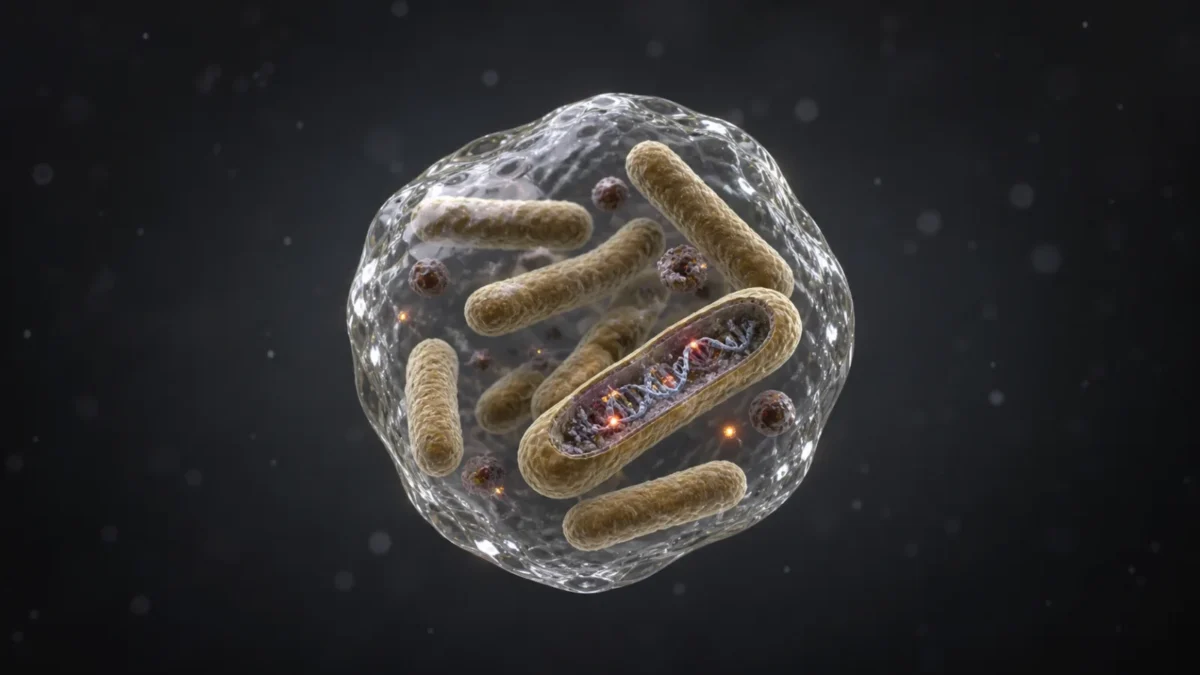
Experiments with Mycobacterium tuberculosis and an analysis of 51,229 clinical genomes indicate that drying during airborne transmission damages bacterial DNA and activates repair processes that may help some rifampin-resistant strains survive.
Published: August 30, 2026, 11:25 p.m. PKT · Reporting cutoff: August 30, 2026, 11:15 p.m. PKT
What you need to know
- Researchers recreated drying and rehydration conditions experienced by airborne tuberculosis bacteria.
- Desiccation produced oxidative stress, DNA damage and double-strand breaks.
- The bacteria activated repair pathways that supported survival but could also generate genetic variation.
- Silencing the repair factor Mfd reduced survival of bacteria carrying a common rifampin-resistance mutation during aerosolization tests.
- The study identifies a possible future drug target; it did not test an Mfd-blocking treatment in patients.
Tuberculosis does not simply ride through the air unchanged. As an infected person breathes, speaks or coughs, bacteria-containing droplets evaporate into much smaller airborne particles. The new study suggests that this drying stage is biologically active: it stresses the bacteria, damages their DNA and forces them to repair themselves.
That repair can be lifesaving for the microbe. It can also introduce variation. The findings connect a poorly understood phase of tuberculosis transmission with the evolution and survival of drug-resistant strains.
What drying did to tuberculosis bacteria
The Weill Cornell Medicine-led team placed bacteria on a filter platform and exposed them to different humidity conditions, then examined their responses during desiccation and rehydration. Drying increased oxidative stress and produced oxidative DNA damage and double-strand breaks.
The bacteria responded by switching on repair programs. These mechanisms helped cells recover when moisture returned, supporting the idea that M. tuberculosis has adaptations for the harsh transition between human hosts.
DNA repair is not perfectly error-free. Damage followed by repair can create mutations, providing raw material for bacterial evolution. The study therefore proposes that airborne transmission may be one period in which tuberculosis populations diversify.
Why the Mfd protein attracted attention
The researchers focused on Mfd, a transcription-coupled repair factor. Its expression increased during drying, and experiments suggested that it buffered the biological cost of some mutations in rpoB, the gene encoding the target of rifampin.
Rifampin is a cornerstone of standard tuberculosis treatment. Certain rpoB mutations prevent the drug from binding effectively, but resistance can impose other costs on bacterial fitness. Mfd may help some resistant strains tolerate those costs during transmission.
When the team reduced Mfd activity during aerosolization experiments, survival fell specifically among bacteria carrying the common S450L rifampin-resistance allele. An analysis of 51,229 genomes from clinical isolates provided population-level support: strains with mutations affecting Mfd were less likely to contain that common resistance allele.
What the study does not prove
The experiments show that desiccation can increase DNA damage and the appearance of rifampin-resistant mutants under controlled conditions. They do not establish that every airborne bacterium becomes more dangerous or that transmission is the dominant source of drug resistance in patients.
Resistance also emerges under antibiotic selection when treatment is inadequate or incomplete, and it can spread when resistant strains pass between people. The new mechanism may contribute to that larger problem; it does not replace existing explanations.
Mfd is a research target, not an approved medicine. A future inhibitor would have to reach bacteria safely, avoid harmful effects on patients and demonstrate that blocking this pathway improves clinical outcomes.
How other headlines framed the research
- Weill Cornell Medicine emphasized transmission as a possible point for future prevention strategies.
- Phys.org foregrounded mutation during drying and the possibility of curbing drug resistance.
Why the finding matters
Tuberculosis causes illness on a global scale, and drug-resistant disease requires longer, more complex treatment. Transmission has often been treated as a physical journey between hosts. Understanding it as a biological stress test may reveal vulnerabilities that conventional drug discovery has overlooked.
Bottom line: drying can damage tuberculosis DNA and activate repair pathways associated with survival and rifampin resistance. The mechanism is credible and important, but stopping it in patients remains an untested goal.
Sources
- Brown et al., “Desiccation promotes DNA damage and rifampin resistance in Mycobacterium tuberculosis,” Nature Microbiology, August 26, 2026.
- Weill Cornell Medicine research release.
- World Health Organization, Global Tuberculosis Report 2025.
Editorial disclosure: The lead image is a biomedical concept illustration, not a microscope image of the experiment or a patient sample. SciQuest received no payment to cover this research. This article is informational and is not medical advice. To report a possible error, contact SciQuest.