
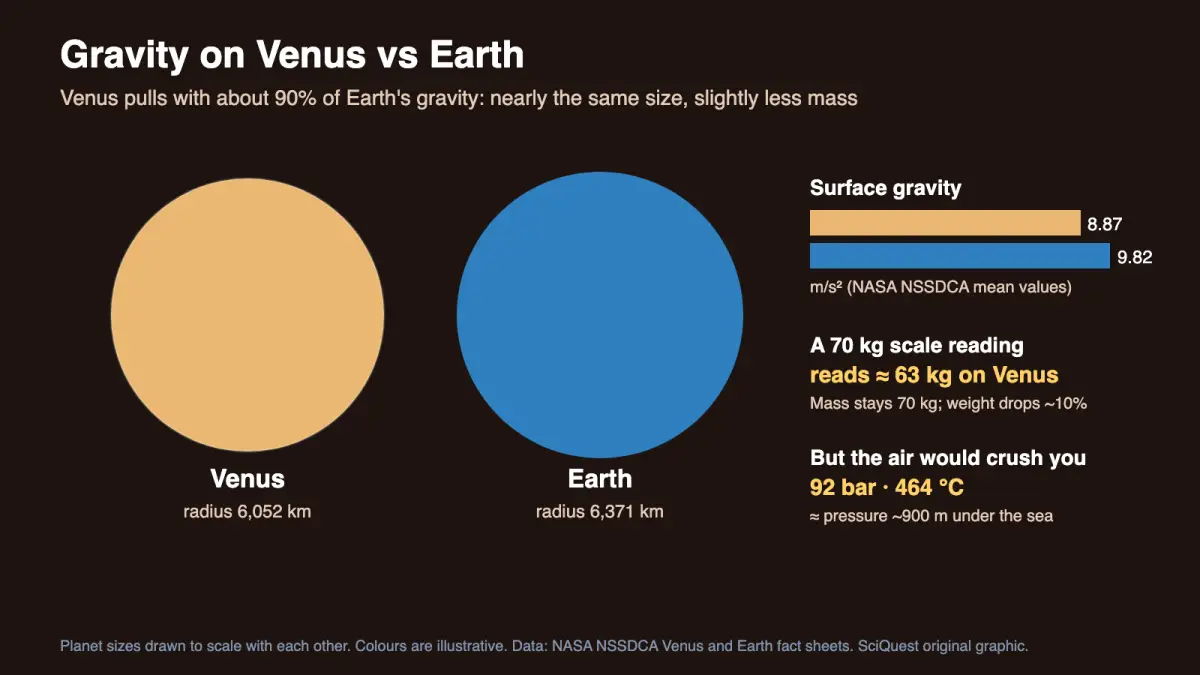
Venus is almost Earth’s twin in size, so you would weigh only about 10% less there, but its 92-bar atmosphere and 464 °C heat would make standing on it impossible.
Gravity on Venus is about 8.87 m/s², or 90.3% of Earth’s, according to NASA’s Venus fact sheet. A person who weighs 70 kg on a bathroom scale on Earth would see about 63 kg on the same scale on Venus.
Your mass would not change at all. Only your weight would, because weight is the force gravity exerts on your mass.
Explain it like I’m busy:
- Venus’s surface gravity is 8.87 m/s², about 0.9 of Earth’s.
- That’s because Venus has about 81.5% of Earth’s mass and 95% of its radius.
- Gravity would feel almost normal, but the air pressure is 92 times Earth’s.
Key facts
- Surface gravity: 8.87 m/s² (Earth: 9.82 m/s² mean), ratio 0.903 (NASA NSSDCA).
- Mass: 4.8673 × 10²⁴ kg, about 81.5% of Earth’s.
- Mean radius: 6,051.8 km, about 95% of Earth’s.
- Escape velocity: 10.36 km/s, compared with Earth’s 11.19 km/s.
- Surface conditions: 92 bar pressure and a mean temperature of 464 °C.
What 8.87 m/s² means
Drop a ball near Venus’s surface and, ignoring the thick air, it would gain about 8.87 m/s of downward speed every second. On Earth it gains about 9.8 m/s each second.
Imagine carrying a full backpack and taking out one textbook. You would notice the difference, but it would still feel like a heavy backpack. That is roughly how a 10% drop in gravity would feel. The comparison has a limit: on Venus the dense air would also push back on every movement, a little like wading through water.
How scientists know Venus’s gravity
The calculation
Surface gravity comes from Newton’s law of gravitation:
g = GM/R²
Here G is the gravitational constant (6.674 × 10⁻¹¹ m³ kg⁻¹ s⁻²), M is Venus’s mass and R its radius. Using NASA’s values:
g = (6.674 × 10⁻¹¹ × 4.8673 × 10²⁴) ÷ (6.0518 × 10⁶)² = 3.248 × 10¹⁴ ÷ 3.662 × 10¹³ ≈ 8.87 m/s².
Why it is a little weaker than Earth’s
Two effects partly cancel each other. Venus has less mass, which lowers gravity. It is also smaller, which puts you closer to its centre and raises gravity. The mass effect wins:
0.815 (mass ratio) ÷ 0.950² (radius ratio squared) ≈ 0.815 ÷ 0.903 ≈ 0.90.
Measured from orbit
Scientists measure the mass of a planet by tracking how spacecraft move around it. NASA’s Magellan orbiter reached Venus on August 10, 1990. After mapping 98% of the surface with radar, it spent its fourth, fifth and sixth mapping cycles gathering gravity data, before it was sent into the atmosphere on October 13, 1994. Following its orbit closely showed how Venus’s gravity changes from place to place.
How much would you weigh on Venus?
| Earth scale reading | Same scale on Venus | Mass on both worlds |
|---|---|---|
| 30 kg / 66 lb | 27.1 kg / 59.6 lb | 30 kg |
| 60 kg / 132 lb | 54.2 kg / 119.2 lb | 60 kg |
| 70 kg / 154 lb | 63.2 kg / 139.1 lb | 70 kg |
| 90 kg / 198 lb | 81.3 kg / 178.8 lb | 90 kg |
Calculated by SciQuest by multiplying each Earth reading by NASA’s Venus/Earth gravity ratio of 0.903. A scale shows force, not mass, so these readings assume a scale calibrated on Earth. Buoyancy in Venus’s dense air would lower the reading very slightly.
What changes the answer
- Which “Earth” number you use: NASA’s mean Earth value is 9.82 m/s², while standard gravity is defined as 9.80665 m/s². Either way the ratio stays about 0.90.
- Location on Venus: gravity is slightly lower on highlands such as Ishtar Terra and varies above dense regions underground.
- Rotation: Venus turns once every 243 Earth days, and backwards compared with most planets. That spin is so slow it has almost no effect on surface gravity, unlike Earth’s faster spin.
How Venus compares
Venus’s gravity is in the same league as Earth’s. Mars has only 38% of Earth’s gravity and the Moon about 16.5%. Uranus has almost exactly the same value as Venus, 8.87 m/s², though as a giant planet with no solid surface its gravity is measured at the level where the air pressure equals 1 bar. Compare every world in our guide to gravity on other planets and moons.
Why it matters to you
This won’t change anything in your daily life, but it shows how gravity and habitability are separate questions. Venus has almost Earth-like gravity, so human bodies would cope with it far better than with Mars’s low gravity. What makes it hostile is its atmosphere. It is mostly carbon dioxide, about 92 times Earth’s surface pressure, with a mean surface temperature of 464 °C.
That pressure is about what you would feel roughly 900 m underwater in the ocean. NASA notes that the longest-lasting lander on the surface survived about two hours. Gravity was never the problem.
“But wait… if gravity is almost the same, why is Venus’s atmosphere so different?”
Gravity helps a planet hold on to gas, and Venus’s escape velocity of 10.36 km/s is strong enough to keep a thick atmosphere. But gravity does not decide what that atmosphere is made of. NASA describes a runaway greenhouse effect that traps heat in Venus’s thick carbon dioxide atmosphere, and says Venus, like Earth, probably had oceans when it was younger. Exactly how and when that water was lost is still being studied, and NASA’s future VERITAS mission includes a gravity science investigation that should help map Venus’s interior.
Related questions
Is gravity on Venus stronger than on Mars? Yes, about 2.4 times stronger: 8.87 m/s² against 3.73 m/s². See gravity on Mars.
How strong is gravity on the Moon? About 1.62 m/s², or one-sixth of Earth’s. See gravity on the Moon.
In one sentence
Gravity on Venus is about 90% of Earth’s, so you would feel almost at home on your feet. The crushing, scorching atmosphere is what makes the planet deadly.
Quick check: did it click?
- What is Venus’s surface gravity? About 8.87 m/s², or 0.9 of Earth’s.
- Would your mass change on Venus? No. Only your weight changes, by about 10%.
- Why is Venus’s gravity weaker than Earth’s if it is also smaller? It has only 81.5% of Earth’s mass, and that outweighs the effect of its slightly smaller radius.
Read next
Disclosure: This article was drafted with AI assistance and checked by the SciQuest editor against the sources below. Weight conversions and the gravity calculation are SciQuest calculations from NASA data. The graphic is an original SciQuest illustration. Spotted an error? See our corrections policy.
Sources
- NASA NSSDCA, Venus Fact Sheet
- NASA NSSDCA, Earth Fact Sheet
- NASA NSSDCA, Planetary Fact Sheet (Mars, Moon and Uranus gravity)
- NASA Science, Venus Facts
- NASA Science, Magellan mission
- NASA Science, VERITAS mission
- NIST, CODATA value: Newtonian constant of gravitation
Discover more from SciQuest
Subscribe to get the latest posts sent to your email.
Leave a comment