
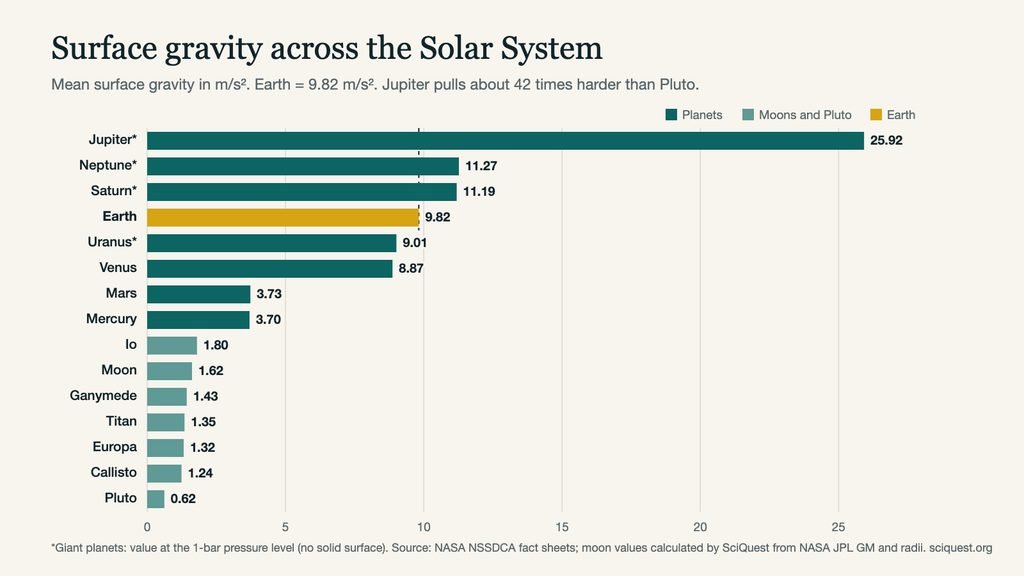
Surface gravity in the Solar System ranges from about 0.62 m/s² on Pluto, roughly 6% of Earth’s, to about 25.9 m/s² at Jupiter’s cloud-top reference level, about 2.6 times Earth’s 9.82 m/s². Every other planet and large moon falls between those two values.
Some results surprise people. Saturn, Uranus and Neptune have surface gravity close to Earth’s, despite being 14 to 95 times more massive. Mercury and Mars pull almost equally hard, although Mars has about twice Mercury’s mass. Among the large moons listed here, Io has the strongest surface gravity, not Ganymede, the largest.
Key facts about planetary gravity
- Strongest: Jupiter, 25.92 m/s² (2.64 g) at the 1-bar pressure level, using NASA’s mean value.
- Weakest in the table: Pluto, 0.62 m/s² (0.063 g).
- Closest to Earth: Uranus (0.918 g) and Venus (0.903 g).
- Mercury and Mars are near twins: 3.70 and 3.73 m/s², a difference of less than 1%.
- Mass stays the same everywhere. Only weight, the gravitational force on that mass, changes from world to world.
Surface gravity of every planet and major moon
The table lists the mean surface gravity calculated from each body’s mass and mean radius, as published in NASA’s planetary fact sheets. For the four giant planets, which have no solid surface, the value applies at the level where atmospheric pressure is 1 bar. The final column gives NASA’s equatorial value, which includes the slight outward effect of the planet’s spin. On a narrow screen, swipe the table sideways to see every column.
| World | Type | Mean surface gravity (m/s²) | Compared with Earth (g) | At the equator, including rotation (m/s²) |
|---|---|---|---|---|
| Jupiter | Gas giant (1-bar level) | 25.92 | 2.640 | 23.12 |
| Neptune | Ice giant (1-bar level) | 11.27 | 1.15 | 11.00 |
| Saturn | Gas giant (1-bar level) | 11.19 | 1.140 | 8.96 |
| Earth | Rocky planet | 9.82 | 1.000 | 9.78 |
| Uranus | Ice giant (1-bar level) | 9.01 | 0.918 | 8.69 |
| Venus | Rocky planet | 8.87 | 0.903 | 8.87 |
| Mars | Rocky planet | 3.73 | 0.380 | 3.69 |
| Mercury | Rocky planet | 3.70 | 0.378 | 3.70 |
| Io (Jupiter) | Moon | 1.80 | 0.183 | Not listed |
| Moon (Earth) | Moon | 1.62 | 0.165 | Not listed |
| Ganymede (Jupiter) | Moon | 1.43 | 0.145 | Not listed |
| Titan (Saturn) | Moon | 1.35 | 0.138 | Not listed |
| Europa (Jupiter) | Moon | 1.32 | 0.134 | Not listed |
| Callisto (Jupiter) | Moon | 1.24 | 0.126 | Not listed |
| Pluto | Dwarf planet | 0.62 | 0.063 | Not listed |
Source: planet, Moon and Pluto values from the NASA NSSDCA fact sheets, including NASA’s Earth ratios. Values for Io, Europa, Ganymede, Callisto and Titan were calculated by SciQuest as g = GM/R², using GM and mean radius from NASA JPL’s satellite physical parameters, then divided by Earth’s mean 9.82 m/s². NASA’s fact sheets give Uranus 0.918 g and Neptune 1.15 g; the other giant-planet ratios are shown to three decimals.
The ranking changes slightly with the definition. On the mean value, Neptune edges past Saturn. At the equator, Saturn’s fast spin and pronounced bulge cut its value to 8.96 m/s², below Earth’s.
How is surface gravity calculated?
Surface gravity is the acceleration a freely falling object would have at the surface. For a round, non-rotating body it follows from Newton’s law of gravitation:
g = GM/R²
G is the gravitational constant, 6.6743 × 10⁻¹¹ m³ kg⁻¹ s⁻²; M is the body’s mass; and R is its radius. Gravity grows with mass but falls with the square of the distance from the centre.
Worked example for Mars:
- M = 6.4169 × 10²³ kg, so GM = 6.6743 × 10⁻¹¹ × 6.4169 × 10²³ ≈ 4.283 × 10¹³ m³/s²
- R = 3,389.5 km = 3.3895 × 10⁶ m, so R² ≈ 1.1489 × 10¹³ m²
- g = 4.283 × 10¹³ ÷ 1.1489 × 10¹³ ≈ 3.73 m/s²
That matches NASA’s published mean value. The same formula explains the Mercury–Mars puzzle. Mars has 1.94 times Mercury’s mass, but its radius is 1.39 times larger, and 1.39² ≈ 1.93. The two effects almost cancel, leaving Mars only about 0.7% stronger. Mercury’s high density, about 5,430 kg/m³ compared with 3,930 kg/m³ for Mars, packs its smaller mass closer to the centre.
For a detailed single-world example, see SciQuest’s explainer on how strong gravity is on the Moon, which works through the same calculation with lunar values.
Why is “surface” gravity on Jupiter measured at 1 bar?
Jupiter, Saturn, Uranus and Neptune have no solid ground to stand on. NASA notes that their true surfaces lie deep in the atmosphere at unknown depths and pressures. Scientists therefore use a convention: radius, gravity and escape velocity are quoted at the altitude where atmospheric pressure is 1 bar.
One bar is close to Earth’s average surface pressure, which NASA lists as 1,014 millibars. The 1-bar level is a reference point for comparison, not a place where a person or spacecraft could stand. An object released there would keep falling into denser, hotter layers.
The giant planets’ modest surface gravity follows from their size. Saturn has 95 times Earth’s mass, but its 1-bar level lies more than nine Earth radii from its centre. Distance cancels most of the extra mass.
Why do sources give different numbers for Jupiter and Saturn?
Search results often quote Jupiter at 24.79 m/s² and Saturn at 10.44 m/s². Those values are correct, but they use a different definition from the table above. Three conventions are common:
| Definition | Jupiter (m/s²) | Saturn (m/s²) | Mars (m/s²) | Where it appears |
|---|---|---|---|---|
| GM ÷ (mean radius)², no rotation | 25.92 | 11.19 | 3.73 | NASA NSSDCA “mean” gravity |
| GM ÷ (equatorial radius)², no rotation | 24.79 | 10.44 | 3.71 | NASA JPL “equatorial gravity” |
| Effective equatorial value, including rotation | 23.12 | 8.96 | 3.69 | NASA NSSDCA “acceleration (eq.)” |
Source: NASA NSSDCA planetary fact sheets; NASA JPL Solar System Dynamics, Planetary Physical Parameters. SciQuest checked the first two rows by recalculating GM/R² from the published GM and radii.
The spread is largest for the fast-spinning giants. Jupiter rotates once every 9.93 hours and Saturn every 10.66 hours, so their equators bulge outward and the spin partly offsets gravity there. Saturn is flattened by almost 10%. For slowly rotating Venus, all three definitions give essentially the same 8.87 m/s². When comparing worlds, use one definition consistently. Mixing them can reverse close rankings, such as Saturn versus Earth.
SciQuest’s dedicated pages explain Jupiter’s gravity and Saturn’s gravity in more detail.
Mass vs weight: how much would a 70 kg person weigh on each world?
Your mass, the amount of matter in your body, is the same everywhere. Your weight is the force gravity exerts on that mass, measured in newtons (N):
Weight = mass × g
A bathroom scale is calibrated for Earth, so it converts force into kilograms. On another world it would show your mass multiplied by that world’s g ratio. For a 70 kg person on Mars, weight is 70 kg × 3.73 m/s² ≈ 261 N, and an Earth-calibrated scale would read 70 × 0.380 ≈ 26.6 kg.
| World | Weight of a 70 kg person (N) = 70 × g | Earth-calibrated scale reading (kg) = 70 × ratio |
|---|---|---|
| Jupiter (1-bar level) | 1,814 | 184.8 |
| Neptune (1-bar level) | 789 | 80.4 |
| Saturn (1-bar level) | 783 | 79.8 |
| Earth | 687 | 70.0 |
| Uranus (1-bar level) | 631 | 64.3 |
| Venus | 621 | 63.2 |
| Mars | 261 | 26.6 |
| Mercury | 259 | 26.5 |
| Io | 126 | 12.8 |
| Moon | 113 | 11.6 |
| Ganymede | 100 | 10.2 |
| Titan | 95 | 9.7 |
| Europa | 92 | 9.4 |
| Callisto | 87 | 8.8 |
| Pluto | 43 | 4.4 |
Calculated by SciQuest from the mean gravity values and Earth ratios in the first table, rounded. The Neptune reading uses 11.27 ÷ 9.82 = 1.148. At Jupiter’s equator, using the 23.12 m/s² value that includes rotation, the weight would be about 1,618 N, equal to a scale reading of about 165 kg.
Lower gravity changes weight, not inertia. On Mars, at 38% of Earth’s gravity, a 70 kg astronaut and their equipment would weigh far less, but their mass would still resist starting, stopping and turning exactly as on Earth.
Which world has the strongest and weakest gravity?
Among the planets, Jupiter has the strongest surface gravity by every definition: 23.1 to 25.9 m/s². Mercury and Mars have the weakest, at about 3.7 m/s². Pluto, a dwarf planet, is far lower still at 0.62 m/s².
Earth’s Moon ranks second among the large moons in the table, behind Io. Ganymede and Titan are both larger than Mercury, but their low densities, about 1,940 and 1,880 kg/m³, give them only 1.43 and 1.35 m/s². NASA describes both as having rocky interiors wrapped in thick shells of water ice, which is far less dense than rock and metal.
For scale beyond the planets, NASA lists the Sun’s equatorial surface gravity as 274.0 m/s², 28 times Earth’s.
What these numbers do not show
Each value is an average. Real gravity varies with location. It is lower on mountaintops, differs between poles and equator on rotating worlds, and changes over dense regions underground. NASA’s GRAIL mission mapped such buried mass concentrations, or “mascons,” beneath lunar impact basins.
Surface gravity also does not decide by itself whether a world keeps an atmosphere. Titan has less gravity than our Moon, yet NASA reports a mostly nitrogen atmosphere with a surface pressure about 60% greater than Earth’s. Temperature and the mass of gas molecules matter as well. Finally, the five outer-moon values are SciQuest calculations from published masses and radii, not figures NASA lists directly, although they rest on the same JPL data.
Related reading
- How big is the Moon compared with other moons in the Solar System?
- Jupiter vs the Sun: how many Jupiters fit inside the Sun?
- Is Europa habitable?
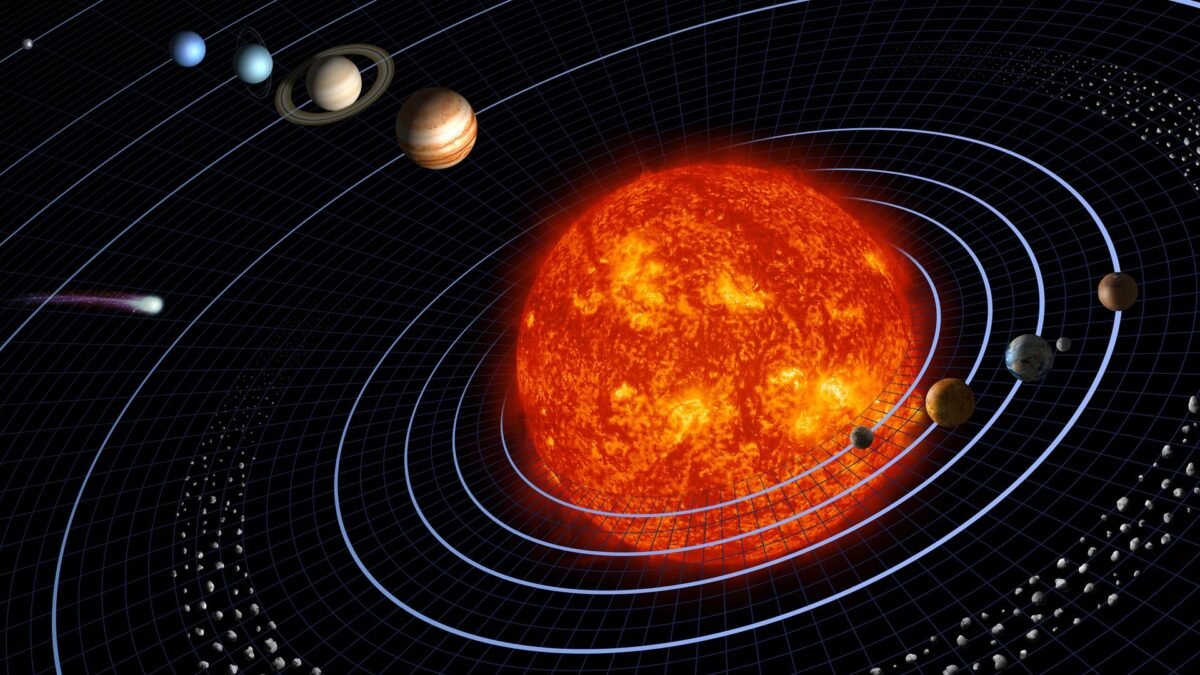
Update note: This article was first published on October 12, 2026. It was drafted with AI assistance and checked against the sources listed below; moon gravity values and weight comparisons were calculated by SciQuest from those sources. The featured image is a NASA/JPL illustration (PIA11800), not to scale.
Sources
- NASA NSSDCA, Planetary Fact Sheet – Metric
- NASA NSSDCA, Planetary Fact Sheet Notes
- NASA NSSDCA fact sheets: Mercury, Venus, Earth, Moon, Mars, Jupiter, Saturn, Uranus, Neptune, Pluto, Sun
- NASA NSSDCA, Jovian Satellite Fact Sheet and Saturnian Satellite Fact Sheet
- NASA JPL Solar System Dynamics, Planetary Satellite Physical Parameters
- NASA JPL Solar System Dynamics, Planetary Physical Parameters
- NIST, CODATA value: Newtonian constant of gravitation
- NASA JPL, NASA’s GRAIL Mission Solves Mystery of Moon’s Surface Gravity
- NASA Science, Titan: Facts and Ganymede
- NASA/JPL, PIA11800: Our Solar System Features Eight Planets (featured image)
Discover more from SciQuest
Subscribe to get the latest posts sent to your email.
Leave a comment