
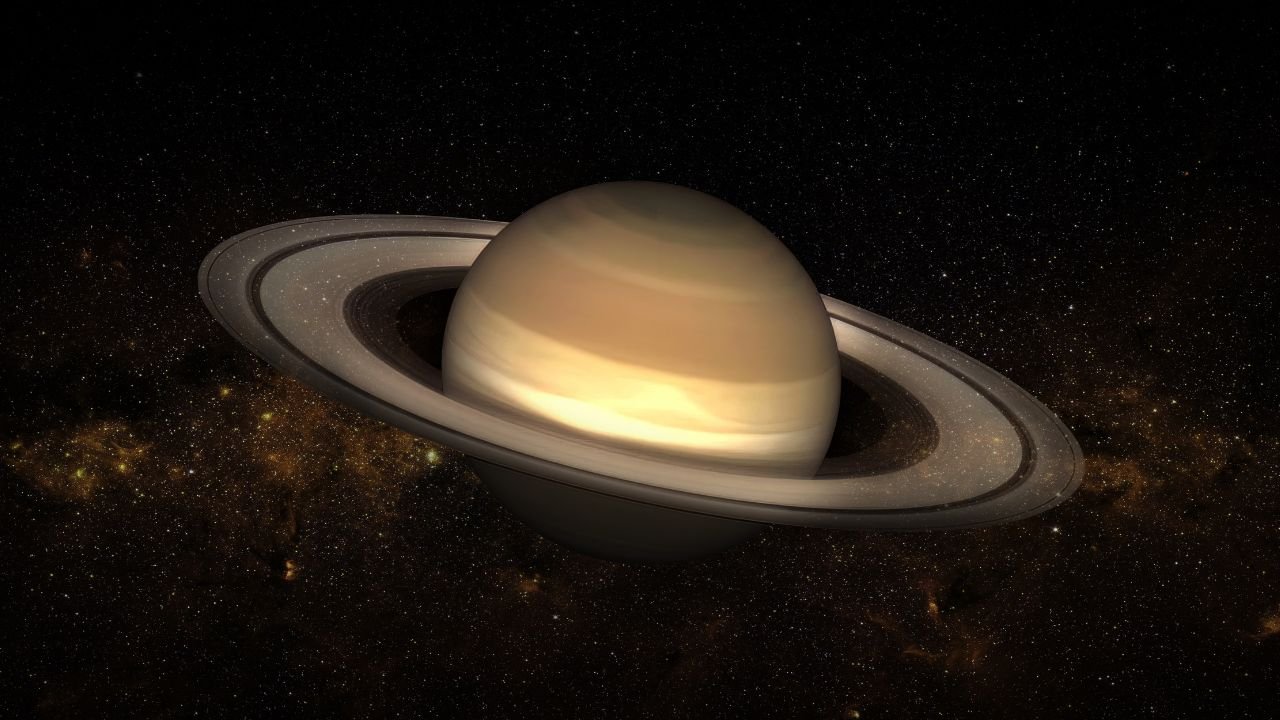
Gravity on Saturn is close to Earth’s: about 9.0 m/s² at the equator (0.92 times Earth’s) and 12.1 m/s² at the poles (1.24 times), with a mean of 11.2 m/s², according to NASA. The figure most often quoted, 10.44 m/s², is about 1.065 times Earth’s gravity.
Saturn has no solid surface, so these values apply where the atmospheric pressure is 1 bar. That near-Earth gravity is surprising for a planet with 95 times Earth’s mass. The answer lies in Saturn’s huge size and rapid spin.
Key facts about Saturn’s gravity
- Mean gravity at 1 bar: 11.19 m/s², or 1.14 times Earth’s mean of 9.82 m/s².
- Equator vs poles: 8.96 m/s² at the equator and 12.14 m/s² at the poles. Gravity is about 35% stronger at the poles.
- Mass and size: 95.2 times Earth’s mass, but 9.14 times Earth’s mean radius.
- Shape: the most flattened planet; its polar radius is 9.8% shorter than its equatorial radius.
- Escape velocity: 35.5 km/s, 3.2 times Earth’s.
Is Saturn’s gravity stronger than Earth’s?
It depends on where you measure it. Averaged over the planet, Saturn’s gravity at the 1-bar level is about 14% stronger than Earth’s. Near the poles it is about 24% stronger. At the equator, however, it is about 8% weaker than Earth’s equatorial gravity.
Either way, the difference is small. A person floating at Saturn’s 1-bar level would feel roughly as heavy as on Earth, somewhat lighter near the equator and somewhat heavier near the poles. Compare that with Jupiter, where gravity is 2.4 to 2.7 times Earth’s.
What does “surface gravity” mean on Saturn?
NASA notes that Saturn, as a gas giant, has no true surface. It is mostly hydrogen and helium, and its atmosphere gets denser and hotter with depth.
By convention, scientists quote the giant planets’ radius, gravity and escape velocity at the altitude where pressure is 1 bar, close to Earth’s sea-level air pressure. It is a reference level, not a floor. A dropped object there would keep falling into denser layers rather than hitting the ground.
Why do sources give 9.0, 10.44 or 11.19 m/s²?
| Definition (1-bar level) | Saturn (m/s²) | Earth, same definition (m/s²) | Saturn ÷ Earth |
|---|---|---|---|
| At the equator, including rotation | 8.96 | 9.78 | 0.916 |
| At the equator, ignoring rotation | 10.44 | 9.80 | 1.065 |
| Mean: GM ÷ (mean radius)², ignoring rotation | 11.19 | 9.82 | 1.140 |
| At the poles | 12.14 | 9.83 | 1.235 |
Sources: NASA NSSDCA Saturn and Earth fact sheets (equatorial with rotation, mean and polar rows); NASA JPL Solar System Dynamics, Planetary Physical Parameters (equatorial without rotation). Ratios calculated by SciQuest.
The 10.44 m/s² value from NASA JPL is the source of the common “1.065 times Earth” answer. It treats Saturn as if it did not spin. NASA’s current fact sheet leads with 9.0 m/s² at the equator including rotation, which is why it lists Saturn at 0.916 times Earth’s gravity. All of these numbers are valid; they simply answer slightly different questions.
How is Saturn’s gravity calculated?
For a non-rotating sphere:
g = GM/R²
G is the gravitational constant, M is the planet’s mass and R is the distance from its centre. NASA gives Saturn’s GM as 3.7931 × 10¹⁶ m³/s², equivalent to a mass of 5.683 × 10²⁶ kg.
- Mean radius: R = 58,232 km = 5.8232 × 10⁷ m, so R² ≈ 3.3910 × 10¹⁵ m²
- g = 3.7931 × 10¹⁶ ÷ 3.3910 × 10¹⁵ ≈ 11.19 m/s²
Comparing Saturn with Earth shows why 95 times the mass yields only slightly more gravity:
Mass ratio ÷ (radius ratio)² = 95.16 ÷ (9.140)² = 95.16 ÷ 83.54 ≈ 1.14
At the 1-bar level you are about nine times farther from Saturn’s centre than from Earth’s, and gravity falls with the square of that distance. Saturn is so large for its mass because its mean density is only 687 kg/m³, lower than water’s 1,000 kg/m³. NASA puts it memorably: Saturn could float in a bathtub if such a colossal thing existed. That is a comparison of densities, not something that could physically happen.
Why is gravity weaker at Saturn’s equator than at its poles?
Saturn spins once about every 10.7 hours, so its equatorial cloud tops travel at nearly 10 km/s. That spin has two effects, both of which reduce gravity at the equator:
- Distance: spin has flattened the planet. The equatorial radius at 1 bar is 60,268 km, but the polar radius is only 54,364 km. Standing at the equator puts you about 5,900 km farther from the centre.
- Rotation: part of gravity’s pull is used to keep equatorial material moving in a circle. For Saturn that “spin effect,” ω²R, is about 1.6 m/s².
A simple estimate shows the scale: 10.44 m/s² for a sphere at the equatorial radius, minus 1.62 m/s² for the spin, plus about 0.26 m/s² for the extra mass in the equatorial bulge, gives roughly 9.1 m/s². NASA’s full calculation, which includes further terms, gives 8.96 m/s². At the poles there is no spin effect and you are closer to the centre, so gravity rises to 12.14 m/s².
NASA’s fact sheet gives Saturn a flattening of 0.098, larger than Jupiter’s 0.065 and the largest of any planet. Earlier versions of this page said objects would feel lighter at the poles; the reverse is true.
How much would you weigh on Saturn?
Your mass stays the same. Your weight, the gravitational force on that mass, changes with latitude:
| Mass | Weight on Earth (N) | Weight at Saturn’s equator (N) | Weight at Saturn’s poles (N) | Earth-calibrated scale reading, equator to pole |
|---|---|---|---|---|
| 60 kg (132 lb) | 588 | 538 | 728 | 54.8–74.3 kg (121–164 lb) |
| 75 kg (165 lb) | 735 | 672 | 910 | 68.5–92.8 kg (151–205 lb) |
| 90 kg (198 lb) | 883 | 806 | 1,093 | 82.2–111.4 kg (181–246 lb) |
Calculated by SciQuest with standard gravity (9.80665 m/s²) for Earth and NASA’s 1-bar values for Saturn of 8.96 m/s² (equator) and 12.14 m/s² (poles). Scale readings are mass × Saturn g ÷ 9.80665.
Using the popular 10.44 m/s² figure instead, a reading of 100 lb on Earth would become about 106.5 lb. The previous version of this page gave 108 lb, which overstated the ratio.
How many moons does Saturn’s gravity hold?
Saturn has 293 confirmed moons, according to NASA JPL’s list of officially recognised planetary satellites and NASA’s Saturn moons page, which gives the count as of August 2026. That is more than any other planet; JPL lists 115 for Jupiter. The total has risen quickly, from 274 in March 2025, the figure still shown on NASA’s Saturn fact sheet, as telescope surveys found more small moons.
Saturn’s gravity also holds its vast ring system in orbit. SciQuest explains what Saturn’s rings are made of and whether you could walk on them.
What did Cassini learn from Saturn’s gravity?
In 2017, during its final orbits, NASA’s Cassini spacecraft dived through the gap between Saturn and its innermost ring, 2,600 to 3,900 km above the cloud tops. On six of those passes, scientists tracked its radio signal from Earth to measure how Saturn and its rings pulled on it. Cassini’s mission ended on September 15, 2017, when it was deliberately sent into Saturn.
The results, published in Science in 2019 by L. Iess and colleagues, showed two things:
- Saturn’s gravity field requires winds that extend at least 9,000 km below the cloud tops.
- The rings have a total mass of about 1.54 × 10¹⁹ kg, with an uncertainty of ±0.49 × 10¹⁹ kg. That is about 0.41 times the mass of the small moon Mimas. The authors concluded that rings this light may have formed only 10 million to 100 million years ago. That age is an inference from the measured mass, not a direct measurement.
Spacecraft have also used Saturn’s gravity directly. Voyager 2 flew past Saturn on August 25–26, 1981, and gravity-assist manoeuvres sent it on to Uranus in 1986 and Neptune in 1989.
How does Saturn’s gravity compare with other worlds?
| World | Mean surface gravity (m/s²) | Compared with Earth (g) | Escape velocity (km/s) |
|---|---|---|---|
| Jupiter (1-bar level) | 25.92 | 2.64 | 59.5 |
| Saturn (1-bar level) | 11.19 | 1.14 | 35.5 |
| Earth | 9.82 | 1.00 | 11.19 |
| Mars | 3.73 | 0.380 | 5.03 |
| Moon | 1.62 | 0.165 | 2.38 |
Source: NASA NSSDCA fact sheets. Giant-planet values apply at the 1-bar pressure level, not at a solid surface.
Jupiter, the other gas giant, is the clearest contrast: see how strong gravity is on Jupiter. For rocky worlds, compare gravity on Mars and gravity on the Moon. Every planet appears in one table in our guide to gravity on other planets.
What scientists do not know yet
Even the length of Saturn’s day has been hard to pin down. Saturn has no surface features to track, and its magnetic field is almost perfectly aligned with its spin axis, so it does not wobble in a way that reveals the rotation. In 2019, a study by Christopher Mankovich used waves in the rings to estimate a day of 10 hours, 33 minutes and 38 seconds, several minutes shorter than the Voyager-era value of 10 hours, 39 minutes and 23 seconds. NASA’s fact sheet still uses the older rotation system. The faster value would make the equatorial spin effect about 2% larger, a small change to the 8.96 m/s² figure.
The age of the rings is also uncertain. Cassini’s low ring mass points to young rings, but the authors framed this as what the rings “may” be, because turning a mass into an age requires assumptions about how the rings have evolved.
Related reading
- When will Saturn’s rings disappear?
- Hubble’s view of the pattern at Saturn’s south pole
- Gravity on other planets: every planet compared
Update note: This article was substantially revised on October 12, 2026. We replaced the overstated 1.08× ratio with NASA’s equator, pole and mean values and explained the 1.065× figure; corrected the claim that Saturn feels lighter at the poles (it is lighter at the equator); updated Saturn’s moon count from “more than 80” to 293; corrected the unit “m/s” to m/s²; replaced a nonstandard equatorial diameter with NASA’s equatorial and polar radii; removed a truncated sentence and the incorrect claim that Cassini used Saturn for gravity assists; and added Cassini’s gravity results. It was drafted with AI assistance and checked against the sources listed below.
Sources
- NASA NSSDCA, Saturn Fact Sheet
- NASA NSSDCA, Earth Fact Sheet, Jupiter Fact Sheet and Planetary Fact Sheet
- NASA JPL Solar System Dynamics, Planetary Physical Parameters
- NASA JPL Solar System Dynamics, Planetary Satellite Discovery Circumstances
- NASA Science, Saturn Moons and Saturn Facts
- Iess, L., et al. (2019), Measurement and implications of Saturn’s gravity field and ring mass, Science 364:eaat2965
- NASA Science, Cassini mission
- NASA Science, Voyager 2
- NASA JPL, Scientists Finally Know What Time It Is on Saturn (2019)
Discover more from SciQuest
Subscribe to get the latest posts sent to your email.
Leave a comment