

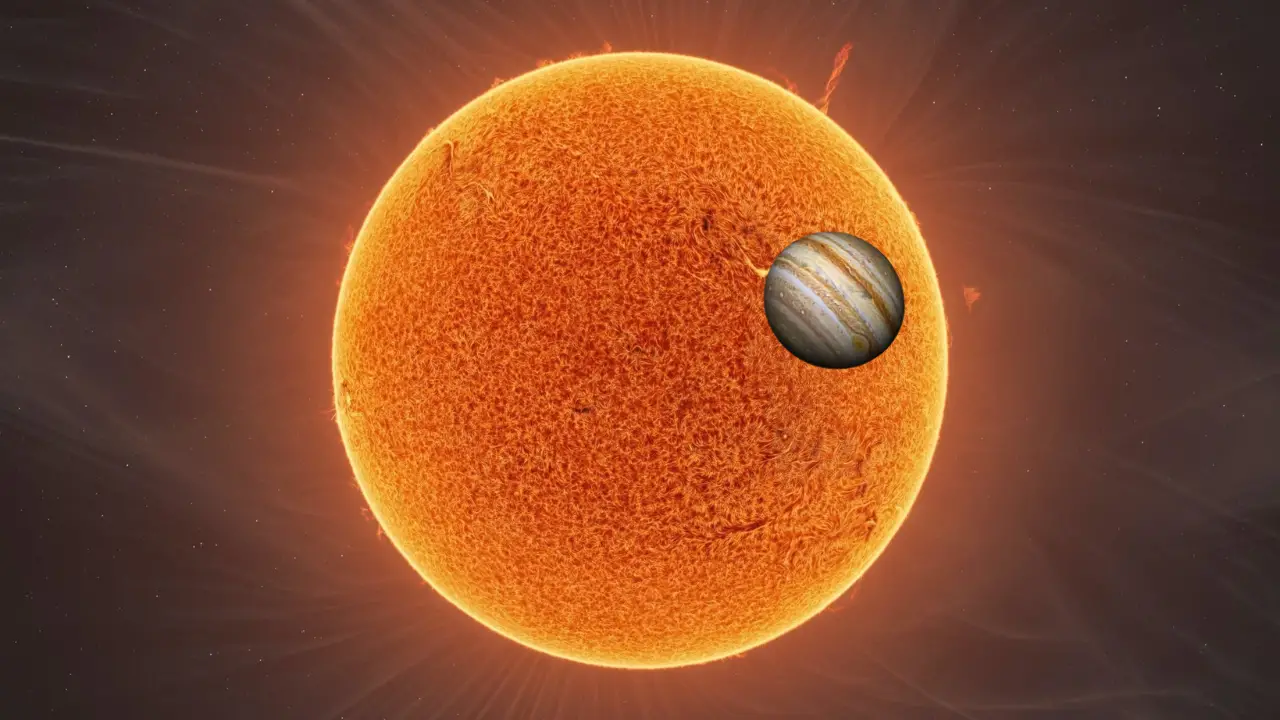
The Sun has roughly 1,000 times Jupiter’s volume. That is why the usual answer says about 1,000 Jupiters could fit inside the Sun. The number is a volume comparison, not a literal packing result: intact spheres leave gaps, so only roughly 600 to 700 whole Jupiters could actually be packed inside.
The Sun is about ten times Jupiter’s diameter and about 1,048 times its mass. Jupiter is enormous for a planet, but it remains tiny beside our star, which lies an average of 778.5 million kilometres (5.2 AU) away from it.
Jupiter and the Sun at a glance
| Property | Jupiter | Sun | Sun-to-Jupiter ratio |
|---|---|---|---|
| Mean radius (km) | 69,911 | 695,700 | About 10:1 |
| Approximate diameter (km) | 139,822 | About 1.39 million | About 10:1 |
| Volume (km³) | 1.43 × 10¹⁵ | 1.41 × 10¹⁸ | About 987:1 |
| Mass (kg) | 1.898 × 10²⁷ | 1.988 × 10³⁰ | About 1,048:1 |
| Mean density (kg/m³) | 1,326 | 1,408 | About 1.06:1 |
Source: NASA NSSDCA Jupiter and Sun fact sheets (volumetric mean radii and volumes). Values are rounded, and the exact ratio changes slightly with the adopted reference radius. Jupiter rotates rapidly and is wider at its equator (71,492 km radius at the 1-bar level) than from pole to pole.
The volume calculation
The volume of a sphere is:
V = 4/3 × π × r³
When comparing two spheres, the shared constants cancel:
Sun/Jupiter volume ratio = (Sun radius ÷ Jupiter radius)³
Using NASA’s rounded Sun radius of 700,000 km and Jupiter’s mean radius of 69,911 km:
(700,000 ÷ 69,911)³ ≈ 1,004
Using the more precise solar radius of 695,700 km produces a ratio of about 985, and dividing NASA’s published volumes directly (1.412 × 10¹⁸ km³ ÷ 1.431 × 10¹⁵ km³) gives about 987. All of these support the appropriately rounded answer: about 1,000 Jupiter volumes equal the Sun’s volume.
Why does a tenfold radius become a thousandfold volume?
Volume grows with the cube of radius. If a sphere is ten times wider in radius, its volume is:
10 × 10 × 10 = 1,000 times greater
That cubic relationship is the central idea. The Sun does not need to be hundreds of times wider than Jupiter to hold roughly a thousand times its volume.
Could 1,000 intact Jupiters literally fit?
No. The simple calculation treats Jupiter’s material as if it could fill the Sun’s entire volume without gaps. Intact spherical Jupiters arranged inside a spherical boundary would leave empty spaces between them, especially near the curved outer edge.
Two packing limits from mathematics and physics give a defensible range:
- Best possible arrangement: The densest packing of equal spheres, achieved by face-centred cubic stacking, fills π/√18 ≈ 74.05% of space. Mathematician Thomas Hales proved that no arrangement can do better.
- Random arrangement: Equal spheres poured in at random and shaken settle at random close packing, about 63–64% of space in experiments and theory.
Applying those fractions to a volume ratio of about 987:
987 × 0.64 ≈ 630 Jupiters (random close packing)
987 × 0.7405 ≈ 730 Jupiters (densest lattice packing)
These are estimates, and both are upper limits. They assume an unlimited volume; inside the Sun’s curved boundary, spheres near the edge waste extra space, so a true count for a finite sphere would be somewhat lower. A reasonable answer is roughly 600 to 700 intact Jupiters.
In reality, neither body has a solid boundary. Jupiter is a gas giant with no solid surface, while the visible “surface” of the Sun is a layer called the photosphere. Putting Jupiters into the Sun is a scale analogy, not a physically possible arrangement.
Is the Sun 1,000 times heavier than Jupiter?
The mass ratio is similar but not identical to the volume ratio. The Sun is about 1,048 times more massive than Jupiter.
This does not mean they have equal average density. Jupiter’s average density is about 1.33 grams per cubic centimetre, while the Sun’s average density is about 1.41 grams per cubic centimetre. Their internal structures are also radically different.
The Sun contains about 99.8% of the Solar System’s mass. NASA says Jupiter holds more than twice the combined material of the Solar System’s other planets and smaller bodies, yet only about one-thousandth of the Sun’s mass. That mass also gives Jupiter the strongest surface gravity of any planet, as SciQuest’s guide to Jupiter’s gravity explains.
How many Jupiters fit across the Sun?
Only about ten Jupiter diameters span the Sun’s diameter: 1,391,400 km ÷ 139,822 km ≈ 9.95. “Across” is a one-dimensional comparison; “inside” normally refers to volume.
This distinction explains why both of these statements can be correct:
- About 10 Jupiters fit side by side across the Sun.
- About 1,000 Jupiter volumes equal the Sun’s volume.
How far is Jupiter from the Sun?
Jupiter orbits the Sun at an average distance of 778.5 million kilometres (about 484 million miles), or 5.2 astronomical units (AU). One AU is roughly Earth’s average distance from the Sun.
Jupiter’s orbit is slightly elliptical, so the distance changes over its 11.9-year orbit:
| Orbital point | Distance (million km) | Distance (AU) | Sunlight travel time (minutes) |
|---|---|---|---|
| Closest (perihelion) | 740.6 | 4.95 | 41.2 |
| Average (semimajor axis) | 778.5 | 5.20 | 43.3 |
| Farthest (aphelion) | 816.4 | 5.46 | 45.4 |
Source: NASA NSSDCA Jupiter Fact Sheet. AU values calculated by SciQuest as distance ÷ Earth’s semimajor axis of 149.598 million km; light-travel times calculated as distance ÷ 299,792.458 km/s.
At that distance the Sun would look much smaller from Jupiter than from Earth: about one-fifth as wide in the sky, because apparent size falls in proportion to distance.
Could Jupiter ever become a star?
No, not at its current mass. Jupiter is made mostly of hydrogen and helium, like the Sun, but NASA notes that it did not grow massive enough to ignite.
NASA describes brown dwarfs, the objects between giant planets and the smallest stars, as having generally between 13 and 80 times Jupiter’s mass and lacking enough mass to sustain the hydrogen fusion that powers stars. Jupiter would therefore need roughly 80 times its current mass to become a true star. SciQuest’s explainer on the life cycle of a star describes what happens once fusion does begin.
How does Earth add to the comparison?
NASA’s fact sheets give the Sun about 1,304,000 Earth volumes and Jupiter about 1,321 Earth volumes. Dividing those figures again gives about 987 Jupiters per Sun. SciQuest’s separate explainer covers how many Earths fit inside the Sun.
These are volume equivalents. Literal sphere packing would again produce a smaller count.
The short answer
The Sun contains approximately 1,000 times Jupiter’s volume, is about 10 times wider, and is about 1,048 times more massive. The popular “1,000 Jupiters fit inside the Sun” answer is a useful volume comparison; packed as intact spheres, only about 600 to 700 would fit.
Related reading
- Gravity on other planets: surface gravity of planets and major moons
- JUICE: the spacecraft exploring Jupiter and its moons
- How old is the Sun, and when will it die?
Update note: This article was substantially revised and independently recalculated on August 23, 2026, to correct the volume ratio and distinguish volume equivalence from literal sphere packing. On October 12, 2026, it was updated to add a packing-adjusted estimate (about 630–730 intact Jupiters before boundary losses), add Jupiter’s distance from the Sun, correct the rounded volume ratios (1,004 and 985), update the Earth-volume comparison to NASA’s 1,321 figure, replace the unsourced 75–80 Jupiter-mass fusion threshold and deuterium claim with NASA’s brown-dwarf range, replace the table’s type row with density, and add internal links. It was drafted with AI assistance and checked against the sources listed below.
Sources
- NASA NSSDCA, Jupiter Fact Sheet
- NASA NSSDCA, Sun Fact Sheet
- NASA Science, Jupiter Facts
- NASA Science, Sun: Facts
- NASA Jet Propulsion Laboratory, Planetary Physical Parameters
- NASA JPL, What Is a Brown Dwarf?
- Thomas C. Hales, The Kepler conjecture (arXiv; proof published in Annals of Mathematics, 2005)
- Wang, Song, Jin and Makse, Jamming II: Edwards’ statistical mechanics of random packings of hard spheres, Physica A 390 (2011)
Discover more from SciQuest
Subscribe to get the latest posts sent to your email.
What is special about this Jupiter