

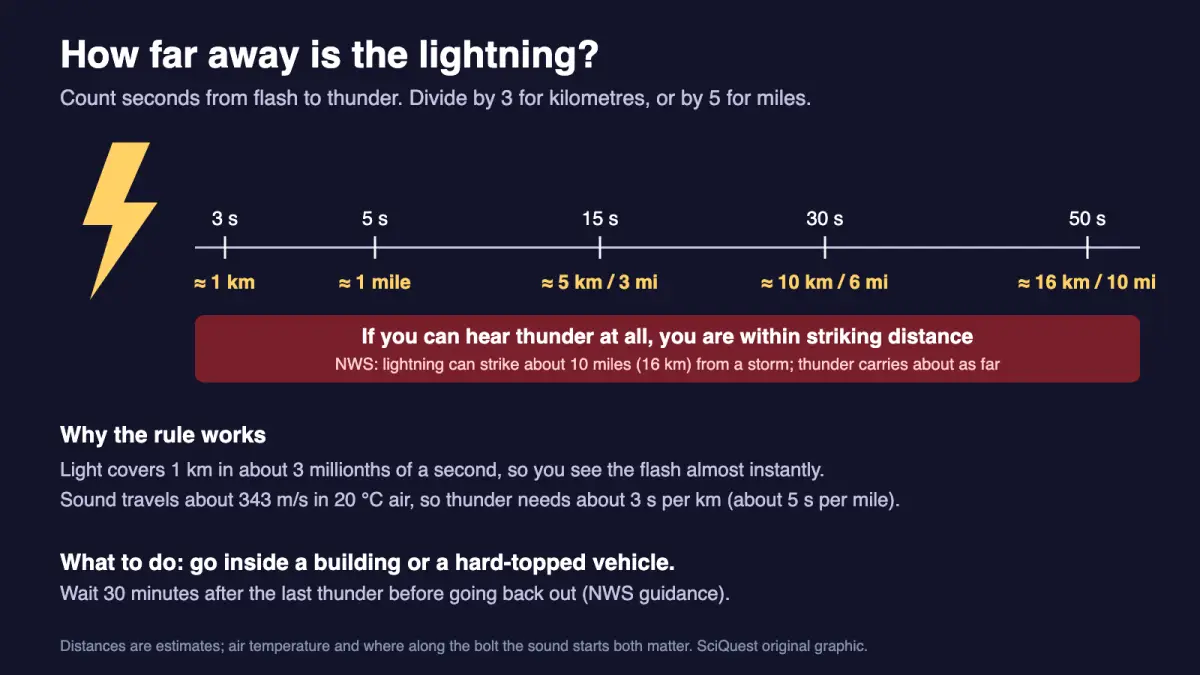
Light from a lightning bolt reaches you almost instantly, but thunder takes about 3 seconds to cross each kilometre, and that delay works as a built-in rangefinder.
To estimate how far away lightning is, count the seconds between the flash and the thunder. Divide by 3 for the distance in kilometres, or by 5 for miles. A 15-second gap means the strike was about 5 km (3 miles) away.
The rule comes with a warning. The US National Weather Service (NWS) says lightning can strike about 10 miles (16 km) from a storm, which is roughly as far as thunder can be heard. If you can hear thunder at all, you are close enough to be struck.
Explain it like I’m busy:
- Seconds ÷ 3 = kilometres. Seconds ÷ 5 = miles.
- It works because light is almost instant while sound travels about 343 m/s.
- Hearing thunder at all means you are within striking range: go indoors.
Key facts
- Speed of sound in air at 20 °C: about 343 m/s, or about 3 seconds per kilometre.
- NWS rule of thumb: thunder takes about 5 seconds to travel a mile.
- Range of thunder: usually audible up to about 10 miles (16 km), according to the NWS.
- Striking range: lightning can strike about 10 miles (16 km) outward from a thunderstorm (NWS).
- When it’s safe again: the NWS advises waiting at least 30 minutes after the last thunder before going back outside.
What it means: a race between light and sound
A lightning flash and its thunder start at the same moment, like a starter pistol whose smoke and bang leave together. Light wins the race by a huge margin. Thunder arrives later, and the size of the delay tells you how far it travelled.
The analogy has one limit. A bolt is not a single point; it can be several kilometres long. So the count gives the distance to the nearest part of the bolt you hear first, not an exact strike point.
How the rule works
Light travels about 300,000 km every second. It covers 1 km in roughly 3.3 millionths of a second, so for practical purposes you see the flash the instant it happens.
Sound is far slower. In dry air at 20 °C it moves at about 343 m/s. That figure is calculated from the standard formula for sound in an ideal gas, and it rises or falls by about 0.6 m/s for each degree Celsius.
Worked example
You count 12 seconds between flash and thunder.
- Distance = speed × time = 343 m/s × 12 s ≈ 4,100 m.
- Rule of thumb: 12 ÷ 3 = 4 km, or 12 ÷ 5 = 2.4 miles.
The shortcut slightly underestimates the distance (dividing by 3 assumes 333 m/s), which errs on the side of caution.
| Seconds counted | Approximate distance (km) | Approximate distance (miles) |
|---|---|---|
| 3 | 1 | 0.6 |
| 5 | 1.7 | 1 |
| 10 | 3.4 | 2 |
| 15 | 5.1 | 3 |
| 30 | 10.3 | 6 |
| 50 | 17 | 10 |
Kilometre values calculated by SciQuest at 343 m/s (20 °C air); mile values use the NWS rule of 5 seconds per mile. All values are rounded estimates.
Where thunder comes from
The NWS says lightning can heat the air around it to about 50,000 °F (roughly 28,000 °C), around five times hotter than the Sun’s surface. The heated air expands so suddenly that it sends out a shock wave. That wave, spreading and weakening, is the thunder you hear.
Because the bolt is long and branched, sound from different parts reaches you at different times. That is why a nearby strike gives a sharp crack while a distant one rolls and rumbles.
What changes the answer
- Air temperature: sound is slower in cold air (about 331 m/s at 0 °C), so a winter count slightly overestimates the distance.
- Counting errors: it is easy to count too fast. Use a watch or say “one-thousand-one” for each second.
- Several strikes: in an active storm it is easy to match thunder to the wrong flash.
- Wind and terrain: hills, buildings and wind can muffle thunder, so silence does not guarantee safety.
Why it matters to you
The NWS says lightning kills about 20 people a year in the United States and seriously injures hundreds more. The flash-to-bang count is a quick way to see a storm approaching. Shrinking gaps mean it is coming closer.
The most important safety message is simpler than any calculation. The NWS says no place outside is safe when a thunderstorm is nearby. As soon as you hear thunder, move into a substantial building with plumbing or electricity, or into an enclosed, metal-topped vehicle with the windows up. Never shelter under an isolated tree; NWS materials also warn against small sheds and convertibles. Indoors, avoid plumbing such as sinks and baths. Stay inside for at least 30 minutes after the last thunder.
“But wait… if the storm is 15 km away, aren’t I safe?”
No. Lightning can strike outward roughly 16 km (10 miles) from a storm. The count tells you where the last strike was, not where the next one will land. The NWS advice is to head for shelter as soon as you hear thunder.
Related questions
Why do you see lightning before you hear thunder? Because light travels nearly a million times faster than sound in air.
Can you have lightning without thunder? Every bolt makes thunder, but if a storm is far enough away, you may see the flashes without hearing anything.
How fast can things travel through space? Light sets the ultimate limit. See how fast we can travel in space.
In one sentence
Count from flash to thunder and divide by 3 for kilometres, but treat any thunder as a signal to get indoors, because lightning reaches as far as thunder can be heard.
Quick check: did it click?
- You count 9 seconds. How far away was the lightning? About 3 km, or nearly 2 miles.
- Why does the method work? Light arrives almost instantly, while sound travels about 1 km every 3 seconds.
- How long should you wait after the last thunder? At least 30 minutes, according to the NWS.
Read next
Disclosure: This article was drafted with AI assistance and checked by the SciQuest editor against the sources below. Safety guidance follows the US National Weather Service; follow your local weather service’s warnings. Distance conversions are SciQuest calculations. The graphic is an original SciQuest illustration. Spotted an error? See our corrections policy.
Sources
- National Weather Service, Understanding Lightning: Thunder
- National Weather Service, Understanding Lightning Science
- National Weather Service, Lightning Safety Tips and Resources
- National Weather Service, Lightning Safety one-pager (PDF)
- National Weather Service, Lightning Safety (annual US deaths)
Discover more from SciQuest
Subscribe to get the latest posts sent to your email.
Leave a comment