

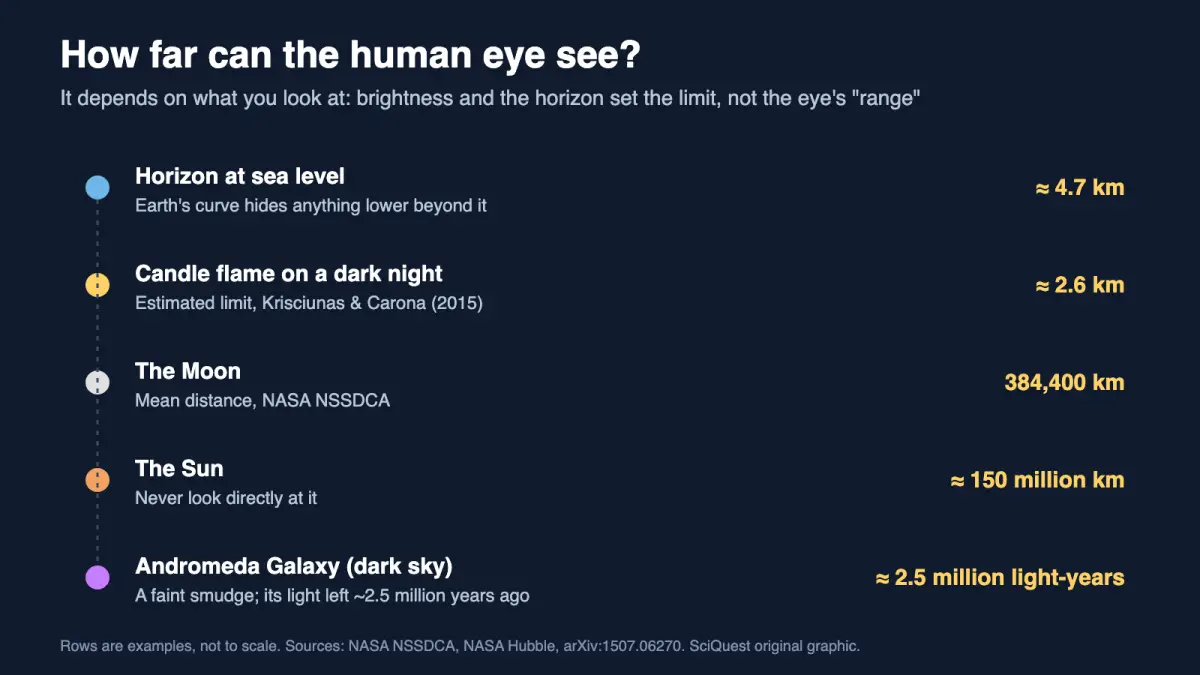
On flat ground, an adult’s view of the sea ends about 4.7 km away, yet on a dark night the same eyes can pick out a galaxy whose light has travelled for about 2.5 million years.
The human eye has no fixed range. What you can see depends on two things: whether Earth’s curve is in the way, and whether enough light from the object reaches your eye. Standing at the edge of a calm sea with your eyes about 1.7 m above the water, the horizon is roughly 4.7 km (2.9 miles) away. Look up instead, and the farthest thing most people can see without a telescope is the Andromeda Galaxy, about 2.5 million light-years away.
So “how far can you see?” really means two questions: how far before the ground curves away, and how faint can something be before your eye stops detecting it?
Explain it like I’m busy:
- On level ground, Earth’s curve limits your view to about 4.7 km.
- Climb higher and the horizon moves out: about 36 km from 100 m up, about 357 km from an airliner.
- In the night sky, brightness is the limit, not distance. That is why you can see Andromeda but not a candle 10 km away.
Key facts
- Horizon from 1.7 m eye height: about 4.7 km (calculated from Earth’s mean radius of 6,371 km).
- Simple rule: horizon distance in km ≈ 3.57 × √(eye height in metres), ignoring refraction.
- Candle flame on a dark night: visible to about 2.6 km, according to an estimate by astronomers Kevin Krisciunas and Don Carona (2015).
- The Moon: 384,400 km away on average (NASA).
- Farthest object most people can see with the naked eye: the Andromeda Galaxy, about 2.5 million light-years away (NASA).
What it means: the eye is a light detector, not a telescope with a range
Think of your eye less like a pair of binoculars with a maximum range and more like a bucket catching raindrops. Distance itself does not stop you seeing something. What matters is whether enough light lands in the bucket.
A bright, enormous object can be seen across vast distances. A small, dim one disappears quickly. The analogy breaks down in one way: your eye also needs the object to be big enough on the sky to make out detail. You can detect a distant star as a point of light, but you cannot see its shape.
How far away is the horizon?
On land or at sea, the planet itself usually sets the limit. Earth is a sphere about 6,371 km in radius, so the surface curves away beneath your line of sight. The horizon is the point where your line of sight just grazes the curve.
The calculation
Draw a right-angled triangle from Earth’s centre to your eye and to the horizon point. Pythagoras’ theorem gives the distance, d:
d = √(2Rh + h²) ≈ √(2Rh)
Here R is Earth’s radius and h is your eye height. Because h is tiny compared with R, the h² term can be dropped. With R = 6,371,000 m and h = 1.7 m:
d = √(2 × 6,371,000 × 1.7) = √21,661,400 ≈ 4,650 m, or about 4.7 km.
Converting the constant gives a handy rule: d (km) ≈ 3.57 × √h (m).
| Where your eyes are | Eye height | Horizon distance |
|---|---|---|
| Child on a beach | 1 m | 3.6 km (2.2 mi) |
| Adult on a beach | 1.7 m | 4.7 km (2.9 mi) |
| Top of a 10-storey building | 30 m | 19.5 km (12.1 mi) |
| Top of a 100 m cliff | 100 m | 35.7 km (22.2 mi) |
| Airliner window | 10,000 m | 357 km (222 mi) |
Calculated by SciQuest using d = √(2Rh) and Earth’s mean radius of 6,371 km (NASA NSSDCA). Real values vary with terrain, refraction and the height of the target.
Why you can see things beyond the horizon
You can see a mountain or a lighthouse well beyond 4.7 km because the target has its own height. Its top pokes above the horizon. Add the target’s own horizon distance to yours: a 100 m tower is visible above the curve from roughly 4.7 + 35.7 ≈ 40 km away, if the air is clear.
The air also bends light slightly downward, a process called atmospheric refraction. In typical conditions it pushes the visible horizon out by several per cent; a common approximation is about 8%. On unusually still, layered days it can do much more, producing mirages.
How far can you see a light at night?
Claims circulate online that the eye can see a candle flame 10 miles (16 km) or more away. In 2015, astronomers Kevin Krisciunas and Don Carona tested that idea. They compared a candle flame with the bright star Vega by eye and with a digital camera, then scaled the result to the faintest stars visible on a dark night.
Their estimate: a candle flame is about as bright as the faintest naked-eye star at roughly 2.6 km (1.6 miles). They concluded that the eye cannot detect a candle at 16 km (10 miles) or more. Their result is a calculation from a small test, not a field trial at 2.6 km, and haze along the ground would cut the distance further.
How far can you see into space?
The sky has no horizon problem, so brightness becomes the only limit. The Moon is 384,400 km away on average, and the Sun about 150 million km. Never look directly at the Sun, at any distance.
Almost every star you see belongs to our own galaxy, the Milky Way. The record for most people belongs to the Andromeda Galaxy. NASA puts it about 2.5 million light-years away. To the naked eye it is only a faint, elongated smudge: the combined glow of an enormous number of stars, none of which you can pick out individually.
That means the light reaching your eye left Andromeda about 2.5 million years ago. You are seeing the galaxy as it was, not as it is now.
What changes the answer
- Your height and the target’s height: both push the visible distance out.
- Air clarity: haze, dust and humidity scatter light and hide distant objects long before the horizon does.
- Darkness: light pollution hides faint stars. Andromeda is hard to spot from cities.
- Your eyes: age, eyesight and how long your eyes have had to adjust to the dark all matter.
Why it matters to you
The horizon rule is practical. It tells a sailor how far away a ship can be spotted, and a hiker how far a summit view really stretches. It also explains a common sight: ships disappearing hull-first over the horizon, one of the oldest everyday clues that Earth is round.
“But wait… don’t some people say they’ve seen mountains hundreds of kilometres away?”
Yes, and such reports can be genuine. They need a tall observer, a very tall target and exceptionally clear air with favourable refraction. They do not break the geometry. Both heights add together, as in the tower example above.
Related questions
How far away is Mars when you see it as a red dot? It varies from about 55 million to 400 million km. See our guide to how far Mars is from Earth.
Where are we in the galaxy we are looking through? Read where Earth sits in the Milky Way.
In one sentence
On the ground, Earth’s curve stops you seeing much past about 5 km, but in a dark sky your eyes can catch light that has travelled for 2.5 million years.
Quick check: did it click?
- Why can you see a lighthouse more than 4.7 km away from a beach? Because the lighthouse is tall, its top rises above the horizon; both heights add to the distance.
- What limits naked-eye vision of the night sky: distance or brightness? Brightness. Andromeda is extremely far away but gives off enough light to see.
- Roughly how far is the horizon from an airliner at 10 km? About 357 km.
Read next
Disclosure: This article was drafted with AI assistance and checked by the SciQuest editor against the sources below. Horizon distances are SciQuest calculations. Both graphics are original SciQuest illustrations. Spotted an error? See our corrections policy.
Sources
- NASA NSSDCA, Earth Fact Sheet (mean radius 6,371 km; Sun distance 149.6 million km)
- NASA NSSDCA, Moon Fact Sheet (mean distance 384,400 km)
- Krisciunas, K. and Carona, D. (2015), At what distance can the human eye detect a candle flame?, arXiv:1507.06270
- NASA Science, NASA’s Hubble Provides Bird’s-Eye View of Andromeda Galaxy’s Ecosystem
Discover more from SciQuest
Subscribe to get the latest posts sent to your email.
Leave a comment