

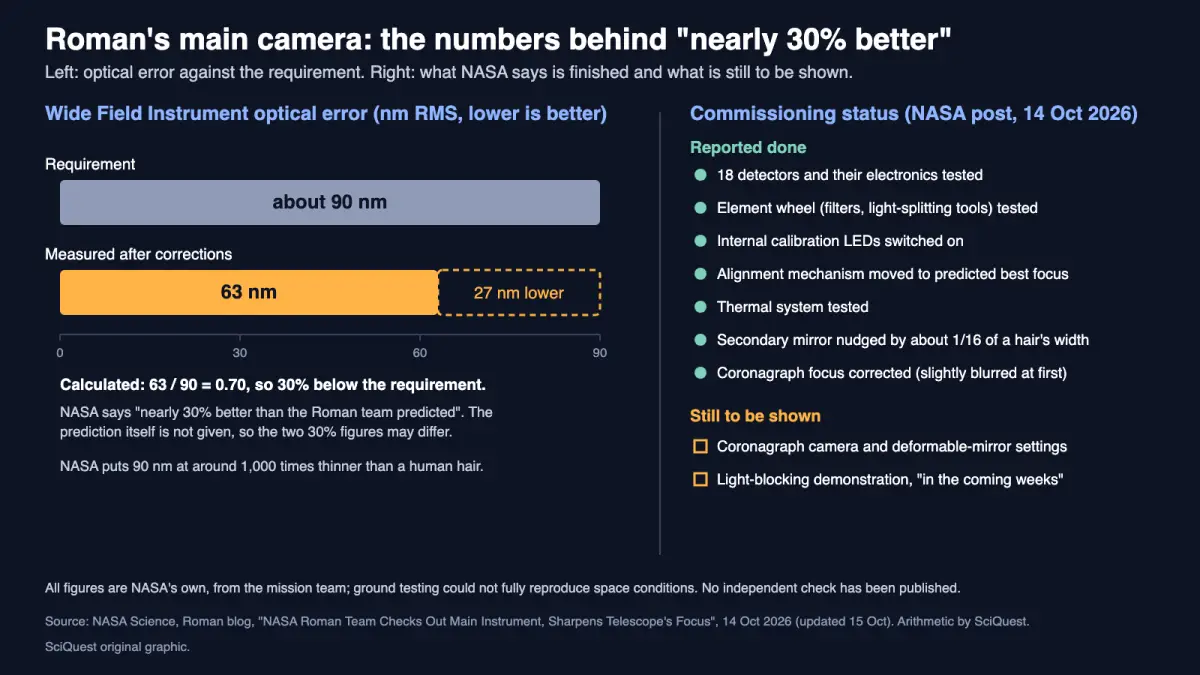
NASA says the optics of the Wide Field Instrument now show an error of 63 nm RMS against a requirement of about 90 nm, but that claim comes from the mission team alone, and the telescope’s second camera has yet to show its light-blocking ability.
Official announcement · Mission team’s own figures · Not independently verified
NASA reported on 14 October 2026 that the main camera of the Nancy Grace Roman Space Telescope is sharper than planned. After engineers adjusted the telescope’s focus, the Wide Field Instrument’s optics deviate from perfection by 63 nanometres RMS, against a requirement of about 90 nm, which NASA calls nearly 30% better than the team predicted. The Coronagraph Instrument, a second camera built to block unwanted light, had a small focus error that was corrected, but its light-blocking test is still weeks away.
What you need to know
- Finding: NASA says the Wide Field Instrument’s optical error is 63 nm RMS after corrections, better than the roughly 90 nm requirement and “nearly 30% better” than the team predicted.
- Method: After launch on 30 August, engineers tested the instrument’s 18 detectors, filter wheel, calibration LEDs, alignment mechanism and thermal system, then nudged the secondary mirror by about one-sixteenth of a hair’s width.
- Source: A NASA Science mission blog post by Ashley Balzer, posted 14 October 2026; it is not a journal paper and no independent measurement is cited.
- Why it matters: Every survey Roman plans, including its studies of dark matter and dark energy, runs through this instrument, so sharper optics should carry through to every image.
- Limitation: The numbers are the mission team’s own and early; NASA says ground tests could not copy space conditions, and the Coronagraph’s light-blocking ability has not yet been shown.
Evidence at a glance
| Item | Assessment |
|---|---|
| Evidence status | Official announcement from the mission team. Engineering measurements reported in a NASA blog post, with named engineers quoted. Not peer reviewed and not a journal paper. |
| Primary source | “NASA Roman Team Checks Out Main Instrument, Sharpens Telescope’s Focus”, NASA Science, posted 14 October 2026 and updated 15 October. No DOI exists for it, so the freshness check was the page’s own timestamp. |
| Evidence strength | Moderate for the engineering result: it is the operating team’s own measurement of its own hardware, stated with a requirement and a result. Limited for what it means for science: no independent check, no published measurement method and no test of the Coronagraph’s main capability yet. |
| Principal limitation | The “nearly 30%” improvement is measured against a prediction that NASA does not state, and everything in the post comes from the mission itself. |
| Coverage at a glance | Not assessed. Only NASA’s post and one ScienceDaily reprint of it could be opened on 19 October 2026 at 13:50 UTC; other outlets would not load, so no defensible count of independent publishers is available. |
Sources: the NASA post, the ScienceDaily reprint, and SciQuest arithmetic on the NASA figures.
Is this a big deal?
A good early sign, not a finished result. The post says the alignment mechanism was stowed out of focus for launch, so some adjustment was expected. What stands out is that NASA reports the main camera beating its requirement. But the evidence is a mission team grading itself in a blog post, and the real test is the science images, which SciQuest’s launch report says NASA expects in early 2027.
What NASA reported
Roman launched on 30 August 2026 and its Wide Field Instrument was activated in September. NASA describes the work since as a “marathon of activities” to fine-tune the observatory’s vision. Two things happened in parallel: the team checked out the instrument itself, and a separate group sharpened the telescope’s focus.
The key numbers are about optical error. NASA says the image-quality requirement was about 90 nm RMS (root mean square), meaning the optics deviate from perfection by 90 nm, which it describes as around 1,000 times thinner than a human hair. After corrections the instrument’s optics show an error of 63 nm RMS. NASA says that is “nearly 30% better” than the team predicted.
The Coronagraph Instrument is a separate camera whose job is to block unwanted light. Its first images were slightly out of focus, less than the team expected, and that was relatively simple to correct. Its camera settings and deformable-mirror settings are still being tuned before the team tries to show its light-blocking ability “in the coming weeks”.
How they did it
The instrument checkout was step by step. Engineers tested the 18 detectors and their electronics, then the element wheel that holds filters and light-splitting tools, then the internal calibration LEDs that measure how the detectors respond to different light levels. They also moved the alignment mechanism from its out-of-focus launch position to its predicted best-focus position, and tested the thermal system that keeps parts at the right temperatures. Maxime Rizzo, a Wide Field Instrument systems engineer at NASA Goddard, said: “Calibrating an instrument is like tuning a piano or guitar before a concert.”
The focus fix was tiny. Alden Jurling, a senior optical engineer at Goddard, said: “We moved the secondary mirror by about one-sixteenth of the diameter of a human hair.” That changed the secondary mirror’s height above the primary mirror, and he offered a scale comparison that SciQuest has not independently checked: the change, scaled to the height of the Empire State Building, would be slightly less than a stack of one U.S. penny on its tip.
Here is the arithmetic. 63 divided by 90 is 0.70, so the measured error is 30.0% below the requirement, with a gap of 27 nm. NASA’s wording, though, is “nearly 30% better than the Roman team predicted”, and the post never states the prediction. If the prediction equalled the requirement, the figure would be exactly 30%, not “nearly”. The difference is small, but it shows why “beats the requirement” and “beats the prediction” are two separate claims.
Why it matters
Dave Hickey, a Wide Field Instrument systems engineer at Goddard, said in the post: “All of Roman’s sweeping surveys will rely on the Wide Field Instrument.” So optical quality here carries into everything else. Jurling added: “All of the images from Roman’s cosmic surveys will be even sharper than we expected.” That second line is a forecast by the team, not a measurement of an image.
The reader-level point is that a space telescope is not finished when it launches. Like the James Webb Space Telescope (see how Webb works), Roman needs a commissioning period of aligning and calibrating before it does science.
What the evidence does not show
The post reports a number, not how it was measured, and it comes with no uncertainty. It does not say which images or tests produced the 63 nm figure. It also does not show that the Coronagraph works: NASA says its light-blocking ability has still to be demonstrated.
The team itself flags a limit. Matthew Bolcar, Roman’s optical systems lead at Goddard, said: “Our ground testing couldn’t exactly reproduce the environment Roman would experience in space, such as the absence of gravity.” Hence the in-space checks matter. Headlines that say Roman “exceeds expectations” compress this into a single comparison, and the baseline for it is not in the post.
How this fits what we knew
Before launch, NASA’s ground tests and modelling, done at Goddard and by contractors L3Harris and BAE Space and Mission Systems, set the predictions. Bolcar said the telescope performed well even before the alignment adjustments, which left only small corrections. In that sense the new result confirms the pre-launch work rather than overturning it. The launch, the trip to the Sun-Earth L2 region and the plan to map billions of galaxies are covered in SciQuest’s launch report.
Independent perspective
SciQuest found no comment from an astronomer or optical engineer outside the Roman project by 13:50 UTC on 19 October 2026, and has not interviewed one. Every voice in the NASA post is a Goddard employee, so treat the result as the mission’s self-assessment.
How other headlines framed it
- NASA Science, the source, used a process headline: the team “checks out” the main instrument and “sharpens” the focus.
- ScienceDaily, reprinting the release, moved to an outcome headline: Roman “exceeds expectations by nearly 30%”.
- Eastern Herald, seen only as a headline in search results because its page would not load, says the camera “beats its optics target by nearly 30%”, which swaps “predicted” for “target”.
The comparison itself shifts between outlets, from “predicted” in the NASA text to “expectations” and “target” in headlines. All three rest on the same single NASA post.
What happens next
The next thing to watch is the Coronagraph’s light-blocking demonstration, which NASA says the team will attempt in the coming weeks. After that come the actual survey images. Until an image-based measurement or an outside check is published, the 63 nm figure is NASA’s report, not a verified performance number.
In one sentence
NASA says the Roman Space Telescope’s main camera has an optical error of 63 nm RMS against a 90 nm requirement after a tiny mirror adjustment, but the figures are the mission team’s own and its second camera’s key test is still to come.
Why it matters to you: it shows how a new space telescope is judged after launch, and why a “30% better” headline needs a baseline before it means anything.
Quick check: did it click?
- What did NASA report about the Wide Field Instrument? An optical error of 63 nm RMS, against a requirement of about 90 nm.
- Why is “nearly 30% better” not the whole story? It is compared with a prediction NASA does not state, and the figures are the mission’s own and unverified by others.
- What is still to be shown? The Coronagraph Instrument’s ability to block unwanted light, planned for the coming weeks.
Read next
- NASA’s Roman Space Telescope launches to map the dark universe, for where Roman is headed and what it is built to do.
- How does the James Webb Telescope work, a comparison with another telescope that was aligned after launch.
- Hubble Space Telescope facts and discoveries, the older observatory Roman is designed to complement.
Sources and disclosure
- Balzer A. “NASA Roman Team Checks Out Main Instrument, Sharpens Telescope’s Focus.” NASA Science, Roman blog, posted 14 October 2026, updated 15 October 2026. All quotations in this article are verbatim from this post.
- ScienceDaily. “NASA’s Roman Space Telescope exceeds expectations by nearly 30%.” Reprint of the NASA release, posted 17 October 2026.
- Eastern Herald. Report on the Wide Field Instrument optics, 14 October 2026 (headline seen in search results only).
Disclosure: This article was drafted with AI assistance and checked against the NASA post, which was read in full. The 27 nm gap and 30.0% figure are SciQuest calculations from NASA’s 63 nm and 90 nm values; the graphic is a SciQuest original. NASA’s penny-and-tower comparison and the “around 1,000 times thinner than a hair” figure are NASA’s and were not independently checked. Spotted an error? See our corrections policy.
Discover more from SciQuest
Subscribe to get the latest posts sent to your email.
Leave a comment