

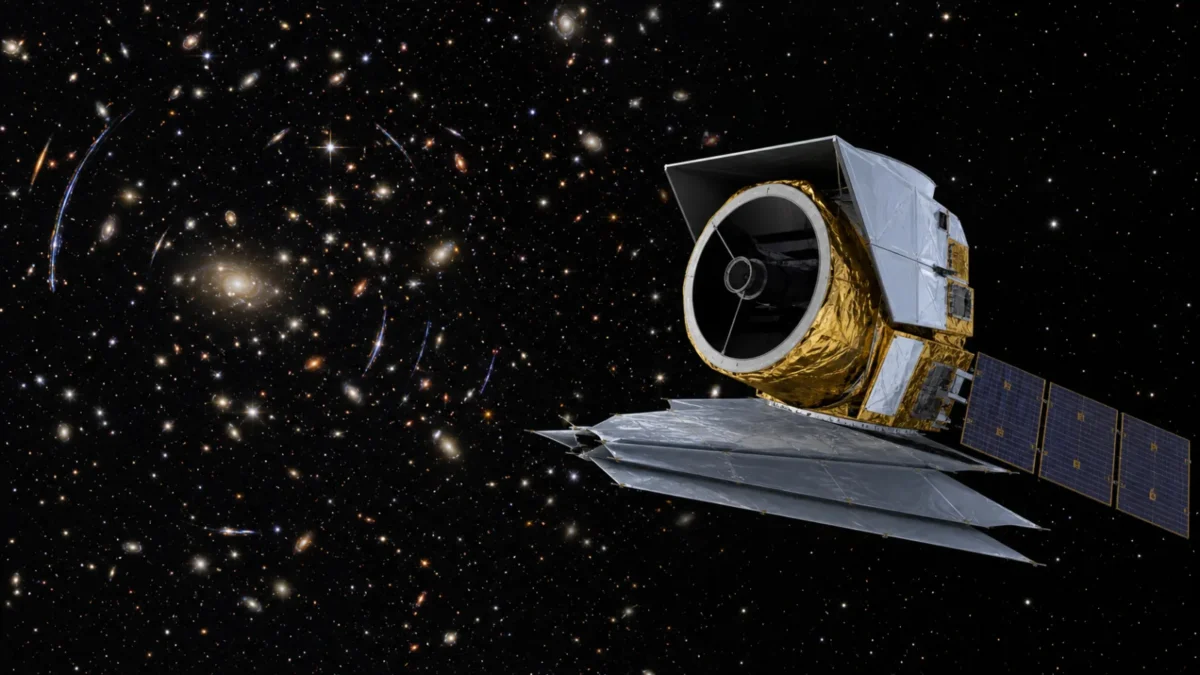
NASA’s Nancy Grace Roman Space Telescope launched aboard a SpaceX Falcon Heavy on August 30 and is now traveling toward a vantage point about 1.6 million kilometres from Earth, where its wide-field infrared surveys are designed to map billions of galaxies and reveal thousands of exoplanets.
Published: August 30, 2026, 11:25 p.m. PKT · Reporting cutoff: August 30, 2026, 11:15 p.m. PKT
What you need to know
- Roman lifted off from NASA’s Kennedy Space Center at 7:26 a.m. EDT on August 30.
- The observatory separated from the rocket, established communications and deployed its solar-array sunshield.
- It is traveling to the Sun–Earth L2 region, about 1 million miles (1.6 million kilometres) away.
- Roman will survey the sky far faster than Hubble while studying dark energy, dark matter and exoplanets.
- The mission has not begun science observations; calibration and commissioning come first.
NASA’s newest flagship observatory is flying on its own. The Nancy Grace Roman Space Telescope separated from the Falcon Heavy’s upper stage about 31 minutes after launch and began sending data to controllers. NASA subsequently confirmed that the spacecraft’s solar panels and lower instrument sunshade had deployed.
The launch is the start, not the scientific result. Roman must reach an orbit around the second Sun–Earth Lagrange point, complete deployments and pass months of calibration before astronomers can judge how well its instruments perform. NASA expects the first images in early 2027.
Why Roman is different from Hubble and Webb
Roman’s 2.4-metre primary mirror is comparable in diameter to Hubble’s, but its Wide Field Instrument sees a patch of sky at least 100 times larger in a single exposure. NASA says Roman is designed to survey the universe about 1,000 times faster than Hubble.
That combination of sharp infrared vision and a panoramic field of view changes the questions astronomers can ask. Hubble and the James Webb Space Telescope excel at detailed observations of selected targets. Roman is designed to find enormous populations: billions of galaxies, tens of thousands of supernovae and thousands of planets, including worlds detected through gravitational microlensing.
Those discoveries can then become targets for closer study with Webb, Hubble and ground-based observatories. Roman is therefore less a replacement for existing telescopes than a wide-angle discovery engine for the entire astronomical community.
How Roman will investigate the “dark” universe
Dark matter does not emit light, while dark energy is the name given to whatever is driving the universe’s accelerating expansion. Roman cannot photograph either substance directly. Instead, it will measure their effects on visible matter and the geometry of the cosmos.
Its surveys will track how galaxies are distributed across cosmic time, observe distant exploding stars and measure gravitational lensing—the bending of light by intervening mass. Comparing those signals with competing cosmological models may help scientists narrow down how dark energy behaves and how dark matter shaped large-scale structure.
This is a measurement mission, not a promise that one observation will “solve” dark energy. The real power comes from repeated, precisely calibrated observations of vast samples.
Roman will create a data challenge as well as an atlas
NASA expects Roman to return about 1.4 terabytes of data per day, the highest daily data rate yet planned for a NASA astrophysics mission. Its processed science data will be public, allowing research groups—and potentially citizen scientists—to search for rare events and unexpected objects.
The huge volume also creates a practical problem: no individual astronomer can examine every galaxy, light curve or transient by eye. Automated pipelines and machine-learning systems will be used to flag candidates, but important discoveries will still require validation against instrumental artifacts and follow-up observations.
How other headlines framed the launch
- NASA emphasized Roman’s search for the dark universe and confirmed early mission milestones.
- The Associated Press via Phys.org framed Roman as NASA’s newest flagship and stressed its expected census of planets, stars and galaxies.
- AFP via Phys.org focused on the telescope’s panoramic cosmic map and its tests of the standard cosmological model.
What happens next
Roman is traveling toward L2, where it will operate in a relatively stable thermal and gravitational environment near Webb. Controllers will check its communications, pointing, thermal behavior and two major instruments before routine science begins.
Bottom line: Roman has cleared the first major hurdle: it launched, separated and communicated successfully. Whether it delivers its promised new atlas of the universe will be established during commissioning and years of openly available observations.
Sources
- NASA, “NASA’s Dark Universe-Seeking Nancy Grace Roman Space Telescope Launches,” August 30, 2026.
- NASA Roman mission blog, spacecraft separation update.
- NASA Roman mission overview.
Editorial disclosure: The lead image is a concept illustration of Roman operating in space, not a photograph of the launch or an observation returned by the telescope. SciQuest received no payment to cover this mission. To report a possible error, contact SciQuest.
Discover more from SciQuest
Subscribe to get the latest posts sent to your email.
Leave a comment