

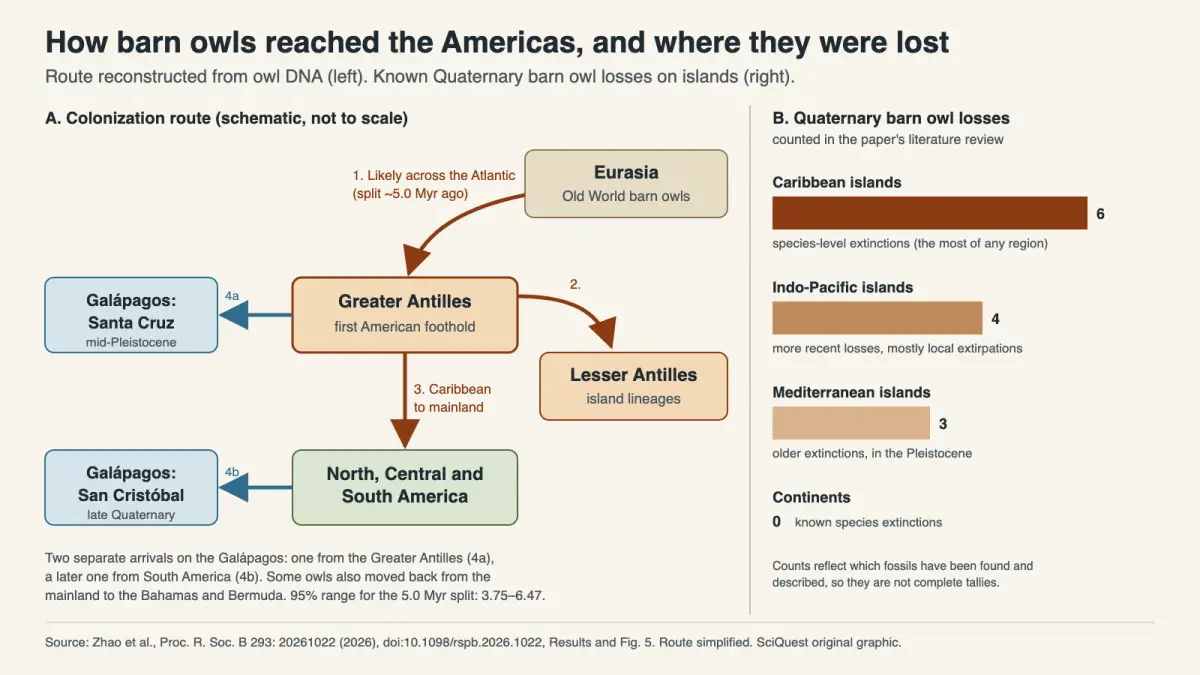
Mitochondrial genomes from 68 owls, most of them sequenced from old museum skins, ribs and fossils, place the first American barn owls in the Greater Antilles, while the same paper’s fossil review counts six Caribbean barn owl species lost, more than any other island region.
Peer reviewed · DNA (phylogenomic) study · Fossil literature review
Barn owls in the Americas descend from owls that came from Eurasia and settled first on Caribbean islands, a team at the Florida Museum of Natural History led by Min Zhao reports in Proceedings of the Royal Society B, published 21 October 2026. The islands were the region’s barn owl hotspot and still are, the authors conclude, even though most barn owl species that lived there are now known only from bones. The route is a statistical reconstruction, and no DNA could be recovered from the extinct giant owls.
What you need to know
- Finding: Western Hemisphere barn owls (Tyto) trace to a single arrival from Eurasia into the Greater Antilles, and spread from the Caribbean to the mainland and, twice, to the Galápagos.
- Method: The team built family trees from nuclear DNA markers and whole mitochondrial genomes, including toe pads from museum skins collected between 1876 and 1995, then modelled where ancestors lived.
- Source: Zhao, Steadman, LeFebvre, Guralnick, Doby, Allen and Oswald, Proc. R. Soc. B 293: 20261022, 21 October 2026 (open access).
- Why it matters: It is a clear case of islands feeding a continent with species, the reverse of the usual textbook direction.
- Limitation: The extinct Caribbean owls yielded no DNA, and when and why they died out is largely unknown; the human link is the authors’ interpretation.
Evidence at a glance
| Item | Assessment |
|---|---|
| Evidence status | Peer reviewed. Genetic family-tree (phylogenomic) study of living and historical specimens, plus a review of published fossil records. |
| Primary source | “Caribbean Islands facilitated the colonization of Western Hemisphere barn owls, yet experienced rampant extinction”, Proceedings of the Royal Society B 293(2081): 20261022, published online 21 October 2026, CC BY 4.0. Data on Figshare. |
| Evidence strength | Moderate. Nuclear and mitochondrial DNA give matching trees at the level of major groups. But the dates rest on fossil calibrations, the route model assumes no owls in the Americas before 2.6 million years ago, and the best-fitting model type is one the authors say should be read with caution. |
| Principal limitation | No DNA came from the extinct species, so their place on the tree is unknown. Extinction counts depend on which fossils have been found. |
| Coverage at a glance | 0 independent publishers found as of 21 October 2026, 07:45 UTC. One repost of the Florida Museum’s release (Phys.org) was found and not counted, because a reposted release is not separate reporting. |
Sources: the paper’s Methods and Results; SciQuest web search for coverage.
Is this a big deal?
A solid step for bird biogeography, built on unusually thorough sampling of Caribbean owls. It agrees with earlier work on an Eastern Hemisphere origin and adds two things: the Caribbean as the entry point, and a clearer count of what was lost there.
What scientists found
The team sampled 15 Tyto species and two bay owls (Phodilus), covering all living members of the family except three Eastern Hemisphere species. They included all 11 recognised subspecies of the American barn owl, Tyto furcata, which was split from the Old World barn owl only in 2024.
The models point to one arrival from Eurasia into the Greater Antilles, the big northern islands such as Cuba, Jamaica and Hispaniola. Owls then spread to the Lesser Antilles before reaching the continental Americas. The split between Eastern and Western Hemisphere barn owls is dated to about 5.0 million years ago (95% range 3.75 to 6.47 million years). The authors describe the crossing as likely trans-Atlantic.
Think of the islands as stepping stones across a river. The analogy has two limits: owls can fly, so the stones were a likely route, not a required one, and some traffic went backwards, with mainland owls later settling the Bahamas and Bermuda.
How they found it
Most of the DNA came from specimens that were never meant for genetics. Of 52 mitochondrial genomes the team produced, 88.5% came from toe pads clipped from museum study skins, from ribs, or from fossils. Those were combined with published genomes for a 68-sample mitochondrial dataset, and a nuclear dataset of 42 samples averaging 3,322 DNA regions each.
Fossils of American barn owls from the Cayman Islands, Jamaica and the Bahamas were radiocarbon dated to less than 220 years before present, so they are recent bones. The team also tried five fossils of the extinct giant Tyto ostologa and three of Tyto pollens. None yielded ancient DNA.
A computer model (BioGeoBEARS) then estimated where each ancestor most likely lived.
Why it matters to you
Nothing changes for you this year. The barn owl that may roost in a barn near you is part of a lineage that probably came through the Caribbean, and the islands that launched it have lost most of their own species. The paper also notes that barn owls are declining in parts of North America and Europe.
What the evidence does not show
It does not show how the extinct Caribbean owls are related to living ones, because their DNA did not survive.
It does not prove that people caused the extinctions. The paper says reliable last-occurrence dates are mostly missing, so the causes remain largely unknown. The authors propose that human arrival, beginning at least 6,000 years ago, is the likely driver, along with the loss of native prey such as hutias, spiny rats and island shrews. Six thousand years is about 0.12% of the 5 million years since the hemispheres split.
How this fits what we already knew
Earlier genetic studies had already placed the American barn owls’ roots in the Eastern Hemisphere and estimated a split near 5 million years ago. This study agrees on both. Its new contribution is dense sampling across the islands. Antillean lineages are more deeply divided from each other than the two mainland groups are, consistent with the authors’ view that the islands were the older home.
The island-to-mainland pattern has been reported before for Turdus thrushes, New World orioles and blackbirds, lizards and bats. The authors also describe islands as “museums of diversity” that hold lineages lost elsewhere. Museum bones carry much of this kind of work, as they do for the extinct Tasmanian tiger’s hunting style.
The Galápagos surprise
Owls reached the Galápagos twice. One lineage came from the Greater Antilles around the mid-Pleistocene, and its Santa Cruz sample is the earliest-branching American barn owl in the tree. A later arrival from South America lives on San Cristóbal. The authors argue the older Galápagos owl deserves full species rank as Tyto punctatissima. It is already gone from Floreana, after people settled there in the nineteenth century.
Independent perspective
SciQuest found no comment from an independent ornithologist outside the team as of 21 October 2026, 07:45 UTC, and has not yet interviewed one.
How other headlines framed it
Only one outlet had covered the paper when we checked. Phys.org, reposting the Florida Museum’s release, led on the Caribbean as a former centre of barn owl diversity and said at least nine Caribbean species are extinct. The paper’s own results count six species-level extinctions on Caribbean islands. SciQuest did not open the supplementary table behind the count, so this article uses the paper’s figure.
What happens next
The authors call for faster study of the remaining island populations, especially the Galápagos owl. Better-dated fossils would test whether the Caribbean giants overlapped with people. Recent arrivals are also worth watching: American barn owls established on Hispaniola around the mid-1900s, with a first Puerto Rico nesting record in 2015.
In one sentence
American barn owls most likely got their start on Caribbean islands, which were richer in barn owl species than the mainland until most of those island species disappeared.
Quick check: did it click?
- Where did Western Hemisphere barn owls first settle, according to the model? The Greater Antilles, after arriving from Eurasia.
- Why can’t the study place the extinct giant owls on the family tree? None of the eight fossils tried yielded ancient DNA.
- How many times did barn owls reach the Galápagos? Twice: once from the Greater Antilles, later from South America.
Read next
- Tasmanian tiger skull reveals a fast-snapping hunter: another predator known mostly from museum specimens.
- Octopus and squid DNA forms flexible loops linked to brain development: another study that reads animal evolution from genomes.
Sources and disclosure
- Zhao M, Steadman DW, LeFebvre MJ, Guralnick RP, Doby JR, Allen JM, Oswald JA. “Caribbean Islands facilitated the colonization of Western Hemisphere barn owls, yet experienced rampant extinction.” Proceedings of the Royal Society B 293(2081): 20261022, published 21 October 2026. doi:10.1098/rspb.2026.1022 (full text read on the journal site).
- Zhao M et al. Data and scripts. Figshare (2026).
- Florida Museum of Natural History release, as reposted by Phys.org, 20 October 2026.
Disclosure: This article was drafted with AI assistance and checked against the sources above, including the full open-access paper. The authors declare no competing interests; the work was funded by the US National Science Foundation. SciQuest calculation: 6,000 years divided by 5 million years is 0.0012, or 0.12%. The graphic is a SciQuest original built from the paper’s reported results, with the route simplified. Spotted an error? See our corrections policy.
Discover more from SciQuest
Subscribe to get the latest posts sent to your email.
Leave a comment