

Across octopus, squid and cuttlefish, the large neighbourhoods of folded DNA looked broadly alike, but only 3 gene-containing loops turned up in all three animals, and deleting one small DNA switch inside a shared loop left some squid embryos with smaller brains.
Peer reviewed · Genomics study (embryos and tissues) · One CRISPR experiment in squid embryos
Octopuses, squid and cuttlefish fold their DNA in a pattern that mixes a stable framework with fast-changing loops, according to a study published on 9 October 2026 in Nature Communications. A University of Vienna team led by Thea Rogers, with senior author Oleg Simakov, mapped how the genome folds inside the cells of three species. The changeable loops often sit near genes linked to the nervous system, and a gene-editing test tied one loop to brain development. The authors propose that this flexibility helped these animals evolve complex traits. That part is an idea, not something the study tested.
What you need to know
- Finding: Large DNA domains were broadly conserved across three cephalopod species, while hundreds of smaller DNA loops differed by species, tissue and stage of development.
- Method: The team used Micro-C, a method that records which stretches of DNA touch inside the nucleus, alongside measures of gene activity (RNA-seq) and open DNA (ATAC-seq).
- Source: Rogers, Simakov and colleagues, Nature Communications, 9 October 2026 (open access).
- Why it matters: It gives a concrete, testable way that an ancient reshuffle of cephalopod chromosomes could have rewired how genes are switched on.
- Limitation: The brain evidence rests on one deleted DNA stretch in one squid species, and the link to the evolution of cephalopod brains is the authors’ proposal.
Evidence at a glance
| Item | Assessment |
|---|---|
| Evidence status | Peer reviewed (accepted 27 August 2026); comparative genomics in embryos; one CRISPR knockout. Preprint on bioRxiv since August 2025. |
| Primary source | Rogers TF, Stock J, … Albertin CB, Simakov O. Nature Communications 17:10319, published 9 October 2026, DOI 10.1038/s41467-026-77625-7 (free full text) |
| Evidence strength | Moderate for the folding maps: three species, several tissues and stages, public data. Limited for the brain link: one knockout in 25 injected embryos of one species. |
| Principal limitation | The study shows how folding differs and that one loop-linked DNA switch matters for embryo development. It does not show that changes in folding caused cephalopod brains or intelligence to evolve. |
| Coverage at a glance | 2 distinct credible publishers (Earth.com, The Debrief) as of 13 October 2026, 13:43 UTC. Counted: outlets with their own article on this paper. Excluded: release reposts (Phys.org, EurekAlert, AZoLifeSciences, Mirage News, BioQuick News) and aggregators. |
Source: full text of Rogers et al. (2026) and University of Vienna news release, 9 October 2026. Coverage counted by SciQuest.
Is this a big deal?
It is a solid step in a young field, not an answer to why octopuses are clever. Few studies compare 3D genome folding across distant animal groups, and this one adds a real experiment. The brain-evolution story is still a hypothesis that needs many more tests.
What scientists found
Picture a garden hose kilometres long, coiled into a shed. Points far apart along the hose end up pressed together. DNA does the same inside a cell, and that matters because genes are often switched on by control sequences far away along the strand. The analogy has a limit: real DNA is wrapped around proteins, keeps moving, and its folds form and come apart.
A chromatin domain is a neighbourhood of DNA whose parts touch one another more than they touch DNA outside it (chromatin is DNA plus its packing proteins). A chromatin loop is a smaller fold that brings two distant points into direct contact, often joining a gene to a control sequence.
The domains were broadly conserved. The team found 1,592 gene pairs that sat in contact in all three species, and those pairs tended to be switched on together and to do basic housekeeping work in cells. The loops were a different story. In whole embryos the team detected 329 loops in the Hawaiian bobtail squid (Euprymna scolopes), 912 in the common cuttlefish (Sepia officinalis) and 663 in the California two-spot octopus (Octopus bimaculoides). Only 3 gene-containing loops were found in all three species.
Loops also changed within a single animal. In the octopus, brain, eye and arm samples had similar numbers of loops, while internal organs had about a third as many. Squid embryos in late organ formation had far more loops than earlier or later ones. Genes in the few loops shared by all three species were highly active in nervous tissue and in the white body, a cephalopod blood and immune organ.
How they found it
Micro-C fixes DNA in place with chemicals, cuts it into small pieces, glues together pieces that were touching, then reads the joined pieces with a DNA sequencer. Enough joins make a map of which parts of the genome sit side by side. For newer ways to image DNA structure directly under the microscope, see our earlier story.
The team built these maps for embryos of all three species. For the squid, it compared three stages of development. For the octopus and the cuttlefish, it also sampled the central brain, eyes, optic lobes, arms and internal organs, all dissected from embryos close to hatching. It then lined up genes across 14 cephalopod genomes to trace how chromosomes had broken, fused and mixed over time.
Next came the direct test. The researchers picked a loop shared by squid and octopus that holds genes active in the brain. Inside one of those genes, called Quaking B, they used CRISPR gene editing to delete a stretch of about 1,000 DNA letters that looked like a control switch. They did this in Euprymna berryi, a close relative of the bobtail squid that can be edited in the lab.
All 25 injected embryos developed slowly. Five had clearly smaller brains, especially the optic lobes, and five more were badly malformed. Six were smaller overall with shorter arms, and nine showed no obvious defect. Genes inside the loop did not change significantly. The clearest drops in gene activity were in genes outside it, between 2.9 and 14.5 million DNA letters away.
“The genome isn’t just a sequence of genes. It’s folded into a complex three-dimensional structure,” lead author Thea Rogers said in the University of Vienna’s announcement.
Why it matters to you
This won’t change your daily life. It speaks to a big question: how did an animal with three hearts and a body without bones end up with the largest brains of any invertebrate? The study suggests part of the answer may lie in how DNA is folded, not only in which genes an animal has. Human cells fold DNA into domains and loops too (a 2014 map found about 10,000), so the idea reaches beyond octopuses.
The median gene-containing loop in the octopus spanned 2.9 million DNA letters. If each letter were 1 millimetre long, that stretch would run 2.9 kilometres, yet the loop pulls its two ends into contact.
What the evidence does not show
It does not show that genome folding made cephalopods intelligent. The authors “propose” that uneven constraints on folding helped complex traits evolve. That is an interpretation of patterns, not a measured cause.
The direct brain evidence comes from one DNA stretch, deleted in one species. The comparison group was uninjected embryos, so SciQuest notes that some effects, such as the general delay seen in all 25, could partly come from the injection itself. Gene activity was measured in groups of three or four embryos.
Every folding map came from embryos, so the maps say nothing direct about adult brains.
How this fits what we already knew
This octopus species’ genome was first published in 2015. In 2022, the Vienna group reported folded domains in cephalopod DNA and linked a large ancient reshuffle of cephalopod chromosomes to new gene regulation. The new paper adds a detailed comparison across squid, cuttlefish and octopus, plus a loop-by-loop view.
It also adds a twist. Squid and cuttlefish genomes are over 5 billion DNA letters long, while some octopus genomes are about 2.5 billion. Yet the octopus had the longest loops: a median of 2.9 million letters, against 1.6 million in the squid and 1.3 million in the cuttlefish. More than half of the octopus loops joined genes whose counterparts sit on different chromosomes in squid and cuttlefish. The authors read this as a sign that the octopus line fused and mixed its chromosomes more, a state they call “regulatory entanglement”.
One date in the coverage needs care. About 270 million years is the paper’s age for the group itself; it places the big reshuffle in the group’s common ancestor without giving that event its own date.
Outside views and open debates
SciQuest found no comment on this paper from a scientist outside the study team. The paper itself raises two points of debate. Whether folded domains are conserved across species is still contested, partly because results depend on the method used to detect them. Some researchers have also argued that the process that forms loops mainly does general housekeeping, keeping the genome orderly, rather than steering particular genes. The knockout result is evidence for a gene-steering role in at least one case.
How other headlines framed it
- Earth.com credited an ancient chromosome rearrangement with possibly explaining complex brains, and said plainly the link is a proposal.
- The Debrief framed it around octopus intelligence. The paper itself talks about nervous systems and complex traits, not intelligence.
- Phys.org reposted the university’s release, which offers “regulatory entanglement” as a possible explanation.
What happens next
The single knockout needs company. Deleting other loop switches, in more species and against embryos injected with a harmless control, would show whether this result is typical. Mapping adult brains, not just embryos, would test whether the loops seen in development persist. The maps and loop calls are public, so other groups can start now.
In one sentence
Cephalopod DNA keeps a stable folded framework with flexible loops on top, one loop switch mattered for squid brain development, and whether this helped brains evolve is still open.
Quick check: did it click?
- Domains or loops: which stayed similar across species? Domains. The loops kept changing between species, and even between tissues of one animal.
- In which animal did the team run the CRISPR test? Embryos of the squid Euprymna berryi, not an octopus.
- Did the study prove that DNA folding made octopuses intelligent? No. The authors propose it helped complex traits evolve; that has not been tested.
Read next
Sources and disclosure
- Rogers TF, Stock J, Schulz NG, Yalçin G, Rencken S, Weissenbacher A, Clarence T, Schultz DT, Ragsdale CW, Albertin CB, Simakov O. “Genome reorganisation and expansion shape 3D genome architecture and define a distinct regulatory landscape in coleoid cephalopods.” Nature Communications 17:10319, 9 October 2026. doi:10.1038/s41467-026-77625-7
- University of Vienna. “3D structure of DNA may explain how cephalopods evolved complex brains”, 9 October 2026.
- Rogers TF, et al. Preprint of the same study, bioRxiv, 29 August 2025. doi:10.1101/2025.08.29.672809
- Schmidbaur H, et al. “Emergence of novel cephalopod gene regulation and expression through large-scale genome reorganization.” Nature Communications 13, 2022. doi:10.1038/s41467-022-29694-7
- Albertin CB, et al. “The octopus genome and the evolution of cephalopod neural and morphological novelties.” Nature 524:220–224, 2015. doi:10.1038/nature14668
- Rao SSP, et al. “A 3D map of the human genome at kilobase resolution reveals principles of chromatin looping.” Cell 159:1665–1680, 2014. doi:10.1016/j.cell.2014.11.021
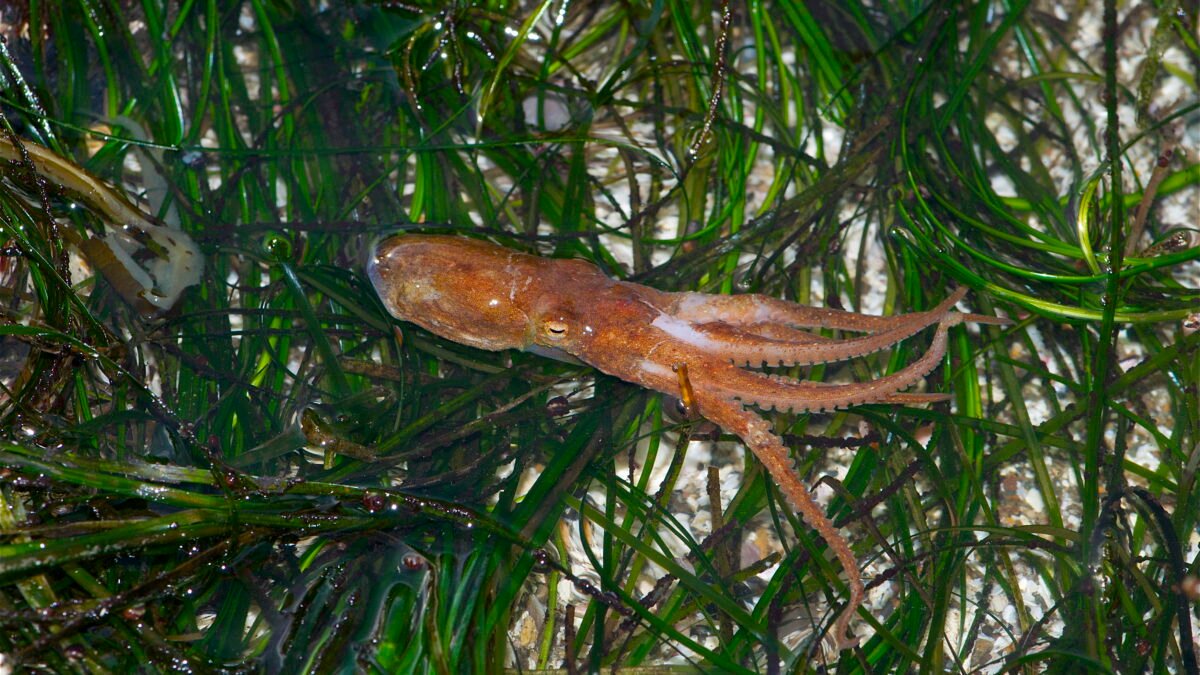
Featured photo: California two-spot octopus (Octopus bimaculoides), one of the three species in the study. Photo by Jerry Kirkhart, CC BY 2.0, via Wikimedia Commons.
Disclosure: This article was drafted with AI assistance and checked against the full open-access paper and the sources above. The quote comes verbatim from the University of Vienna release. The graphic is a SciQuest original drawn from the paper’s text and figures; the 2.9 km comparison is SciQuest’s own arithmetic (2.9 million × 1 mm). The authors declare no competing interests, and SciQuest has none. Spotted an error? See our corrections policy.
Discover more from SciQuest
Subscribe to get the latest posts sent to your email.
Leave a comment