

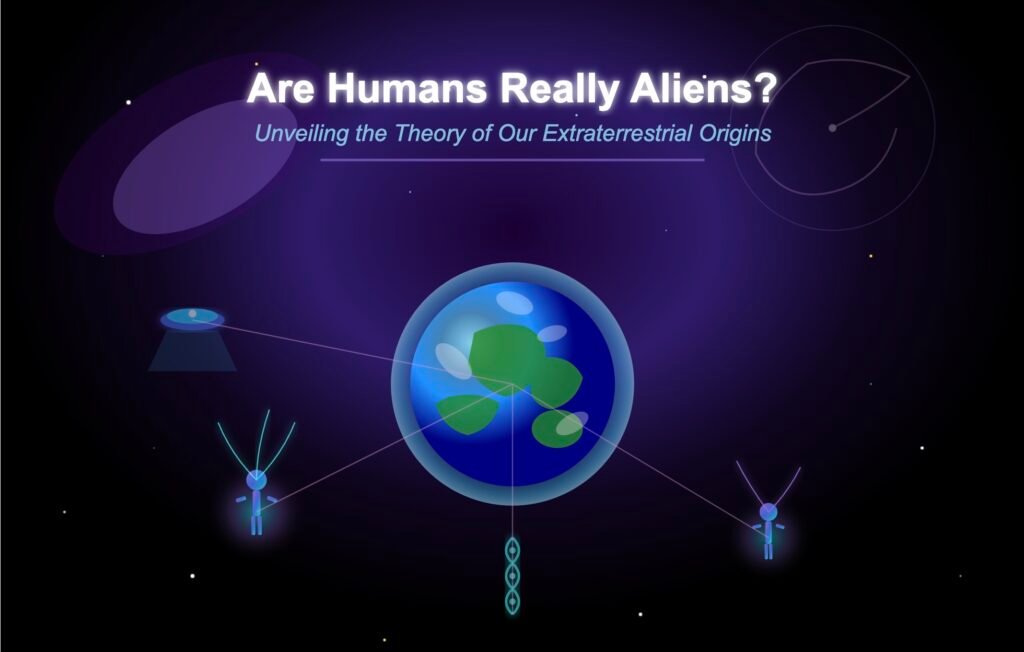
No. Humans are not aliens: fossils, comparative anatomy and DNA all show that our species evolved on Earth, in Africa, about 300,000 years ago. Our DNA differs from a chimpanzee’s by only about 1.2% in shared genes, and we use the same genetic system as every other organism on the planet.
The scientific idea behind the question is panspermia, the hypothesis that life’s first microbes or its chemical ingredients arrived from space. Even if that were true, it would concern events roughly 4 billion years ago. It would not make Homo sapiens extraterrestrial.
Key facts about human origins and panspermia
- Human origin: Homo sapiens evolved in Africa about 300,000 years ago; the oldest securely dated fossils come from Jebel Irhoud, Morocco.
- Closest relatives: humans and chimpanzees shared a common ancestor about 8 to 6 million years ago.
- Fossil record: early human fossils representing more than 6,000 individuals have been found.
- Panspermia: a hypothesis about how life started, not about where humans came from. No organism has ever been shown to travel between planets.
- Space chemistry: asteroid samples returned by spacecraft contain amino acids and nucleobases, but NASA says they show no evidence of life.
How do scientists know humans evolved on Earth?
Three independent lines of evidence point to the same answer. Fossils record a sequence of human relatives; the Smithsonian’s Human Origins Program says that fossils of early humans from 6 to 2 million years ago come entirely from Africa. Archaeological remains such as stone tools, footprints and hearths add a record of behaviour.
Genetics provides the third check. Measured across shared genes, human and chimpanzee DNA differs by about 1.2%; whole-genome comparisons that include insertions, deletions and duplications add roughly 4–5% more. The degree of similarity falls off in the order predicted by the fossil-based family tree: bonobos and chimpanzees are closest, then gorillas.
That distinction matters because an organism imported from another world would have no reason to slot neatly into Earth’s family tree. Humans do, down to individual genes. The Smithsonian notes that, because of billions of years of evolution, humans share genes with all living organisms. That shared heritage shows up even when you compare plant and animal cells, which run on much of the same basic cellular machinery.
When did life and humans appear? A timeline
| Event | Approximate time (years ago) | Evidence status |
|---|---|---|
| Earliest traces of life on Earth | about 3.5 billion | Fossil evidence; older chemical traces have also been reported |
| Relatively uncontroversial animal fossils | about 640–540 million (last ~100 million years of the Proterozoic) | Fossil record |
| Human and chimpanzee lineages split | 8–6 million | Fossils and genetics |
| Homo sapiens appears in Africa | about 300,000 | Dated fossils (Jebel Irhoud) |
Source note: UC Museum of Paleontology (early life and animals); Smithsonian Human Origins Program; Max Planck Society (Jebel Irhoud dating).
The sequence runs from simple microbes to complex animals over billions of years. Simple life came first and complex life much later, which is what gradual evolution predicts. It is the opposite of a sudden arrival of complex beings.
What is panspermia, and is there evidence for it?
Panspermia is the proposal that life can spread between worlds. Its best-studied version, lithopanspermia, suggests that microbes could ride inside rocks blasted off one planet by an impact and later land on another. The physical transport is real: NASA’s astrobiology program notes that more than 100 meteorites from Mars have been found on Earth. To see how far those rocks travel, compare the distance between Earth and Mars.
What is missing is evidence that anything alive has ever made the trip. Researchers can calculate how often rocks are exchanged and test how microbes survive impact shocks in the laboratory. No study has shown a living organism, or its fossil, arriving from another world. Panspermia therefore remains physically plausible but unconfirmed. It also does not explain how life began; it only moves that question to another place.
What did Crick and Orgel propose about directed panspermia?
In 1973 the molecular biologist Francis Crick and the chemist Leslie Orgel published “Directed Panspermia” in the journal Icarus (volume 19, pages 341–346). They considered whether an intelligent civilization might deliberately send microorganisms to other planets. They presented this as a speculative possibility. They concluded that the evidence was inadequate to judge its probability. They did not claim that it happened.
Directed panspermia makes no prediction that current observations can test, so it should be labelled speculative. Like natural panspermia, it concerns microbes about 4 billion years ago, not the origin of humans.
What do meteorites and asteroid samples actually show?
Space rocks carry some of life’s chemical building blocks. In 2011 a NASA-led team reported a range of nucleobases, the “letters” of DNA and RNA, in the Murchison meteorite and other carbon-rich meteorites. The team’s evidence for a non-terrestrial origin included rare nucleobase relatives that were absent from soil, ice and laboratory blanks.
Spacecraft samples have since removed most of the worry about contamination on Earth. Japan’s Hayabusa2 mission returned sealed samples from asteroid Ryugu, and in 2023 a team led by Yasuhiro Oba of Hokkaido University reported uracil, an RNA nucleobase, at 6–32 parts per billion. In January 2025, NASA reported that samples of asteroid Bennu returned by OSIRIS-REx contain 14 of the 20 amino acids that life on Earth uses to build proteins and all five nucleobases used in DNA and RNA.
There is one important limitation. NASA states plainly that the Bennu findings “do not show evidence for life itself.” The amino acids were present in roughly equal left- and right-handed forms, whereas life on Earth almost exclusively uses the left-handed form. These results support the idea that ingredients for life were widespread and could have been delivered to the early Earth. That is different from delivering life.
Did scientists find signs of life on K2-18b?
Not convincingly. K2-18b is a planet about 2.4 times Earth’s radius and roughly 9 times its mass, orbiting a red dwarf (M-type) star. In 2025, a team led by Nikku Madhusudhan reported a signal in James Webb Space Telescope data that they interpreted as possible evidence of dimethyl sulfide (DMS) or dimethyl disulfide at 3-sigma significance. On Earth, DMS is produced mainly by marine life.
Independent analyses disagree. A joint analysis of all available JWST spectra by Luque and colleagues found insufficient evidence for DMS. A separate reanalysis of the near-infrared data found no statistically reliable DMS signal and said the planet could be an oxygen-poor mini-Neptune with no ocean. A third team concluded that K2-18b “does not meet the standards of evidence for life.” DMS has also been found in comet 67P, which suggests that non-biological chemistry can produce it. A May 2026 modelling preprint argues that a water-world interpretation remains possible without DMS. As of October 2026, the claim is disputed and unconfirmed.
What about fossil gaps and “ancient alien” claims?
Gaps in the fossil record are not evidence of intervention. Fossilization is rare, so some gaps are expected. Yet fossils of more than 6,000 early human individuals have been found, and the human family tree has grown since the “Lucy” skeleton was discovered in 1974. Genetic evidence tests the same family tree independently of fossils and agrees with it.
Ancient-astronaut claims fall outside the evidence. They point to no fossils, genes or artifacts that require an origin off Earth, and genetic comparisons place humans firmly within Earth’s family of life. Treat them as unsupported claims, not as a rival scientific theory.
What scientists don’t know yet
Researchers still do not know how the first cells formed on Earth. Nor do they know whether life arose elsewhere in the Solar System, for example on an early Mars that may once have been habitable. Sample-return missions and future telescopes could show how common life’s ingredients are, and whether biology ever started twice. Those are genuine open questions. Whether humans evolved on Earth is not one of them.
Related reading
- What would aliens look like? What evolution and physics can predict
- Where did Earth’s water come from?
- Is Europa habitable?
Update note: This article was substantially revised on October 12, 2026. The revision replaced a pasted standalone web page (with a duplicate headline and empty headings) with a single structured article. It also removed an unverified quotation attributed to Francis Crick and corrected the date of Crick and Orgel’s directed-panspermia paper to 1973. It updated the K2-18b section to reflect independent reanalyses, reclassified fossil-gap and ancient-astronaut arguments as unsupported claims, and added sources. It was drafted with AI assistance and checked against the sources listed below.
Sources
- Smithsonian National Museum of Natural History, Human Origins: Genetics
- Smithsonian National Museum of Natural History, Introduction to Human Evolution
- Smithsonian National Museum of Natural History, Homo sapiens and Human Fossils
- Max Planck Society, The first of our kind (Jebel Irhoud, 2017)
- UC Museum of Paleontology, Life of the Proterozoic
- Wellcome Collection, Crick, F. and Orgel, L. E., “Directed Panspermia,” Icarus 19 (1973), 341–6
- NASA Astrobiology, Could Life Hitch a Ride to Saturn and Jupiter?
- NASA Technical Reports Server, Callahan et al., Carbonaceous Meteorites Contain a Wide Range of Extraterrestrial Nucleobases (PNAS, 2011)
- NASA, NASA’s Asteroid Bennu Sample Reveals Mix of Life’s Ingredients (January 2025)
- Madhusudhan et al., New Constraints on DMS and DMDS in the Atmosphere of K2-18 b from JWST MIRI (ApJ Letters, 2025)
- Luque et al., Insufficient evidence for DMS and DMDS in the atmosphere of K2-18 b (A&A, 2025)
- Schmidt et al., A Comprehensive Reanalysis of K2-18 b’s JWST NIRISS+NIRSpec Transmission Spectrum (AJ, 2025)
- Stevenson et al., K2-18b Does Not Meet The Standards of Evidence For Life (AJ, 2025)
- Hokkaido University, Uracil found in Ryugu samples (Oba et al., Nature Communications, 2023)
- NASA Science, K2-18 b
- Hänni et al., Evidence for Abiotic Dimethyl Sulfide in Cometary Matter (ApJ, 2024)
- Fujisawa et al., A Hycean Interpretation of K2-18b Supported by Photochemical Atmospheric Compositional Structure (arXiv preprint, May 2026)
Discover more from SciQuest
Subscribe to get the latest posts sent to your email.
Leave a comment