

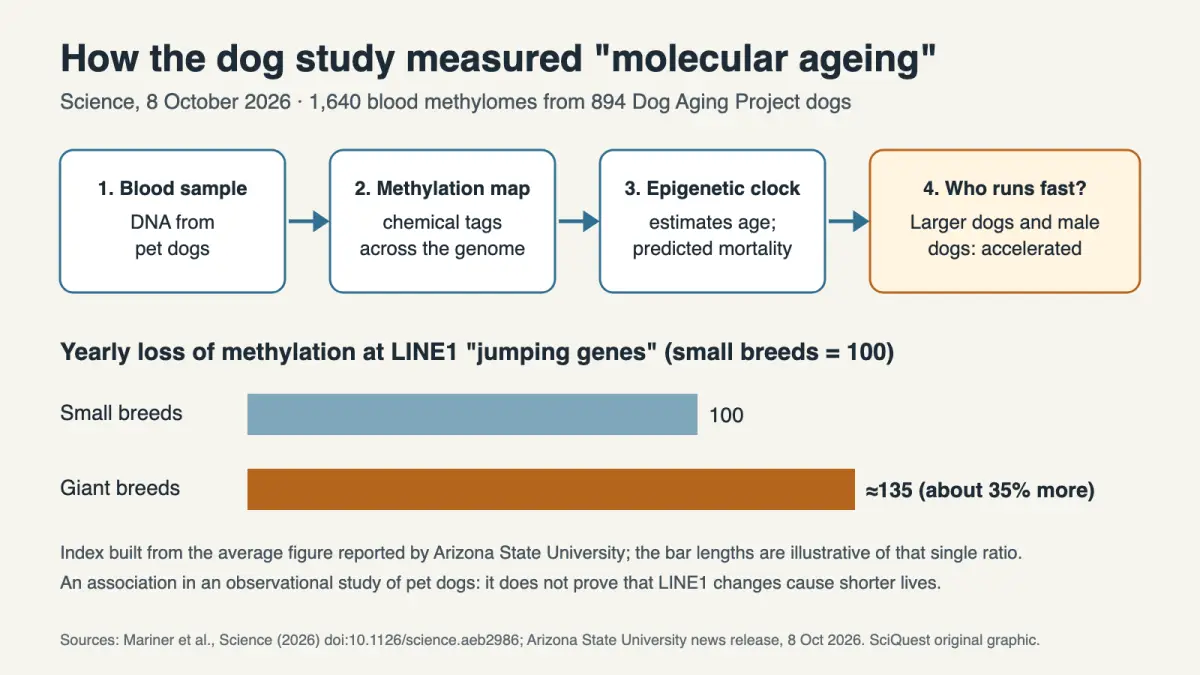
In 1,640 blood samples from 894 pet dogs, larger and male dogs showed faster “molecular ageing” on an epigenetic clock, and the size effect was strongest at self-copying stretches of DNA, though the study shows a link, not a cause.
Peer reviewed · Observational study (pet dogs)
Why do big dogs die younger than small ones? A team led by researchers at Arizona State University, working with the US-based Dog Aging Project, reports in Science (8 October 2026) that larger dogs and male dogs, both shorter-lived groups, show accelerated ageing in chemical marks on their DNA. In larger dogs the change was concentrated at “jumping genes” called transposable elements. That offers a candidate molecular explanation for a pattern owners have long noticed. It is still an association: the study does not show that these DNA changes cause shorter lives.
What you need to know
- Finding: Larger and male dogs aged faster on an epigenetic clock; in larger dogs the effect was strongest at transposable elements.
- Method: The team read DNA methylation in 1,640 blood samples (methylomes) from 894 dogs enrolled in the Dog Aging Project.
- Source: Mariner, McCoy, Snyder-Mackler and colleagues, Science, 8 October 2026.
- Why it matters: It points to a specific, testable piece of biology behind the size–lifespan trade-off in dogs.
- Limitation: The data show correlation; whether these changes drive ageing or just accompany it is not yet known.
Evidence at a glance
| Item | Assessment |
|---|---|
| Evidence status | Peer reviewed; observational study of pet dogs |
| Primary source | “Epigenetic aging and transposon dysregulation reflect size-related lifespan compression in dogs”, Science, published 8 October 2026, DOI 10.1126/science.aeb2986 |
| Evidence strength | Moderate, because the sample is large and the clock was checked against later deaths, but the design cannot separate cause from consequence |
| Principal limitation | Faster methylation loss at jumping genes is linked to body size, not shown to shorten life |
| Coverage at a glance | 3 distinct credible publishers found (Live Science, GEN, Techlicious) as of 12 October 2026, 11:12 UTC. Counted: independent outlets reporting this paper; excluded the university’s own release, syndicated reposts and content farms. Nature’s news coverage was reported but not located, so it is not counted. |
Source: abstract of the Science paper (via Crossref) and Arizona State University news release, 8 October 2026.
Is this a big deal?
It is a solid step, not a final answer. The basic pattern, that larger dogs tend to grow faster and die younger, was already well known. What is new is a large, peer-reviewed map of where in the genome that faster ageing shows up, and a specific suspect (transposable elements) that later experiments can test.
What scientists found
The researchers built an epigenetic clock: a model that estimates age from DNA methylation, the small chemical tags that help switch genes on or off without changing the DNA sequence. According to the paper’s abstract, the clock predicted mortality, and epigenetic ageing ran fastest early in life.
Two shorter-lived groups ran fast on that clock. Larger dogs and male dogs both showed accelerated molecular ageing, but by different routes. In males the changes were concentrated on the X chromosome. In larger dogs they were especially pronounced at transposable elements, stretches of DNA that can copy themselves to new places in the genome.
The paper’s abstract does not give effect sizes. Arizona State University’s news release, which SciQuest could not check against the paywalled full text, adds two figures for one family of these elements, called LINE1: according to the release, more than 40% of LINE1-associated regions lost methylation with age, and giant breeds lost about 35% more LINE1 methylation per year than small breeds, on average.
How they found it
The data came from the Dog Aging Project, a long-term study of pet dogs living ordinary lives with their owners. The team mapped methylation in blood-derived DNA, producing 1,640 methylomes from 894 dogs; some dogs were sampled more than once. The university’s release gives a slightly different figure (864 dogs) in places; SciQuest uses the numbers in the peer-reviewed abstract.
Think of methylation tags as clamps on a jumping gene. With age, some clamps loosen. The study’s central observation is that, in bigger dogs, the clamps on these elements seem to loosen faster.
Why it matters to you
If you share your home with a Great Dane or a Chihuahua, this study changes nothing you should do now. It offers no test or treatment; if you have questions about your own dog’s health or age, ask your vet. It explains, at the level of DNA chemistry, part of why a giant breed’s “dog years” may pass more quickly. The researchers also argue that pet dogs, which share our homes and environments, are a useful model for studying human ageing. For more on how pets affect their owners, see the science of why owning a pet is good for your health.
What the evidence does not show
It does not show that loosened control of jumping genes causes shorter lives. Arizona State University’s own release says more research is needed to decide whether LINE1 activity is a cause or a consequence of ageing.
The clock reads blood, one tissue. It also measures methylation, not whether the jumping genes actually became more active. And because these are pet dogs, breed size travels with many other differences in genetics, growth and health care.
How this fits what we already knew
Across mammal species, bigger usually means longer-lived: whales outlive mice. Within a species, the reverse often holds, and dogs are the clearest example. A 2024 preprint from the same Dog Aging Project group had already reported faster epigenetic ageing in larger breeds; this peer-reviewed paper extends that work and pins the size effect to transposable elements. Human research has found that ageing is not a smooth slope either; see evidence that ageing occurs in two bursts of human life.
What other scientists say
SciQuest searched news coverage on 12 October 2026 and found no named independent scientist quoted on this paper; the quotes in circulation come from the study team. Earlier peer-reviewed work by other groups is still useful, because it shows which parts of the new result were already expected.
| Study | Data | Key result | How it relates |
|---|---|---|---|
| Kraus, Pavard & Promislow, American Naturalist, 2013 | Death records from 74 breeds | Breeds differ in average life expectancy by a factor of about two; large dogs die young “mainly because they age quickly”, not because ageing starts earlier | Predicted a faster ageing rate in big dogs; Promislow is also an author of the new paper, so this is not fully independent |
| Teng et al., Scientific Reports, 2022 | 30,563 UK dogs that died 2016–2020 (VetCompass vet records) | Life expectancy at birth 11.23 years overall; females 11.41 vs males 11.07 years; Jack Russell Terrier 12.72 vs French Bulldog 4.53 years | Independent data showing males live slightly shorter lives, and that breed factors other than size (such as the French Bulldog’s flat face) also matter |
| Wang et al., Cell Systems, 2020 | Methylomes of 104 Labrador Retrievers aged across 16 years | Methylation changes shared with humans can translate dog age into human-equivalent age | Showed dog epigenetic clocks work; it used one breed, so it could not test size |
Sources: abstracts on PubMed (PMID 23535614, 32619550) and the open-access full text of Teng et al. (PMC9050668). Life expectancy is at age 0, UK population.
Taken together, the new paper fits a pattern other researchers had already measured from death records. What it adds is a candidate molecular route for that faster ageing. The finding is not disputed as far as SciQuest could find, but it is new and needs replication outside the Dog Aging Project.
How other headlines framed it
- Live Science framed it as a possible answer to the old question of why big dogs die younger.
- GEN (Genetic Engineering & Biotechnology News) led with the technical result: accelerated molecular ageing in both larger and male dogs.
- Techlicious called it a clue, a more cautious framing that fits the correlational evidence.
What happens next
The obvious test is causal: would keeping LINE1 elements in check slow ageing in large dogs, or in lab animals first? The Dog Aging Project keeps following its dogs, so later deaths and health records can show how well the clock forecasts real outcomes. The team suggests the same mechanism could matter in humans, which remains speculative; for one example of how anti-ageing claims are tested in animals, see the semaglutide lifespan study in older mice.
In one sentence
Big dogs’ DNA shows faster signs of ageing, especially where self-copying genes are normally held in check, but this is a strong lead, not proof of why they die younger.
Quick check: test yourself
- Which two groups of dogs aged faster on the epigenetic clock? Larger dogs and male dogs.
- Does the study prove jumping genes shorten dogs’ lives? No. It shows an association; cause and effect remain untested.
Read next
Sources and disclosure
- Mariner B, McCoy B, … Snyder-Mackler N, et al. “Epigenetic aging and transposon dysregulation reflect size-related lifespan compression in dogs.” Science, 8 October 2026. doi:10.1126/science.aeb2986
- Arizona State University News. “Why big dogs age faster”, 8 October 2026.
- Dog Aging Project researchers. “Aging at scale” (preprint), bioRxiv, 2024.
- Kraus C, Pavard S, Promislow DEL. “The size–life span trade-off decomposed: why large dogs die young.” American Naturalist 181(4):492–505, 2013. doi:10.1086/669665
- Teng, Brodbelt, Pegram, Church, et al. “Life tables of annual life expectancy and mortality for companion dogs in the United Kingdom.” Scientific Reports, 2022. doi:10.1038/s41598-022-10341-6
- Wang T, et al. “Quantitative translation of dog-to-human aging by conserved remodeling of the DNA methylome.” Cell Systems 11(2):176–185, 2020. doi:10.1016/j.cels.2020.06.006
Disclosure: This article was drafted with AI assistance and checked against the sources above. The graphic is a SciQuest original; its index of 100 vs about 135 is computed from the 35% figure in the university release. The comparison table is compiled by SciQuest from the cited abstracts and open full text. SciQuest has no conflicts of interest. Spotted an error? See our corrections policy.
Discover more from SciQuest
Subscribe to get the latest posts sent to your email.
Leave a comment