

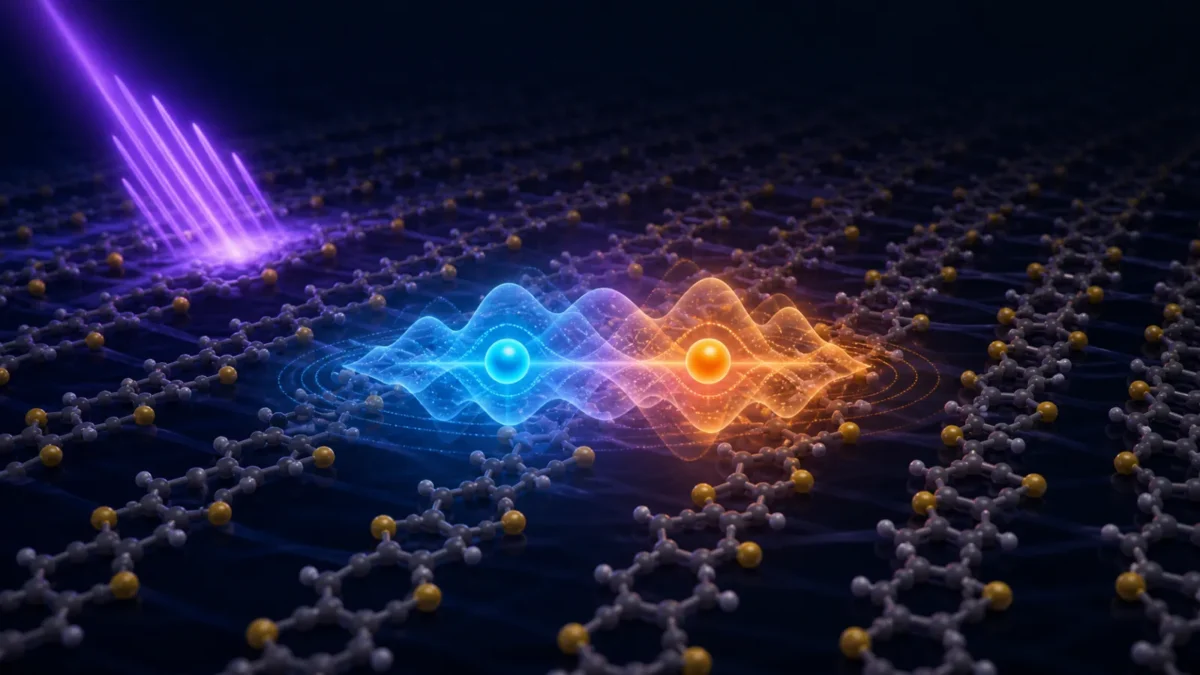
Ultrafast photoemission measurements reconstructed an exciton spread across roughly three α-sexithiophene molecules before its radius contracted by about 25% within 400 femtoseconds.
Published: September 1, 2026, 9:30 p.m. PKT · Primary paper published: August 28, 2026 · Reporting cutoff: September 1, 2026, 9:15 p.m. PKT
What you need to know
- An exciton is a correlated electron–hole pair created when a semiconductor absorbs light.
- The experiment studied thin films of the organic semiconductor α-sexithiophene.
- Femtosecond photoemission orbital tomography recorded the exciton’s momentum-space fingerprints over time.
- A model reconstructed the real-space wave function, showing an initial span of about three molecules and a roughly 25% contraction within 400 femtoseconds.
- The result is a reconstructed quantum evolution, not a camera video or proof of a more efficient commercial solar cell.
The first step from absorbed light toward electrical energy lasts for less than a trillionth of a second. Researchers have now reconstructed that step with unusual detail, following the changing quantum wave function of an exciton inside an organic semiconductor.
The result is often described as filming light on its way to electricity. That is a useful metaphor, but not a literal account. The team measured electrons knocked out of the material, then combined those patterns with quantum calculations to reconstruct what the exciton was doing.
What an exciton is—and why it matters
When a semiconductor absorbs a photon, an electron can move into a higher-energy state, leaving behind a positively charged absence called a hole. The electron and hole remain correlated through their electrical attraction; together they form an exciton.
Excitons govern how energy moves through organic solar cells, light-emitting diodes and other optoelectronic materials. If an exciton becomes trapped or loses energy before its charges separate, less useful electrical energy may emerge. Understanding its earliest motion is therefore essential for designing materials, even though a basic measurement does not automatically improve a device.
How scientists reconstructed 400 femtoseconds of motion
The researchers prepared ordered films of α-sexithiophene, an organic semiconductor made from linked thiophene units. An ultrashort pump pulse created excitons. A second, higher-energy probe pulse ejected electrons from the material at carefully controlled time delays.
Measuring the energies and emission angles of those electrons produced momentum-space fingerprints. Photoemission orbital tomography and many-body calculations then mapped the fingerprints back to a real-space wave function, including its spatial extent and internal quantum phase.
The reconstructed exciton initially extended coherently across about three molecular units. During the first 400 femtoseconds—0.0000000000004 seconds—its radius contracted by approximately 25%. The behavior matched calculations in which coupling between the exciton and vibrations of the molecular lattice drives partial self-trapping.
Why “light becoming electricity” needs qualification
The experiment captured an early energy-bearing state, not the complete production of usable current. In a photovoltaic device, the electron and hole must ultimately separate, reach contacts and travel through an external circuit. This study did not demonstrate those later steps or report a higher solar-cell conversion efficiency.
The reconstructed movie also depends on a model linking measured photoelectrons to the wave function. Agreement with advanced calculations strengthens the interpretation, but researchers should test the method in other materials and less idealized structures.
Readers interested in ultrafast optical measurements can also explore SciQuest’s report on fluorescent probes that improve nanoscale DNA imaging, another case where the measurement method determines what scientists can reliably see.
How other headlines framed it
- Physical Review X emphasizes the spatial and temporal evolution of exciton wave functions in organic semiconductors.
- The University of Graz uses the accessible “first moments from light to electricity” framing.
- Forschungszentrum Jülich foregrounds the tomography method and the approximately 25% contraction within 400 femtoseconds.
What happens next
The method could be applied to other low-dimensional and organic semiconductors to test how molecular packing, disorder and interfaces alter exciton motion. Those comparisons may eventually guide material design by showing where energy becomes localized too quickly.
Bottom line: Scientists reconstructed an exceptionally fast quantum contraction at the start of light-driven energy transport. It is a new window into photovoltaic physics, not a finished solar-energy breakthrough.
Sources
- Theilen et al., “Observing the Spatial and Temporal Evolution of Exciton Wave Functions in Organic Semiconductors,” Physical Review X, August 28, 2026.
- University of Graz research summary, September 1, 2026.
- Forschungszentrum Jülich publication record.
Editorial disclosure: The lead image is an original concept illustration of an exciton in an organic molecular film, not a direct photograph, measured wave-function plot or study figure. SciQuest received no payment for this coverage. To report a possible error, contact SciQuest.
Discover more from SciQuest
Subscribe to get the latest posts sent to your email.
Leave a comment