

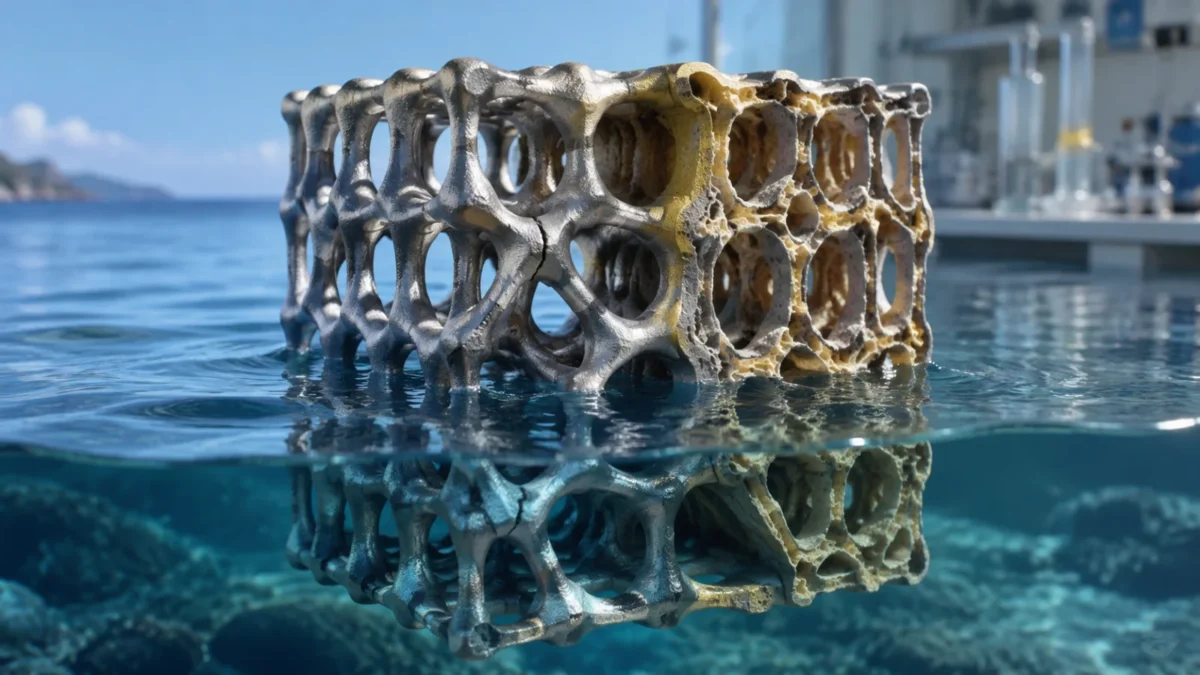
A 3D-printed titanium-alloy lattice with polymer foam sealed inside its hollow struts floated for more than two months and remained buoyant after cracking, but it is still a small-scale prototype.
Published: September 3, 2026, 9:27 p.m. PKT · Reporting cutoff: September 3, 2026, 9:15 p.m. PKT
What you need to know
- The material combines a 3D-printed Ti-6Al-4V hollow-strut lattice with expandable polyurethane foam inside the struts.
- Its large outer cells stay open to water, while sealed foam lowers the load-bearing skeleton’s effective density enough to float.
- Samples remained buoyant in freshwater for more than two months, and a prototype buoy stayed stable in a tilted turbulent seawater tank.
- The hybrid retained buoyancy after substantial cracking and showed less than 1% strength loss after a two-week seawater test.
- Long-term ocean durability, environmental effects, manufacturing cost and full-scale performance remain unproven.
Titanium is much denser than water, yet engineers have made a titanium-based structure that floats—even after parts of it crack. The trick is not changing the metal’s chemistry. It is redesigning where mass, empty space and sealed buoyancy sit inside a 3D-printed lattice.
The result could point toward tougher buoys, floating sensors or marine structures. It is not ready to replace conventional materials: the evidence comes from laboratory specimens and a prototype, not years in a working ocean.
How engineers made a titanium lattice float
An ordinary open-cell metal lattice can have a low bulk density, but water floods its connected pores and it sinks. The RMIT-led team printed a Ti-6Al-4V lattice whose individual struts were hollow, then injected expandable polyurethane foam into those internal channels.
Water can still flow through the large spaces between struts, so the structure does not rely on a sealed outer shell. The foam trapped inside the load-bearing network excludes water and lowers what the researchers call the “skeletal density”—the density of the material that water cannot enter—below the density of the surrounding liquid.
What the flotation and damage tests showed
Small samples floated in freshwater for more than two months. The team also built a buoy that stayed upright in a turbulent seawater tank as the tank tilted by as much as 45 degrees.
Cracking or fracturing layers did not immediately flood the structure because buoyancy was distributed through foam-filled channels. The researchers reported that severe densification eventually caused sinking, which defines an important failure boundary rather than suggesting the material is unsinkable.
After two weeks of seawater exposure, samples lost about 0.15% of their mass and less than 1% of their strength. At the same bulk density, the hybrid’s reported strength was about 70% higher than density-scaled reference values for high-density polyethylene and 316L stainless steel. Real components, however, may face joints, impacts and cyclic loads not captured by that comparison.
Why the design could matter
Marine engineers often trade strength against buoyancy and repairability. A permeable metal skeleton that retains distributed flotation could offer a different damage mode from hollow sealed shells, which can rapidly lose buoyancy after a breach.
The architecture is also tunable. Researchers propose changing the internal filler for energy absorption, heat control or vibration damping, although those uses remain design possibilities rather than demonstrated products.
What still needs to be proved
Two months of floating and two weeks of seawater exposure cannot reproduce years of waves, salt, ultraviolet light, temperature cycling, biofouling and abrasion. Scale-up may introduce printing defects, while polyurethane aging and end-of-life recycling need environmental assessment.
How other headlines framed it
- RMIT University presented the work as a world-first floating titanium structure and emphasized possible marine applications.
- Tech Xplore stressed that the hollow struts are foam-filled and that flotation persisted after damage.
- CHIP foregrounded the apparently paradoxical idea of titanium staying on the water’s surface.
Bottom line: Engineers did not make solid titanium lighter than water; they created a strong, open titanium–polymer architecture whose sealed skeleton is buoyant. The laboratory result is credible, while full-scale ocean performance remains to be demonstrated.
Sources
- Noronha and colleagues, “Breaking the Surface: Buoyant Metal–Polymer Open–Cell Hybrid Lattice Metamaterials,” Advanced Materials, 2026.
- RMIT University research release, September 3, 2026.
Editorial disclosure: The lead image is an original concept illustration, not a photograph or study figure. SciQuest received no payment for this coverage. To report a possible error, contact SciQuest.
Discover more from SciQuest
Subscribe to get the latest posts sent to your email.
Leave a comment