

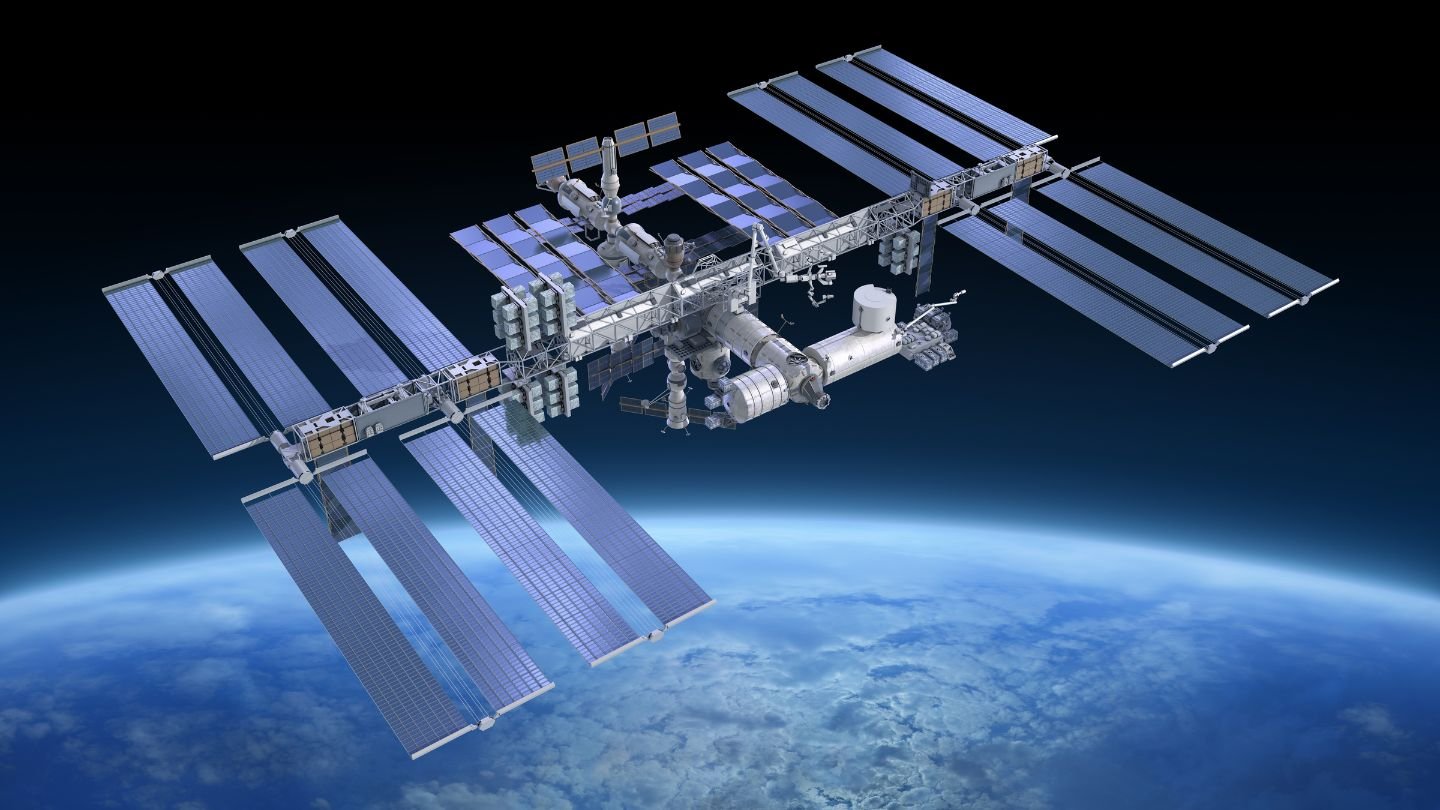
The International Space Station (ISS) measures about 109 metres (356 feet) from end to end, one yard short of an American football field including the end zones, and has a mass of about 419,725 kg (925,335 lb), according to NASA. Its solar arrays span about 73 m (239 ft) in the other direction.
Inside, the station has about 1,005 cubic metres of pressurized volume, which NASA compares with the interior of a Boeing 747. It orbits roughly 415 km (257 miles) above Earth at about 28,000 km/h (17,500 mph).
Key ISS size facts
- End-to-end span: 109 m (356 ft), across the outermost solar arrays
- Main truss: 94 m (310 ft), the beam that carries the arrays and radiators
- Mass: about 419,725 kg (925,335 lb), or roughly 420 metric tonnes
- Living space: 388 m³ (13,696 ft³) of habitable volume, not counting visiting spacecraft
- Altitude: around 415 km (257 miles), adjusted by regular reboosts
ISS dimensions: the full measurements
| Measurement | Metric | Imperial | What it describes |
|---|---|---|---|
| End-to-end span | 109 m | 356 ft | Tip to tip along the truss, including the outermost solar arrays |
| Integrated truss length | 94 m | 310 ft | The main beam itself |
| Solar array length | 73 m | 239 ft | Across both longitudinally aligned arrays |
| Pressurized module length | 67 m | 218 ft | Along the major axis of the crewed modules |
| Mass | 419,725 kg | 925,335 lb | Whole station; NASA gives no date or configuration |
| Pressurized volume | 1,005 m³ | 35,491 ft³ | All pressurized space |
| Habitable volume | 388 m³ | 13,696 ft³ | Usable living space, excluding visiting vehicles |
| Power | 75–90 kW | — | From eight solar arrays |
Source: NASA, International Space Station Facts and Figures (page last updated July 16, 2024). Values are NASA’s rounded figures.
Is the ISS 94 metres or 109 metres long?
Both figures are correct; they measure different things. The integrated truss, the station’s backbone, is 94 m (310 ft) long. Solar array wings mounted near each end extend beyond the truss, so the full span from one array tip to the other is 109 m (356 ft). NASA calls this the solar array wingspan.
The 73 m (239 ft) figure runs the other way, across a pair of solar arrays. In plan view, then, the station covers an area of roughly 109 m by 73 m, although most of that area is open framework and solar panels rather than enclosed rooms.
How big is the ISS compared with familiar things?
| Comparison | ISS value | Reference value | Result |
|---|---|---|---|
| American football field, including end zones | 109 m (356 ft) span | About 110 m (about 359–360 ft) | About the same length; NASA says the ISS is one yard shorter |
| Airbus A380 wingspan | 109 m (356 ft) span | 80 m (262 ft) | ISS is about 1.36 times wider (109 ÷ 80) |
| Boeing 747 cabin | 1,005 m³ pressurized volume | Comparable, per NASA | Similar interior volume |
| A house | 388 m³ habitable volume | — | NASA: larger than a six-bedroom house |
Source: NASA, International Space Station Facts and Figures. The football-field length is derived from NASA’s “one yard shy” comparison (356 ft + 3 ft); the A380 ratio was calculated by SciQuest.
The football-field comparison applies to length. Earlier versions of this article said the station was “as wide as” a football field, which was wrong.
How many rooms are on the ISS?
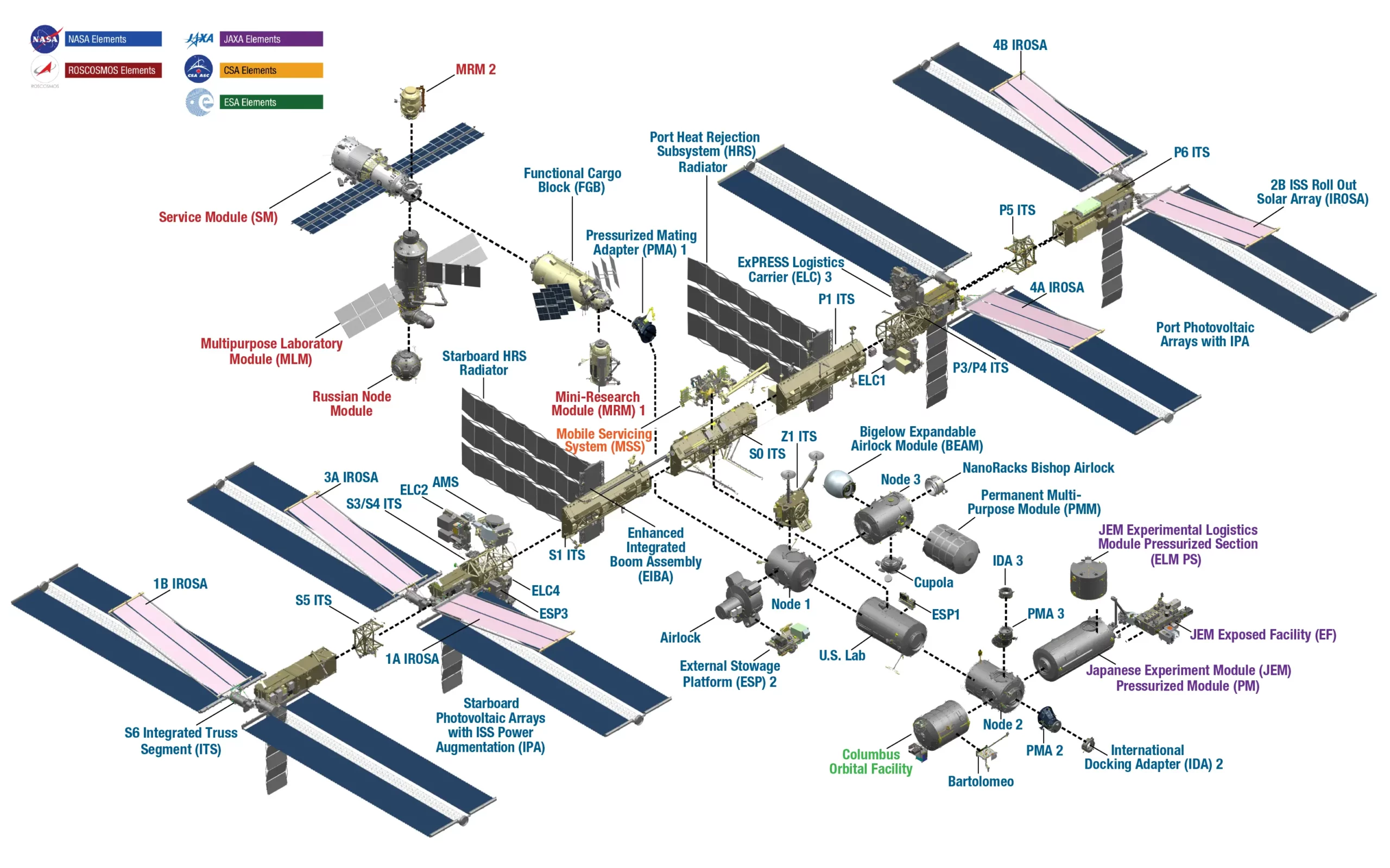
NASA describes the station as larger than a six-bedroom house, with six sleeping quarters, two bathrooms, a gym and a 360-degree bay window. Its pressurized modules also include laboratories from the United States, Europe and Japan, plus Russian modules, airlocks and docking ports.
The station’s size makes room for traffic, too. NASA says eight spacecraft can be connected at once, which is one reason the station’s total mass is best treated as approximate: visiting vehicles and cargo come and go.
How high is the International Space Station?
NASA says the station operates at about 415 km (257 miles) altitude. The height is not fixed. At that altitude Earth’s thin upper atmosphere still causes drag, so the station needs regular reboosts. NASA estimates that without them it would re-enter within roughly one to two years, depending on solar activity.
The ISS is visible to the naked eye because it reflects sunlight, much as the Moon does. NASA says the best viewing is usually at twilight or night, and sighting opportunities range from about one a month to several a week depending on location.
How fast does the ISS travel, and how long is a day on board?
The station travels at about 28,000 km/h (17,500 mph) and circles Earth roughly every 90 minutes. That means about 16 orbits, and 16 sunrises and sunsets, every 24 hours. For more on orbital speeds, see SciQuest’s explainer on how fast we can travel in space with current technology.
A 90-minute orbit is not a 90-minute day: those 16 sunrises all happen within one ordinary 24-hour day. NASA says astronauts work out at least two hours a day, part of its research into protecting bones and muscles on long missions.
How many people live on the ISS?
NASA describes an international crew of seven people living and working aboard; NASA’s station overview listed seven Expedition 74 crew members in October 2026. The station has been continuously occupied since November 2000.
As of NASA’s count updated on October 1, 2026, 298 people from 26 countries have visited the ISS. Astronauts eat, sleep and work in the habitable volume described above; SciQuest has a separate guide to what astronauts eat in space.
Who owns and operates the ISS?
The ISS is operated by a partnership of five space agencies representing 15 countries: NASA (United States), Roscosmos (Russia), the European Space Agency, the Japan Aerospace Exploration Agency and the Canadian Space Agency. Europe takes part through ESA rather than as a single country, which is why earlier descriptions of “five owner countries” were inaccurate.
The station is also a proving ground. NASA says research on board lays the groundwork for missions to the Moon and beyond, from crew-health studies to tests of life-support, radiation-sensing and fuel-storage technology. That work feeds into plans for longer trips, such as those covered in SciQuest’s explainer on how far Mars is from Earth.
Is the ISS the only space station?
No. China operates its own crewed outpost, the Tiangong space station, which the United Nations Office for Outer Space Affairs identifies as run by the China Manned Space Agency (CMSA), not the China National Space Administration as this article previously said. SciQuest has covered research on microbes found aboard Tiangong.
NASA is also supporting private companies that are developing commercially owned and operated stations intended to follow the ISS.
When will the ISS be retired?
NASA’s current plan is to operate the station through 2030 and then bring it down in a controlled re-entry over a remote ocean area. In June 2024, NASA selected SpaceX to build the U.S. Deorbit Vehicle for that final manoeuvre, under a contract with a potential value of up to $843 million. The United States, Japan, Canada and participating European countries have committed to operations through 2030; Russia has committed through at least 2028.
These dates are plans, not certainties. They depend on budgets, partner agreements and whether commercial stations are ready to take over, so check NASA’s transition updates for the latest schedule.
Related reading
- How large is the Hubble Space Telescope?
- What do astronauts eat in space?
- How fast can we travel in space with current technology?
Update note: This article was substantially revised on October 12, 2026, to reconcile all dimensions with NASA’s figures (mass corrected from “450 tons (408,000 kg)” to 419,725 kg; the conflicting 32,333 ft³ “total volume” removed), explain the 94 m truss versus the 109 m end-to-end span, correct the football-field comparison to length, correct sleeping quarters to six, identify the ISS partners as five agencies from 15 countries, correct Tiangong’s operator to the China Manned Space Agency, update altitude, visitor numbers and the planned 2030 retirement, and add sources. It was drafted with AI assistance and checked against the sources listed below.
Sources
- NASA, International Space Station Facts and Figures
- NASA, International Space Station Overview
- NASA, International Space Station Visitors by Country
- NASA, International Space Station Cooperation
- NASA, FAQs: The International Space Station Transition Plan
- NASA, NASA Selects International Space Station US Deorbit Vehicle (June 26, 2024)
- NASA, Spot the Station Frequently Asked Questions
- NASA, NASA Shares Station Research Today Supporting Moon, Mars Tomorrow
- United Nations Office for Outer Space Affairs, UNOOSA and CMSA announce winners of opportunity to fly experiments on board China Space Station
Discover more from SciQuest
Subscribe to get the latest posts sent to your email.
Leave a comment