
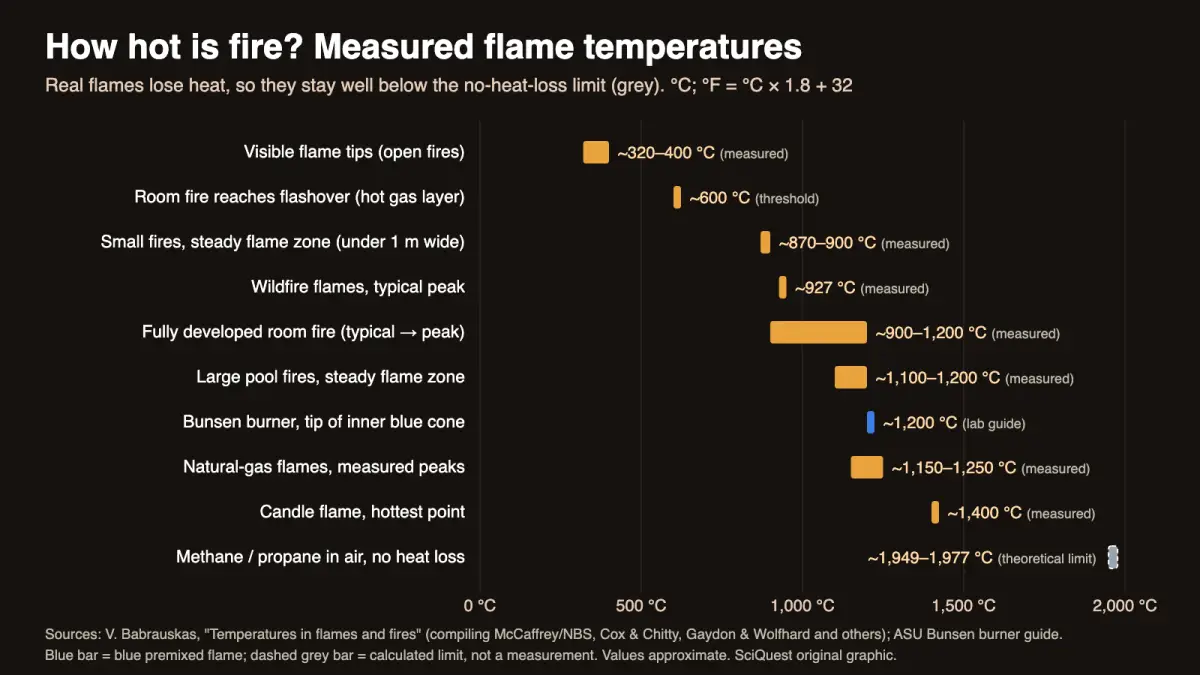
Most flames you will ever see burn at roughly 900–1,400 °C, but the number depends on where you measure, what is burning and how much heat escapes, which is why ordinary fires stay well below the 1,949 °C that textbook tables quote for natural gas burning in air.
Ordinary fire is usually about 900–1,400 °C (1,650–2,550 °F) in its hottest parts. Fire scientist Vytenis Babrauskas, summarising decades of measurements, puts the steady flame zone of small fires at around 900 °C and the peak of a candle flame at around 1,400 °C. The visible tips of a flame are far cooler, roughly 320–400 °C.
So “how hot is fire?” has no single answer. A flame is not one temperature but a moving map of temperatures, and the colour you see tells you more about soot than about heat.
Explain it like I’m busy:
- Measured flames mostly fall between about 900 and 1,400 °C; flame tips can be as cool as about 320 °C.
- Textbook values near 1,950 °C are calculated limits that assume no heat is lost, so real fires stay well below them.
- Blue means little or no soot and light from chemical reactions; yellow means glowing soot. Colour alone is not a reliable thermometer.
Key facts
- Candle: peak temperature around 1,400 °C (about 2,550 °F), measured (Gaydon and Wolfhard, cited by Babrauskas).
- Small open fires: about 900 °C in the continuous flame zone; about 320–400 °C at the flickering tips (measured).
- Bunsen burner: about 1,200 °C at the tip of the inner blue cone, its hottest part, according to an Arizona State University lab guide.
- Natural gas or propane, theoretical limit: 1,949 °C and 1,977 °C (calculated adiabatic flame temperatures, which assume zero heat loss).
- Blue vs yellow: NASA attributes blue flame light to chemiluminescence and yellow, orange and white light to glowing soot.
| Flame or fire | Temperature (°C) | Temperature (°F) | What kind of number |
|---|---|---|---|
| Visible tips of open turbulent flames | ~320–400 | ~610–750 | Measured, summary range |
| Room fire at flashover (average hot gas layer) | ~600 | ~1,110 | Widely used threshold |
| Small fires (base under ~1 m), steady flame zone | ~900 | ~1,650 | Measured |
| Wildfire flames, typical peak | ~927 | ~1,700 | Measured (Australian studies) |
| Fully developed room fire | ~900–1,000 typical; ~1,200 peak | ~1,650–1,830; ~2,190 | Measured |
| Large pool fires, steady flame zone | ~1,100–1,200 | ~2,010–2,190 | Measured |
| Bunsen burner, tip of inner blue cone | ~1,200 | ~2,190 | Lab guide figure |
| Turbulent natural-gas flames, peak | ~1,150–1,250 | ~2,100–2,280 | Measured |
| Candle flame, hottest point | ~1,400 | ~2,550 | Measured |
| Methane (natural gas) in air, no heat loss | 1,949 | 3,540 | Calculated limit |
| Propane in air, no heat loss | 1,977 | 3,591 | Calculated limit |
Sources: Babrauskas, Temperatures in flames and fires, which compiles measurements by McCaffrey (US National Bureau of Standards), Cox and Chitty, Ingason, Gaydon and Wolfhard and others; Arizona State University Bunsen burner guide. Fahrenheit values converted by SciQuest (°F = °C × 1.8 + 32) and rounded.
What “fire temperature” really means
Think of a flame as a thin, moving shell where fuel vapour and oxygen meet and react, not as a uniformly hot object. Inside that shell there may be unburned fuel; above it, hot gases cool as they rise and mix with air.
That is why a candle shows a dark inner region near the wick, where wax vapour has not yet met enough oxygen to burn, wrapped in a bright zone where it does. Any single “fire temperature” is really a statement about one place in that map. The analogy has a limit: unlike a shell, a real flame flickers, so a fixed probe sees hot and cooler gas pass by in turn.
How scientists measure flame temperature
Measuring a flame is harder than it sounds. Babrauskas notes that most fire tests rely on thermocouples, small wire temperature sensors, which carry several possible errors, including heat lost by radiation from the sensor itself. Laser-based optical methods avoid touching the flame but are difficult and expensive, so they are rarely used for building fires.
Turbulence adds a second problem. A large flame moves in pockets, so a sensor at one spot records an average of burning and non-burning gas. This is a major reason published figures for the “same” fire can differ by hundreds of degrees.
The cleanest numbers come from experiments on gas burners. B. J. McCaffrey’s measurements at the US National Bureau of Standards (now NIST) described three regions above a fire: a continuous flame zone at slightly below 900 °C, an intermittent zone where temperature falls with height, and the visible flame tips at around 320 °C. Later research groups, including one at France’s University of Poitiers, reported very similar values.
Why the textbook number is too high
Combustion tables usually list the adiabatic flame temperature: the temperature a flame would reach if it lost no heat at all. It can be calculated from chemistry alone. For methane, the main component of natural gas, it is 1,949 °C; for propane, 1,977 °C. Babrauskas notes that the value for wood is nearly the same as for propane.
Real flames radiate heat to cooler surroundings and mix with extra air, so they stay well below that ceiling. The gap is the reason a measured campfire-sized flame sits near 900 °C, not near 1,950 °C, even though the fuel’s calculated limit is similar.
Here is a worked example of the unit conversion. A candle’s 1,400 °C peak becomes 1,400 × 1.8 + 32 = 2,552 °F, which we round to about 2,550 °F because the original figure is itself approximate.
How hot is blue fire, and why are some flames yellow?
The hottest part of a blue Bunsen burner flame is about 1,200 °C (about 2,190 °F), according to an Arizona State University lab guide, and measured turbulent natural-gas flames peak at about 1,150–1,250 °C. A natural-gas flame, such as on a gas hob, cannot exceed the 1,949 °C limit for methane in air. What makes it blue is not simply heat.
NASA explains that blue regions of a flame come from chemiluminescence, light given off directly by short-lived molecules formed during the chemical reaction. The white, yellow and orange regions are glowing soot: tiny carbon-rich particles heated until they shine, the same way a hot stove element glows. NASA images of flames in microgravity show soot clusters that “glow yellow when hot.”
A gas burner looks blue because air is mixed with the gas before it burns (a premixed flame), so little soot forms. A candle, wood fire or match is a diffusion flame: fuel and air meet only at the flame, soot forms inside, and the flame shines yellow. That distinction matters because a yellow candle flame can have a hotter peak (around 1,400 °C) than the 1,200 °C figure for a blue Bunsen cone. Colour tells you mainly how the fuel is burning, not exactly how hot it is.
What changes the answer
- Where you measure: the base, middle and tip of the same flame can differ by more than 500 °C.
- Size: large fires lose a smaller share of heat, so big pool fires reach about 1,100–1,200 °C versus about 900 °C for small ones.
- Surroundings: in a room, hot walls radiate heat back, so fully developed room fires commonly reach 900–1,000 °C and occasionally about 1,200 °C.
- Oxygen supply and mixing: premixed (blue) and diffusion (yellow) flames have different structures.
- Measurement method: thermocouple readings in turbulent flames carry errors that are hard to quantify.
Why it matters to you
These numbers explain everyday observations, such as why the flickering tip of a flame is far cooler than its body and why the blue ring on a gas hob burns without the yellow glow of a candle. They also explain why fire investigators should not judge what melted in a fire by comparing materials with textbook flame temperatures, the misuse Babrauskas’s paper was written to correct.
Fire-science figures for room fires, such as flashover at about 600 °C, describe how fires develop. They are not safety guidance; for home fire safety, follow your local fire service or the US Fire Administration.
“But wait…”
Isn’t blue fire always hotter than yellow fire? Not as a rule. Blue light reveals reaction chemistry with little soot, and a soot-free flame can be cooler than a sooty one, as the Bunsen and candle figures show. To compare two flames you need a measurement, not a colour chart.
If a flame is 900 °C, why doesn’t a pan over it instantly reach 900 °C? Temperature is not the same as heat transferred. As Babrauskas notes, objects take time to heat up, depending on their size, density and conductivity.
Related questions
How hot is a candle flame? Its hottest point is about 1,400 °C (about 2,550 °F); the rest of the flame is cooler.
How hot is a wood fire? Measurements of comparable small open fires show about 900 °C in the steady flame zone and roughly 320–400 °C at the tips; wood’s calculated no-heat-loss limit is close to propane’s 1,977 °C.
What is the hottest thing in the universe? Fire is mild by cosmic standards; see what the hottest thing in the universe is.
In one sentence
Real flames usually burn at about 900–1,400 °C, cooler at their tips and well below textbook limits, and their colour reveals soot and chemistry more reliably than temperature.
Quick check: did it click?
- Why don’t real fires reach the 1,949 °C listed for methane? That value assumes no heat loss; real flames radiate heat and mix with air.
- What makes a candle flame yellow? Soot particles heated until they glow.
- Does a blue flame prove it is hotter? No. Blue mainly indicates little soot and chemiluminescence.
Read next
- What is the hottest thing in the universe? From flames to the hottest temperatures ever recorded.
- The stages of a star’s life cycle, where nuclear fusion, not chemical burning, sets the temperature.
- Safety in smoke: health challenges for today’s firefighters.
Sources
- Babrauskas, V. Temperatures in flames and fires. Fire Science and Technology Inc. Review citing McCaffrey (NBSIR 79-1910), Cox and Chitty (Combustion and Flame, 1980), Smith and Cox (Combustion and Flame, 1992), Gaydon and Wolfhard (Flames, 3rd ed., 1970) and others.
- Arizona State University Environmental Health and Safety. Guide for Bunsen burner use.
- NASA. Aflame (image article, 23 June 2011): blue chemiluminescence and glowing soot.
- NASA. Studying flames in microgravity (23 February 2022).
- US Energy Information Administration. Natural gas explained: methane is the largest component of natural gas.
Disclosure: This article was drafted with AI assistance and checked against the sources above. Fahrenheit conversions and the bar chart are SciQuest’s own, using only values from the cited sources. Spotted an error? See our corrections policy.
Discover more from SciQuest
Subscribe to get the latest posts sent to your email.
Leave a comment