

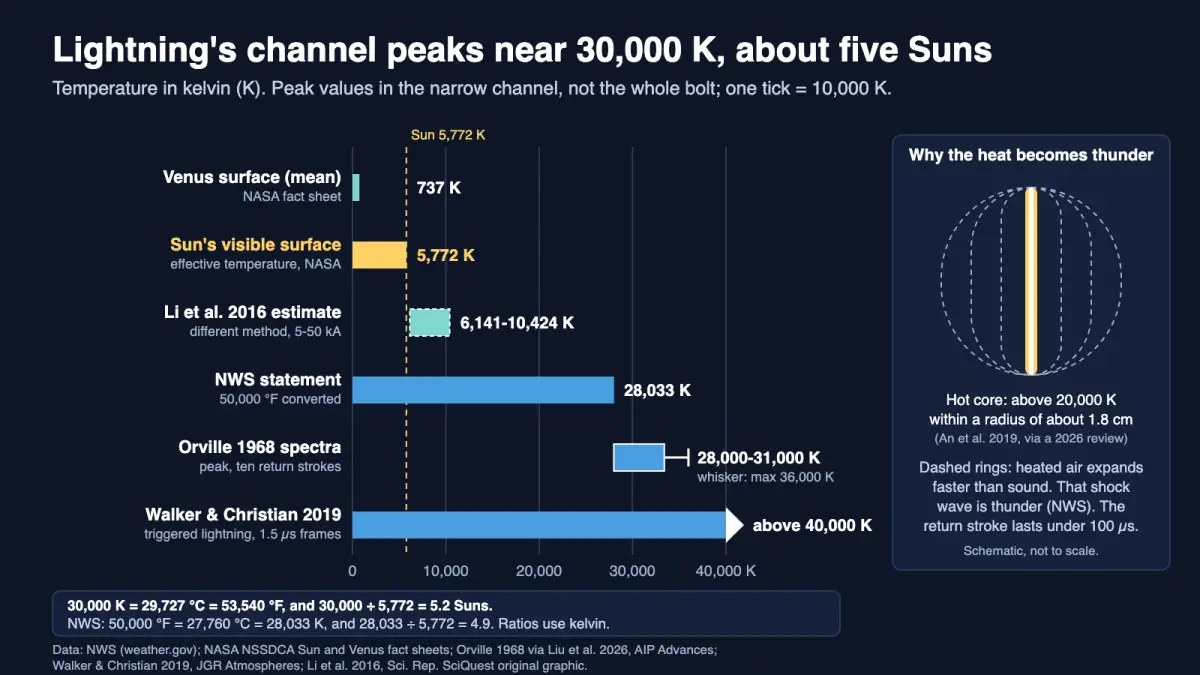
Spectra recorded from lightning return strokes put the peak near 30,000 K, but the figure describes a channel only centimetres across for a few microseconds, and published values run from about 10,000 K to more than 40,000 K depending on the method.
Lightning’s channel reaches about 30,000 K (roughly 29,700 °C or 53,500 °F) at its hottest, around five times the 5,772 K of the Sun’s visible surface. That peak is a temperature calculated from measured light spectra in the first microseconds of a return stroke, the bright surge that follows once a leader has connected the cloud to the ground. It applies to a thin channel of air turned to plasma, not to the whole flash and not to the air around it.
The National Weather Service rounds the same idea to 50,000 °F, which converts to 27,760 °C or 28,033 K, within about 7% of the research figure. A 2019 study of triggered lightning reported above 40,000 K, so “about 30,000 K” is a typical peak, not a ceiling.
Explain it like I’m busy:
- Peak channel temperature is about 30,000 K (29,727 °C, 53,540 °F), calculated from spectra. That is 5.2 times the Sun’s 5,772 K visible surface.
- NWS says 50,000 °F, which is 28,033 K, so the official and research numbers agree once the units are converted.
- The heat is brief and narrow, which is why it makes thunder and can melt sand but does not warm the whole sky.
Key facts about lightning’s temperature
- Typical peak: 28,000 to 31,000 K across ten return strokes in Orville’s 1968 spectra, with a hottest stroke near 36,000 K.
- Highest reading: above 40,000 K in a five-stroke triggered flash recorded at 673,000 frames per second (Walker and Christian, 2019).
- Official wording: NWS says lightning can heat the air to 50,000 °F, about five times the Sun’s surface.
- Duration: the return stroke takes under 100 microseconds (NWS), and the current reaches its peak in about 1 microsecond (NOAA JetStream).
- Not the Sun’s core: NASA lists the Sun’s central temperature as 1.571 × 10⁷ K, about 520 times lightning’s peak.
| Source and what it reports | Value as published | Kelvin (K) | Celsius (°C) | Fahrenheit (°F) | Times the Sun’s 5,772 K |
|---|---|---|---|---|---|
| NASA, Sun: effective temperature of the visible surface | 5,772 K | 5,772 | 5,499 | 9,930 | 1.0 |
| NASA, Venus: mean surface temperature | 737 K | 737 | 464 | 867 | 0.13 |
| Li et al. 2016: channel estimate for 5 to 50 kA currents | 6,141 to 10,424 K | 6,141 to 10,424 | 5,868 to 10,151 | 10,590 to 18,300 | 1.1 to 1.8 |
| NWS Flagstaff: air heated “near” this value | 10,000 °C | 10,273 | 10,000 | 18,030 | 1.8 |
| Prueitt 1963, five return strokes (as summarised in a 2026 review) | 24,200 to 28,400 K | 24,200 to 28,400 | 23,927 to 28,127 | 43,100 to 50,660 | 4.2 to 4.9 |
| Uman 1964, estimated peak (same review) | 25,000 to 26,000 K | 25,000 to 26,000 | 24,727 to 25,727 | 44,540 to 46,340 | 4.3 to 4.5 |
| NWS (several pages): maximum air temperature in the channel | 50,000 °F | 28,033 | 27,760 | 50,000 | 4.9 |
| Orville 1968, peak across ten return strokes (same review) | 28,000 to 31,000 K | 28,000 to 31,000 | 27,727 to 30,727 | 49,940 to 55,340 | 4.9 to 5.4 |
| Orville 1968, hottest of ten strokes (same review) | 36,000 K | 36,000 | 35,727 | 64,340 | 6.2 |
| Walker and Christian 2019, triggered lightning | above 40,000 K | above 40,000 | above 39,727 | above 71,540 | above 6.9 |
Sources: NASA NSSDCA Sun and Venus fact sheets; NWS pages cited below; Walker and Christian (2019); Li et al. (2016); Prueitt, Uman and Orville values as reported in Liu, Jiang and Wang (2026), AIP Advances 16, 105205. Conversions are SciQuest calculations: °C = K − 273.15; °F = °C × 1.8 + 32, rounded to the nearest 10 °F above 1,000 °F. Ratios use kelvin.
What 30,000 K means in plain terms
Temperature measures how energetically the particles in a material move. At these temperatures the air in the channel is ionised: the spectra show free electrons at densities above 1019 per cubic centimetre (Walker and Christian). An ionised gas like this is called a plasma.
For scale, 30,000 K is about 41 times the mean surface temperature of Venus (737 K, NASA). The analogy that fits best is a pinprick of intense heat rather than a bath of it. The limit of the comparison is that a pinprick stays put, while this one leaves behind a pressure wave.
The NWS makes a point that is easy to miss: lightning itself, being a movement of electric charge, does not have a temperature. The figure belongs to the air and any material that resists the current and heats up.
How scientists measure it
Nobody pushes a thermometer into a stroke. Researchers photograph the light through a spectrograph, which spreads it into its component wavelengths, and then read the temperature from the pattern. In the mid 1960s researchers first recorded return-stroke spectra with time resolution. Orville’s 1968 papers in the Journal of the Atmospheric Sciences followed ten return strokes, and, as summarised in a 2026 review, found peaks of 28,000 to 31,000 K with a maximum of 36,000 K.
The review lists several ways to turn a spectrum into a temperature: comparing two emission lines, fitting many lines in a Boltzmann plot, adding ionisation stages in a Saha-Boltzmann plot, or fitting the continuous glow. It also names plasma inhomogeneity as an open difficulty, which matters because the channel is not uniform.
Walker and Christian (2019) repeated the job with a modern high-speed camera at 673,000 frames per second, 1.5 microseconds per frame. They found temperatures above 40,000 K, electron densities above 1019 per cubic centimetre and peak pressures of 20 to 350 atmospheres, all “significantly greater than previous studies”. They also found the channel changing quickly through the first microseconds and said submicrosecond resolution is needed.
Here is the conversion done step by step, since the unit mix-up is where many printed figures go wrong.
- Kelvin to Celsius: 30,000 − 273.15 = 29,726.85 °C, or about 29,700 °C.
- Celsius to Fahrenheit: 29,726.85 × 1.8 + 32 = 53,540 °F.
- Fahrenheit to kelvin for the NWS value: (50,000 − 32) ÷ 1.8 = 27,760 °C, then + 273.15 = 28,033 K.
- Ratio to the Sun’s visible surface: 30,000 ÷ 5,772 = 5.2, and 28,033 ÷ 5,772 = 4.9.
What changes the answer
Several things explain why one search turns up 10,000 °C and another 50,000 °F. None of them means one source is careless. They measure different moments, places and methods.
Units. NWS Melbourne gives 50,000 °F with about 28,000 °C in brackets, and the national NWS pages give 50,000 °F alone. Some popular write-ups print 30,000 °C and 54,000 °F next to the NWS link. Converted properly, 30,000 °C is 30,273 K and 54,032 °F, about 8% above the NWS value of 50,000 °F.
A reported “27,000 K” sits inside the 24,200 to 28,400 K range of Prueitt’s 1963 strokes. Check which scale a number is in before trusting “five times”.
Time. The peak lasts microseconds, and Walker and Christian saw conditions changing within the first few. A longer exposure blends those changing conditions into one number.
Place in the channel. A 2026 review of the channel’s radial structure reports, from work by An and colleagues in 2019, temperatures above 20,000 K within a radius of about 1.76 cm, and a much cooler luminous edge farther out.
A separate 2021 study, as summarised in the other 2026 review, found vertical temperature gradients up to 12,000 K per kilometre across the visible channel.
Method. Li and colleagues (2016) derived 6,141 to 10,424 K for currents of 5 to 50 kA and extrapolated about 14,000 K for natural lightning. NWS Flagstaff says near 10,000 °C.
A 2025 paper on fulgurites says calculated temperatures can exceed 20,000 K. The highest spectroscopic values come from fast, sensitive instruments, and no single number describes every stroke.
How it compares
Lightning is hotter than the Sun’s visible surface and far cooler than the Sun’s core. NASA lists the core at 1.571 × 10⁷ K, about 520 times 30,000 K, and the Sun produces that heat continuously while a stroke lasts under 100 microseconds. Temperature says how energetic particles are. It does not say how much energy there is in total. For the extremes beyond the Sun, see our look at the hottest thing in the universe.
Why the hot channel does not simply burn everything
Three limits keep that heat local. The core is narrow, with a radius of centimetres, so only a thin column of air is at the extreme temperature. The stroke is brief: the NWS says the return stroke takes under 100 microseconds, and the current climbs to its peak in about a microsecond (NOAA JetStream). And conditions in the channel change rapidly through those first microseconds (Walker and Christian), so 30,000 K is a peak and not a steady state.
What the heat does do is push. NWS explains that the surrounding air is heated so fast that it expands faster than sound, producing the acoustic shock wave we hear as thunder. Thunder carries only about 10 miles (about 16 km), according to NWS.
Solid material in the path does melt. When lightning runs through sand or rock it can leave a glassy tube called a fulgurite. A 2025 study by Bindeman, Cimarelli and Palandri infers from melted quartz and pyroxene crystals that the temperatures were “likely in excess of 1500–2000 °C”, and that a tube 0.1 to 1 cm across cools over tens of seconds to perhaps minutes. That is the conducted temperature in the ground, an inference from the crystals, not a measurement of the 30,000 K channel.
The fulgurite evidence is a reminder that the channel does act on what it touches, so the safety advice below stands.
Why it matters to you
The figure explains why the NWS slogan is “When Thunder Roars, Go Indoors”. The NWS states that there is no safe place outside when thunderstorms are in the area, and that hearing thunder means you are likely within striking distance. For guidance on shelter, see the NWS lightning safety pages. This article explains the physics and is not safety advice.
“But wait…”
Readers often ask whether “hotter than the Sun” is fair. It is true only for the Sun’s visible surface. The comparison uses the 5,772 K effective temperature of the photosphere, and the Sun’s interior is much hotter. For the Sun’s own story, see our explainer on how old the Sun is and when it will die.
A second doubt is which scale to use for “five times”. Only kelvin, which starts at absolute zero, gives a meaningful ratio: 28,033 ÷ 5,772 = 4.9. Dividing the Celsius or Fahrenheit numbers (27,760 ÷ 5,499, or 50,000 ÷ 9,930) happens to give about 5.0 here, but that is a coincidence of the scale offsets.
Related questions
Is lightning plasma? The spectra show electron densities above 1019 per cubic centimetre, so the air in the channel is strongly ionised, which is what plasma means.
How many strokes can one flash have? A flash can hold a single stroke or many. NOAA JetStream says the most strokes recorded in one cloud-to-ground flash is 47.
How does 28,033 K compare with Venus? It is about 38 times Venus’s mean surface temperature of 737 K. Our gravity on Venus explainer covers the planet itself.
Which number should I quote? Say “about 30,000 K at the peak in the channel”, or “about 50,000 °F, per the NWS”, and name the unit.
In one sentence
Lightning’s channel peaks at roughly 30,000 K (29,727 °C, 53,540 °F), about five times the Sun’s visible surface, calculated from spectra, but only in a centimetre-scale column for microseconds, which is why it creates thunder and melts sand without heating the sky.
Quick check: did it click?
- What is the peak lightning channel temperature in kelvin? About 30,000 K, from spectra. NWS’s 50,000 °F is 28,033 K.
- Why is 30,000 °C not the same as 30,000 K? They differ by 273.15 degrees; the bigger trap is reading the NWS’s 50,000 °F as degrees Celsius.
- What does the heated air do? It expands faster than sound and makes the shock wave heard as thunder.
Read next
- What is the hottest thing in the universe?
- How old is the Sun, and when will it die?
- The stages of the life cycle of a star
Disclosure: This article was drafted with AI assistance and checked against the sources below. The unit conversions, ratios and the comparison table are SciQuest calculations, and the chart is an original SciQuest graphic. Values from Prueitt, Uman and Orville are taken from a 2026 review and not from the original papers. Spotted an error? See our corrections policy.
Sources
- NWS, How Hot Is Lightning? (50,000 °F; “lightning … doesn’t have a temperature”)
- NWS, Lightning science: thunder (thunder audible about 10 miles; 50,000 °F)
- NWS Melbourne, What is lightning? (about 28,000 °C; thunder as shock wave; return stroke under 100 microseconds)
- NWS Flagstaff, Lightning (near 10,000 °C)
- NWS, Lightning safety (“When Thunder Roars, Go Indoors”; no safe place outside in thunderstorms)
- NOAA JetStream, The lightning process (current peaks in about 1 microsecond, averages 30,000 A; 47 strokes maximum)
- NASA NSSDCA, Sun Fact Sheet (5,772 K effective temperature; 1.571 × 10⁷ K central temperature) and Venus Fact Sheet (737 K)
- S. Walker and H. Christian (2019), Triggered Lightning Spectroscopy: 2. A Quantitative Analysis, Journal of Geophysical Research: Atmospheres (abstract: above 40,000 K; 673 kfps; pressures 20 to 350 atm)
- G. Liu, S. Jiang and W. Wang (2026), Research progress on channel temperature diagnosis based on lightning spectroscopy, AIP Advances 16, 105205 (Prueitt, Uman, Orville and other historical values)
- R. E. Orville (1968), A High-Speed Time-Resolved Spectroscopic Study of the Lightning Return Stroke, Part II, Journal of the Atmospheric Sciences 25, 839 to 851 (not opened; values taken from source 9)
- G. Liu, S. Jiang and W. Wang (2026), Research status, opportunities, and challenges of the radial structure of lightning channel, AIP Advances 16, 090701 (An et al. core temperature and radius)
- X. Li et al. (2016), Measuring Method for Lightning Channel Temperature, Scientific Reports 6, 33906
- I. N. Bindeman, C. Cimarelli and J. Palandri (2025), Fulgurites: the Earth’s minute melts and their interaction with the atmosphere, Geochemical Perspectives Letters 38, 1 to 5
Discover more from SciQuest
Subscribe to get the latest posts sent to your email.
Leave a comment