

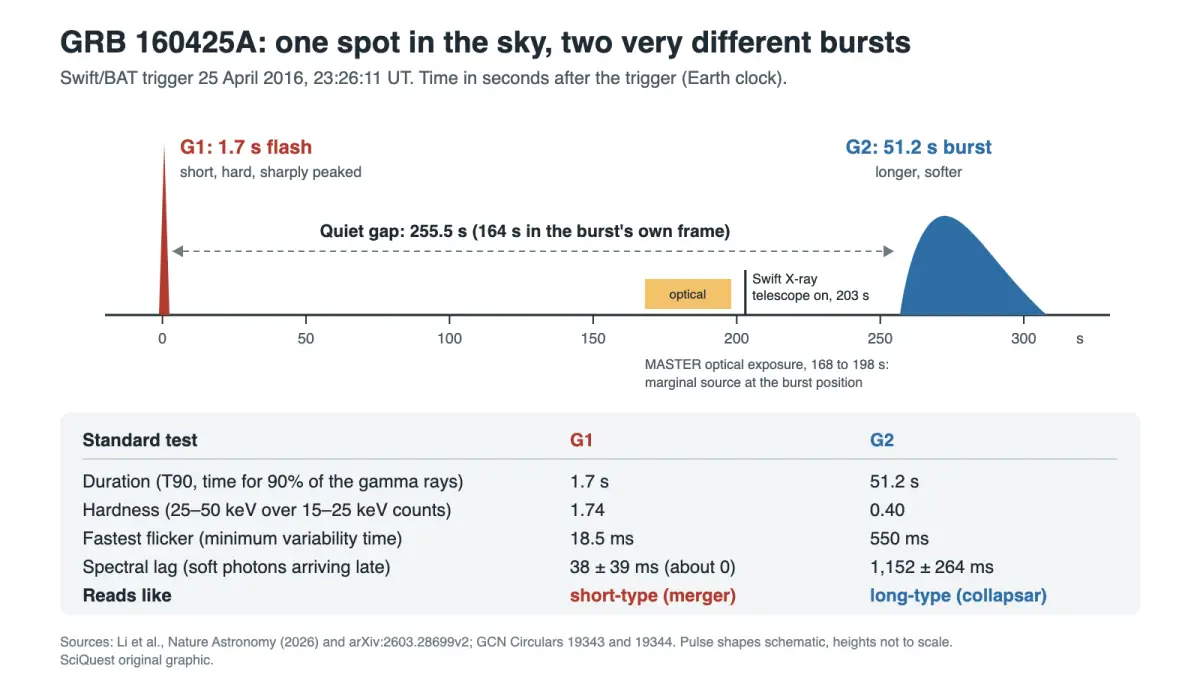
A 1.7-second gamma-ray flash in April 2016 was followed 255.5 seconds later by a 51.2-second burst from the same patch of sky, and standard tests sort the first with merging compact stars and the second with collapsing massive ones.
Peer reviewed · Single event · Archival data from 2016
In April 2016, NASA’s Swift satellite caught a gamma-ray burst that seemed to arrive twice. A flash lasting 1.7 seconds was followed about four minutes later by a 51-second burst from the same spot. A 22-author team led by Liang Li of Ningbo University now reports in Nature Astronomy that the flash passes nearly every standard test for a burst from merging compact stars, and the second burst passes the tests for a collapsing massive star. If both came from one system, the authors say, no current model predicted it. The link between them rests mainly on position and timing.
What you need to know
- Finding: GRB 160425A has two parts, G1 and G2. On nearly every standard test, G1 reads as a short, merger-type burst and G2 as a long, collapsar-type burst.
- Method: The team re-analysed Swift gamma-ray, X-ray and ultraviolet data plus ground-based optical follow-up, and measured duration, hardness, flicker speed and timing lag for each part separately.
- Source: Li et al., Nature Astronomy, published online 23 October 2026.
- Why it matters: Astronomers sort gamma-ray bursts into two families with two different causes. A single event that sits in both families tests that scheme.
- Limitation: No afterglow was seen between the two parts. Linking G1 to G2 relies on matching sky position and timing, and one peer reviewer called the chance of a coincidence “small but not negligible”.
Evidence at a glance
| Item | Assessment |
|---|---|
| Evidence status | Peer reviewed; analysis of one burst observed in 2016, using public and team data. |
| Primary source | “An intertwined short and long γ-ray burst with a 4-minute separation”, Nature Astronomy, online 23 October 2026. Abstract, figure captions and open peer review file read; full text read via arXiv:2603.28699v2 (April 2026). |
| Evidence strength | Limited to moderate: several independent measurements agree on the split classification, but it is one event and the physical link between its two parts is inferred. |
| Principal limitation | The two parts may be unrelated. In their reply to reviewers, the authors put the chance of an unrelated pair turning up anywhere in Swift’s records at about 1 in 100,000 to 1 in 10 million. |
| Coverage at a glance | 0 distinct news publishers found as of 25 October 2026, 11:15 UTC (standard and extended web searches; no university or agency press release found). Preprint listings not counted. |
Sources: the paper page and peer review file, arXiv:2603.28699v2, Crossref, NASA GCN Circulars 19343, 19344 and 19350, and a SciQuest web search.
Is this a big deal?
A striking oddity, not yet a textbook rewrite. The tests disagree sharply between the two parts, but one event can still prove to be a chance alignment or an extreme case of a known type.
What scientists found
Gamma-ray bursts are among the most energetic explosions in the universe. The deaths of massive stars make the long ones, lasting more than about 2 seconds. Collisions of compact objects such as neutron stars make most short ones, under 2 seconds.
GRB 160425A breaks that pattern within one trigger. G1 began at the trigger and lasted 1.7 seconds. After 255.5 seconds with no detectable gamma rays, G2 arrived and lasted 51.2 seconds. Within an hour, Swift’s burst advocate, Hans Krimm, sent a circular calling it “extremely unusual”: the later pulse delivered far more gamma rays.
The host galaxy sits at redshift 0.555; its light left about 5.6 billion years ago. Cosmic expansion stretched the burst’s clock, so the gap lasted 164 seconds in its own frame.
How they found it
The team ran G1 and G2 through the classic checks as if they were separate bursts. Picture two fingerprints at one scene, each matching a different kind of suspect. Where that breaks down: burst classes overlap, so every match is a probability.
G1 was hard, meaning rich in higher-energy photons. It flickered on timescales as short as 18.5 milliseconds, against 550 for G2. Its low- and high-energy photons arrived together, while G2’s softer photons trailed by more than a second. Short bursts typically show no such lag.
Energy tests agreed. Assuming it shone equally in all directions, G2 released about 2.1 × 1044 joules, roughly what the Sun emits in 17 billion years, and G1 about a third of that. Bursts are beamed jets, so true energies are lower.
Show the maths
- Rest-frame gap: 255.5 s ÷ (1 + 0.555) = 164.3 s.
- Energy units: 1 erg = 10−7 J, so 2.1 × 1051 erg = 2.1 × 1044 J and 7.2 × 1050 erg = 7.2 × 1043 J.
- Sun comparison: 2.1 × 1044 J ÷ 3.828 × 1026 W = 5.5 × 10¹⁷ s, or about 17 billion years.
- Ratio: 7.2 × 1043 ÷ 2.1 × 1044 ≈ 0.34, about a third.
- Lookback time for z = 0.555 (Planck 2018 cosmology): about 5.6 billion years.
Why it matters to you
Nothing changes for you; this is about how stars die. Astronomers sort thousands of bursts with these rules to decide which were mergers, events known to forge heavy elements such as gold. A burst that mixes both signatures warns that the rules can mislead.
What the evidence does not show
It does not prove one system made both bursts. Swift’s X-ray telescope started watching only 203 seconds after the trigger, so no afterglow belongs to G1 alone. A MASTER robotic telescope in South Africa saw a marginal optical source at the spot 168 to 198 seconds in, which the authors cite as a link.
G1’s peak photon energy was inferred, not measured: Swift’s detector records spectra only to about 150 keV, and the team estimates above 500 keV. No supernova was clearly seen, though a faint one is not ruled out. The published source data for Figure 2 hold summary values, not light curves.
How this fits what we already knew
The two-family scheme has been cracking for years. The long burst GRB 211211A was followed by a kilonova, the glow of a merger, and the short GRB 200826A came from a collapsing star. Those blurred the duration rule in single episodes. Li’s team argues GRB 160425A differs: two separate episodes on opposite sides.
Independent perspective
SciQuest has not interviewed an outside astronomer, but the paper’s peer review file is public. One referee, an expert in burst engines, first wrote, “I remain unconvinced that the paper merits publication in Nature Astronomy,” and challenged the peak-energy and probability claims. After revisions softened them, that referee recommended publication.
Ya-Hui Jiang, Bin-Bin Zhang and colleagues at Nanjing University, none of them authors of the new paper, argue in a September 2026 preprint that merger bursts can open with a hard spike and fade into softer emission that looks collapsar-like on its own. They count GRB 160425A among eight such cases, though its quiet gap suggests a restarting engine.
How other headlines framed it
No news outlet had covered the paper by 25 October 2026, 11:15 UTC. The only earlier framing is Swift’s 2016 circular, which called it “an unusual burst”.
What happens next
The real test is a repeat. X-ray monitors such as the Einstein Probe, which caught lingering soft X-rays from GRB 250704B, could catch a G1-like flash and its afterglow before any second episode. A second case would make chance far less likely.
In one sentence
GRB 160425A delivered a merger-like flash and, four minutes later, a collapsar-like burst from the same spot, a pairing current models do not predict, though whether one system made both is still inferred.
Quick check: did it click?
- Which part of GRB 160425A looks like a merger? G1, the 1.7-second flash.
- Why is the quiet gap shorter in the burst’s own frame? Cosmic expansion stretches time by a factor of 1 + z, here 1.555.
- What is the main reason for caution? The two parts are linked mainly by position and timing; no afterglow belongs to G1 alone.
Read next
- How is a black hole formed? The collapse that powers long bursts.
- The stages of a star’s life cycle, from birth to supernova or neutron star.
- What is the hottest thing in the universe? Where extreme explosions rank.
Sources and disclosure
- Li, L., Wang, Y., Zhang, B. et al. “An intertwined short and long γ-ray burst with a 4-minute separation.” Nature Astronomy (2026), published 23 October 2026. doi:10.1038/s41550-026-03007-0. Peer Review File (CC BY 4.0) on the same page. Preprint: arXiv:2603.28699v2.
- Krimm, H. A. et al. “GRB 160425A: Swift detection of an unusual burst with an optical afterglow.” GCN Circular 19343 (2016).
- Lipunov, V. et al. “GRB 160425A: MASTER earlier optical observations.” GCN Circular 19344 (2016).
- Tanvir, N. R. et al. “GRB 160425A VLT/X-shooter redshift.” GCN Circular 19350 (2016).
- Jiang, Y.-H. et al. “Short Spike, Long Story: Episode-Dependent Shifts of Long-Duration Type-I GRBs on Ep,z–Eiso Plane.” Preprint, arXiv:2606.15098v2 (2026).
- Rastinejad, J. C. et al. “A kilonova following a long-duration gamma-ray burst at 350 Mpc.” Nature 612, 223 (2022). doi:10.1038/s41586-022-05390-w.
- Zhang, B.-B. et al. “A peculiarly short-duration gamma-ray burst from massive star core collapse.” Nature Astronomy 5, 911 (2021). doi:10.1038/s41550-021-01395-z.
Disclosure: This article was drafted with AI assistance and checked against the sources above. The final journal text is paywalled, so detailed values come from the open arXiv version and the published peer review file; some may differ slightly in print. The authors declare no competing interests. Calculations (rest-frame gap, joule conversion, Sun comparison, lookback time) are by SciQuest and shown in the expander; the graphic is a SciQuest original drawn from the paper’s values. Spotted an error? See our corrections policy.
Discover more from SciQuest
Subscribe to get the latest posts sent to your email.
Leave a comment