

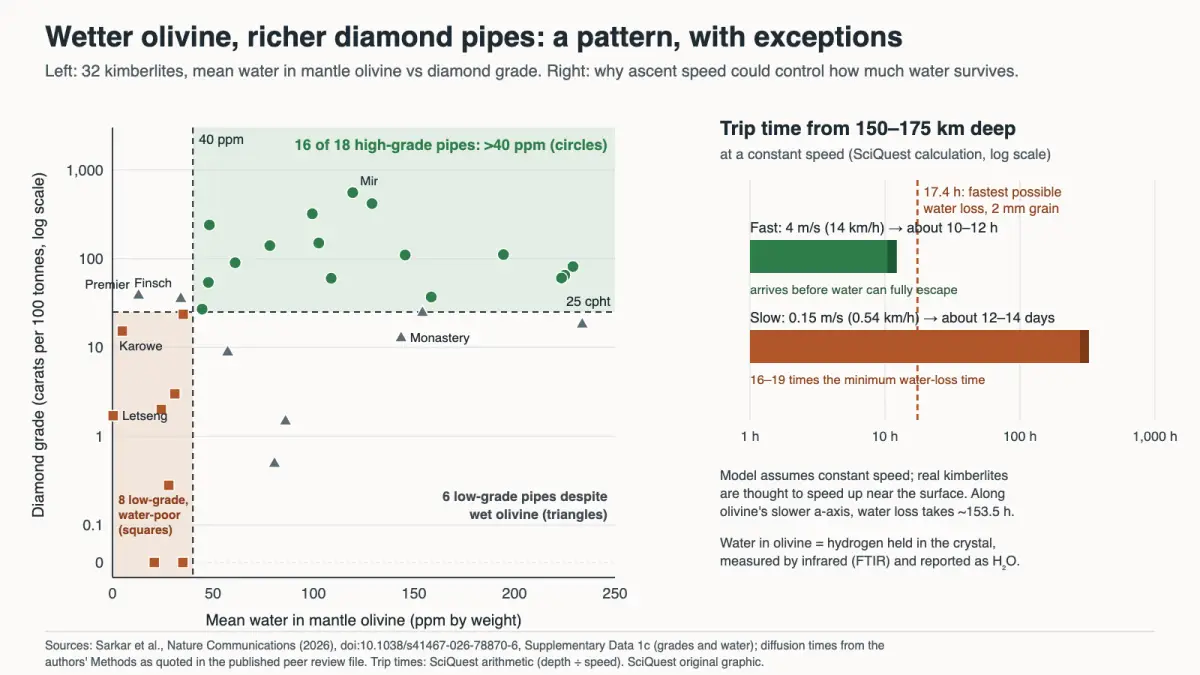
Across 32 diamond-bearing kimberlites, 16 of the 18 grading above 25 carats per hundred tonnes held mantle olivine averaging more than 40 parts per million of water, a pattern the authors tie to faster-rising magma, though 6 of the 14 poorer pipes carried water-rich olivine too.
Peer reviewed (accelerated preview) · Data compilation plus modelling · Correlation, not a measured ascent speed
Kimberlite pipes whose olivine crystals still hold more water tend to be richer in diamonds, a team led by Soumendu Sarkar of the University of Alberta reports in Nature Communications. They read the water as a stopwatch: hydrogen leaks out of olivine during a slow trip from the mantle, so wetter crystals point to faster-rising magma, and fast magma should deliver its diamonds more efficiently. The pattern holds for most, not all, of the 32 pipes. Seven of the ten water-poor pipes rest on four or fewer measurements.
What you need to know
- Finding: In a 32-kimberlite compilation, 16 of 18 pipes grading above 25 carats per hundred tonnes had mean olivine water above 40 ppm; 8 of 14 lower-grade pipes fell below it.
- Method: Infrared (FTIR) measurements of water in mantle olivine, more than 130 of them new, combined with published data and a model of hydrogen loss and crystal settling during ascent.
- Source: Sarkar, Davies, Zhang, Carvalho, Stachel and Pearson, Nature Communications, published 22 October 2026 (open access, accelerated preview).
- Why it matters: The authors propose olivine water as a cheap extra test for whether a kimberlite rose fast enough to carry diamonds up efficiently.
- Limitation: It is a correlation between mines, the low-water group is thinly sampled, and the ascent speeds are modelled, not measured.
Evidence at a glance
| Item | Assessment |
|---|---|
| Evidence status | Peer reviewed; accelerated preview that may still be edited. New and published mineral data, plus a model. |
| Primary source | “Water in kimberlitic olivine provides insights into kimberlite ascent and diamond transport”, Nature Communications, published online 22 October 2026, CC BY-NC-ND 4.0. |
| Evidence strength | Limited to moderate: 32 pipes on three continents, but many sites have one to four analyses, and the speed link is modelled. |
| Principal limitation | Wet olivine does not guarantee a rich pipe: 6 of the 14 low-grade kimberlites had it. |
| Coverage at a glance | 0 credible publishers found covering the paper as of 24 October 2026, 13:04 UTC (standard and extended web searches; no university release located). Not assessed beyond that search. |
Sources: the paper’s abstract, Supplementary Data 1 and the published peer review file (the full article text was not yet accessible as HTML or PDF); counts by SciQuest from Supplementary Table 1c.
Is this a big deal?
A useful step, not a new law. Linking olivine hydrogen to diamond grade is an older idea; what is new is the size of the dataset and its pairing with an ascent model. The exceptions mean olivine water works best as one clue among several.
What scientists found
Kimberlites are volatile-rich magmas that carry diamonds and other mantle fragments up from deep below the continents; the authors model pick-up depths of 150 and 175 km. Among that cargo are crystals of olivine, the main mineral of mantle rock (see the layers of Earth). Olivine stores small amounts of hydrogen in its crystal structure, which geologists report as water in parts per million by weight. Forty ppm means 40 grams of water per tonne of crystal.
Diamond grade is reported in carats per hundred tonnes (cpht). One metric carat is exactly 0.2 g, so Russia’s Mir pipe, at 555 cpht, yields about 1.1 g of diamond per tonne of rock. Lesotho’s Letseng, at 1.7 cpht, yields about 3.4 mg.
Plotting mean olivine water against grade for 32 kimberlites, the team found the richest pipes clustered above 40 ppm.
How they found it
The team measured water in the cores of olivine crystals with Fourier-transform infrared spectroscopy, which detects the hydrogen-oxygen bonds inside the mineral. By SciQuest’s count of the supplementary tables, 132 analyses are new, from nine kimberlites in Canada and Botswana. Published values brought the total to 381 measurements.
Then they asked how long olivine takes to lose its hydrogen. Using a published diffusion rate at 1,200 °C, they put the minimum time for a 2 mm grain to dry out at about 17.4 hours. That uses the crystal’s fastest direction; along the slowest it takes about 153.5 hours.
Think of each crystal as an ice cube carried home in a warm pocket: what is left tells you how long the walk took. The analogy has a limit. Nobody knows exactly how much water each crystal started with, a gap the authors acknowledge.
SciQuest did the trip arithmetic for the two speeds the authors model. At 4 m/s, about cycling pace, magma covers 150 to 175 km in roughly 10 to 12 hours, under the 17.4-hour minimum. At 0.15 m/s, slower than a stroll, the trip takes about 12 to 14 days.
Show the maths: trip time against water-loss time
Trip time is depth divided by speed, assuming the constant speed used in the authors’ model.
- Fast, 4 m/s: 150,000 m ÷ 4 m/s = 37,500 s, about 10.4 h; from 175 km, 43,750 s, about 12.2 h.
- Slow, 0.15 m/s: 150,000 m ÷ 0.15 m/s = 1,000,000 s, about 278 h (11.6 days); from 175 km, about 324 h (13.5 days).
- Minimum water-loss time for a 2 mm grain (authors, t = L²/D with L = 1 mm, fastest axis, 1,200 °C): about 17.4 h. So the slow trip lasts 16 to 19 times longer than that minimum; the fast trip ends before it.
- Grade: 555 cpht × 0.2 g per carat ÷ 100 t = 1.11 g of diamond per tonne of rock.
Why it matters to you
This changes nothing about any diamond you own. Its audience is exploration geologists: if it holds up, a lab test on a few olivine grains could help flag kimberlites worth a closer look.
What the evidence does not show
Ascent speed was not measured. The two speeds are model inputs, the model holds speed and melt stickiness constant, and real kimberlites are thought to accelerate near the surface. At the slow speed, the authors’ crystal-settling delay ranges from about 3 hours to thousands of hours across the melt viscosities they tested.
The pattern is also lopsided. Monastery in South Africa has wet olivine (about 144 ppm) and a grade of 13 cpht. The authors explain such cases as mantle that held few diamonds to begin with: fast magma cannot carry what is not there. Finsch and Premier run the other way, with dry olivine and grades of 36 and 39 cpht.
How this fits what we already knew
In 2014, Hilchie and colleagues used hydrogen zoning in olivine from four kimberlites to argue for a link between ascent speed and diamond survival. In 2023, a study co-written by Sarkar and Pearson tied high grades to magnesium-rich olivine, a marker of mantle less altered by melts and fluids. The new paper adds a much larger water dataset and a physical reason, crystal settling and hydrogen loss, for why speed should matter. For the general physics of rising magma, see what triggers volcanic eruptions.
What the peer reviewers said
The journal published the signed peer reviews. Federico Casetta wrote that “H2O-rich olivine alone is not enough to ensure high diamond grade” , while calling it a cost-effective extra indicator. Luc Doucet judged the high-grade link interesting but said the novelty lies in the amount of data. A third, anonymous reviewer questioned the thin sampling of low-water pipes and the unoriented grains, which scatter infrared readings, before approving the final version. SciQuest has not interviewed an outside geologist.
What happens next
The clearest test is more analyses from water-poor, low-grade pipes, ideally on oriented grains. The authors call olivine water an “additional, complementary” proxy, meant to sit alongside other indicators rather than replace them.
In one sentence
Olivine that reached the surface still wet usually rode up in a diamond-rich kimberlite, possibly because faster magma both kept the water in and carried more diamonds out, but the rule has real exceptions.
Quick check: did it click?
- Why would slow-rising magma leave olivine drier? Hydrogen diffuses out of the crystal over hours to days, so a longer trip lets more escape.
- Does wet olivine guarantee a rich diamond pipe? No. Six of the 14 low-grade kimberlites had it, often because their mantle source held few diamonds.
Read next
- From crust to core: the layers of Earth, where kimberlites start.
- Water locked in mantle minerals, another case of water hiding inside crystals.
- Is lonsdaleite stronger than diamond? What makes diamond hard.
Sources and disclosure
- Sarkar S, Davies RM, Zhang Q, Carvalho LDV, Stachel T, Pearson DG. “Water in kimberlitic olivine provides insights into kimberlite ascent and diamond transport.” Nature Communications, published 22 October 2026. doi:10.1038/s41467-026-78870-6. Abstract, Supplementary Data 1 (Tables 1a to 1d) and the peer review file read in full.
- Hilchie L, Fedortchouk Y, Matveev S, Kopylova MG. “The origin of high hydrogen content in kimberlitic olivine.” Lithos (2014). doi:10.1016/j.lithos.2014.06.010.
- Giuliani A et al. “Diamond preservation in the lithospheric mantle recorded by olivine in kimberlites.” Nature Communications 14, 6999 (2023). doi:10.1038/s41467-023-42888-x.
- NIST Special Publication 811, Appendix B.9: metric carat = 0.2 g (exact).
Disclosure: This article was drafted with AI assistance and checked against the sources above. The full article text was not yet available; figures come from the abstract, the supplementary data and the authors’ Methods as quoted in the published peer review file, so final wording may differ. The authors declare no competing interests; the paper notes that De Beers Group donated the FTIR equipment used. Calculations by SciQuest: trip time = depth ÷ speed (150 km at 4 m/s = 10.4 h; 175 km at 0.15 m/s = 324 h); grade in grams = cpht × 0.2 g ÷ 100 t; pipe counts from Supplementary Table 1c. The graphic is a SciQuest original built from those values. Spotted an error? See our corrections policy.
Discover more from SciQuest
Subscribe to get the latest posts sent to your email.
Leave a comment