

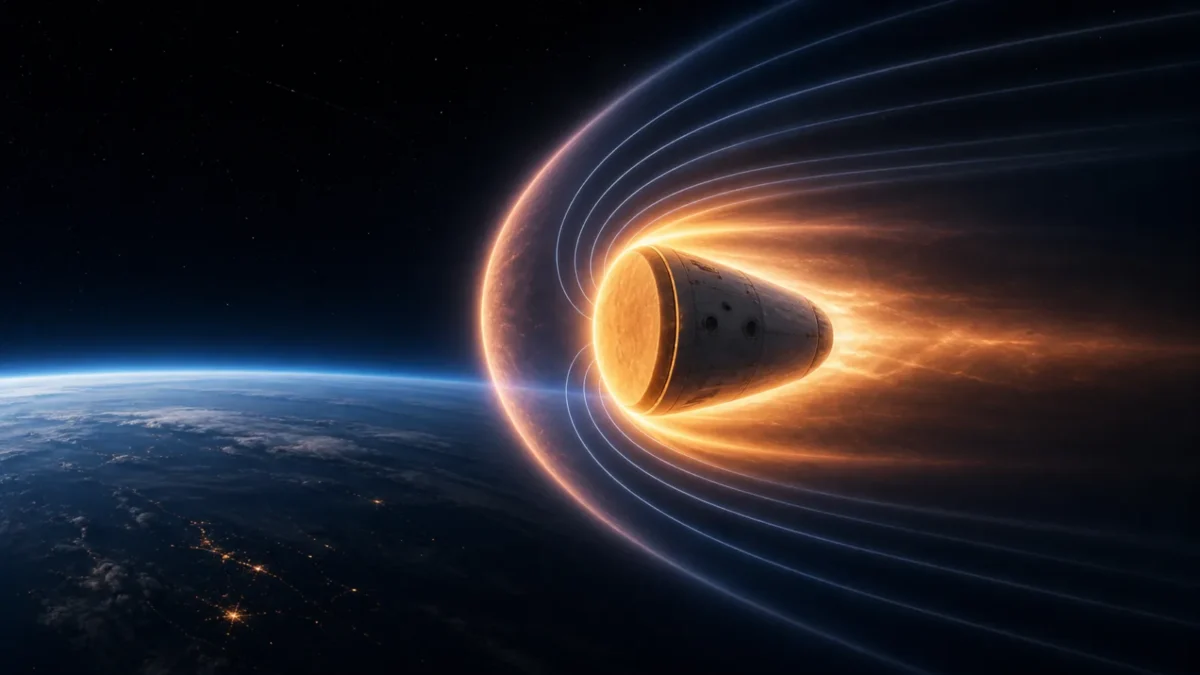
A laboratory platform generated magnetic fields as strong as 1.58 tesla during simulated seven-kilometre-per-second reentry conditions, pushing the glowing shock layer more than 15% farther from a miniature spacecraft model.
Published: August 30, 2026, 11:25 p.m. PKT · Reporting cutoff: August 30, 2026, 11:15 p.m. PKT
What you need to know
- The experiment tested magnetohydrodynamic aerobraking, which uses magnetic forces to alter electrically charged gas around a reentering vehicle.
- A pulse-forming network powered customizable electromagnet coils inside two small test models.
- The system produced fields of 1.24 and 1.58 tesla during shockwaves traveling at roughly 7 km/s.
- High-speed images showed the luminous shock layer became about 16% thicker when the field was active.
- This was a microsecond-scale ground test, not a spacecraft flight or a demonstration of a complete heat shield.
A spacecraft returning through an atmosphere compresses gas in front of it so violently that the gas becomes extremely hot and partially ionized. Conventional heat shields survive that environment through insulation, high-temperature materials or controlled erosion. Magnetohydrodynamic aerobraking asks a different question: can a magnetic field push the charged flow away before as much heat reaches the vehicle?
Researchers led by Tokyo Metropolitan University have built a laboratory system that lets them change both the strength and shape of that magnetic field during a simulated reentry shock. The result is a test platform—not yet a flight-ready shield—but it reaches conditions that permanent magnets could not.
How magnetic aerobraking is supposed to work
At hypersonic speed, a bow shock forms in front of a blunt spacecraft. Behind that shock, intense heating strips electrons from some atoms, creating an electrically conducting mixture of ions and electrons called plasma.
A magnetic field can exert forces on moving charged particles. In the proposed aerobraking system, those forces alter the plasma flow, moving the shock layer farther from the heat shield and increasing aerodynamic drag. A larger separation could reduce heat transfer while helping slow the vehicle.
The concept is physically plausible, but useful performance depends on plasma conductivity, magnetic-field geometry, vehicle speed and the mass and power needed to generate the field.
What the new experiment measured
Earlier laboratory studies often placed a permanent magnet inside a small model. That limits the field strength and makes it difficult to compare different magnetic geometries. The new apparatus uses customizable coils powered by a pulse-forming network, which releases an intense, carefully timed surge of current.
The models were struck by shockwaves moving at more than 7 km/s inside a hypersonic expansion tube. Because the useful test interval lasted only tens of microseconds, the researchers synchronized the magnetic pulse and high-speed camera with the shock’s arrival.
Two coil configurations generated peak fields of 1.24 and 1.58 tesla. With the magnetic field active, the visible self-emission region ahead of the models expanded by approximately 15.7% and 16.2%. That change is evidence that the field interacted with the hot flow.
What a thicker glowing layer does not establish
The experiment did not send a spacecraft through the atmosphere. It did not demonstrate a reusable vehicle or show that magnets can replace ablative heat shields. Most importantly, an expanded luminous layer is not itself a direct measurement of how much the vehicle’s surface heat load fell.
A working system must carry coils, power electronics and thermal protection without adding more mass than it saves. Engineers also need to determine how the field behaves across a full trajectory as speed, altitude, atmospheric composition and plasma conductivity change.
How other headlines framed the experiment
- Tokyo Metropolitan University’s release on EurekAlert described “magnet-powered brakes” and emphasized the stronger, adjustable test field.
- Scienmag focused on the possibility of slowing spacecraft during high-speed reentry.
What happens next
The researchers describe the platform as a foundation for quantitative tests of heat-flux reduction and added drag. Their longer-term program includes a low-orbit reentry capsule experiment using a sounding rocket, which would expose the technology to a real trajectory.
Bottom line: the team has shown that a strong, shaped magnetic pulse can measurably alter a simulated reentry shock layer. Calling it a magnetic heat shield is a useful description of the goal, not yet a description of proven flight hardware.
Sources
- Muramatsu et al., “Quasi-Steady Magnetic Field Generated by Pulse Forming Network for Magnetohydrodynamic Aerobraking,” Journal of Spacecraft and Rockets, July 23, 2026.
- Tokyo Metropolitan University research release, August 29, 2026.
- Experimental illustration and publication metadata supplied by Tokyo Metropolitan University.
Editorial disclosure: The lead image is a concept illustration of magnetohydrodynamic reentry, not a photograph of the laboratory experiment or a demonstrated spacecraft system. SciQuest received no payment to cover this research. To report a possible error, contact SciQuest.
Discover more from SciQuest
Subscribe to get the latest posts sent to your email.
Leave a comment