

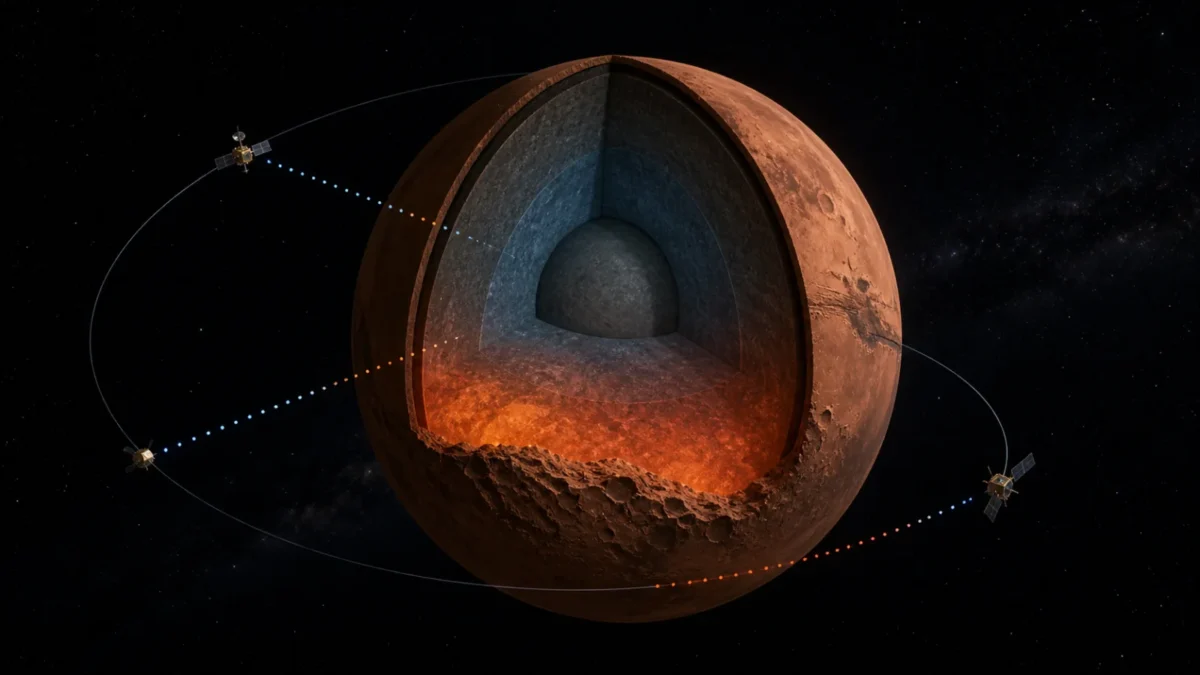
Sixteen years of spacecraft tracking reveal that the mantle beneath Mars’s southern highlands is likely 200–400°C hotter than the northern mantle, exposing a deep asymmetry that may still influence the planet today.
Published: August 31, 2026, 10:20 p.m. PKT · Reporting cutoff: August 31, 2026, 9:45 p.m. PKT
What you need to know
- Researchers analyzed roughly 16 years of radio tracking from three Mars orbiters.
- Seasonal shifts in carbon dioxide ice create tiny gravity changes that deform the planet’s interior.
- The response indicates a greater than 20% variation in mantle rigidity between regions.
- Models explain the southern anomaly with about 200–400°C of extra heat and possibly up to 5% more iron.
- The temperatures are inferred rather than directly measured, and the study does not prove a continuous molten layer.
Mars looks divided at the surface: smooth northern lowlands face heavily cratered southern highlands. New research suggests that split extends hundreds of kilometres beneath the crust. The mantle under the south appears softer—and therefore hotter—than the mantle under the north.
The conclusion comes from an unusual planetary scan. Scientists treated Mars’s seasonal carbon-dioxide ice caps as a repeating load, then measured how the planet’s gravity field and shape responded. The method is called tidal tomography: instead of sending seismic waves through the planet, it uses small periodic deformations to probe the interior.
Three orbiters turned seasonal ice into an interior probe
Researchers combined radio-tracking records from Mars Global Surveyor, Mars Odyssey and the Mars Reconnaissance Orbiter. As the spacecraft communicated with Earth, tiny changes in their motion revealed changes in the planet’s gravity field.
Each Martian year, carbon dioxide freezes onto one pole and later returns to the atmosphere before accumulating at the other. That redistribution of mass applies a predictable, shifting force. A rigid mantle and a softer mantle do not respond in quite the same way.
Across roughly 16 years of observations, the time-varying, degree-three gravity signal indicated that mantle shear modulus—a measure of resistance to deformation—varies by more than 20% across Mars. The strongest anomaly lies below the southern highlands.
Why 200–400°C is an inference, not a thermometer reading
Temperature lowers the rigidity of mantle rock. Composition also matters, so the team tested models that varied both heat and iron. Their preferred explanations require the southern mantle to be approximately 200–400°C warmer than the northern mantle, with iron enrichment of as much as 5% in some models.
Those values do not mean the entire southern mantle is liquid. Warmer rock can remain solid while flowing extremely slowly over geological time. Localized partial melting may be possible, but the measurements do not establish a global magma ocean or a continuous molten layer beneath the pole.
A deep clue to Mars’s lopsided history
The thermal contrast could help explain why Mars developed two markedly different hemispheres. It may reflect long-lived mantle upwelling, extra radioactive heating, insulation by the thick southern crust or consequences of ancient giant impacts. The data identify an anomaly; they do not yet choose among those origin stories.
The finding also matters for present-day activity. Heat affects volcanism, crustal stress and the stability of subsurface ice. But a warm mantle is not evidence for current eruptions, accessible liquid water or life. Those possibilities require separate observations.
How other headlines framed it
- Nature led with the method: tidal tomography of the Martian mantle.
- Caltech emphasized discovery of a thermal anomaly below Mars’s south polar region.
- Phys.org foregrounded the estimated temperature difference of hundreds of degrees.
- Science Times emphasized possible partial melting, a more speculative implication that the primary paper does not establish as a continuous layer.
What could test the result next
Longer tracking records and improved gravity models could sharpen the anomaly’s boundaries. Future seismometers placed far from NASA’s former InSight lander would provide a complementary test by measuring how waves cross different parts of the mantle.
Bottom line: Mars is not thermally uniform. Orbital tracking supports a much warmer, softer mantle beneath the southern highlands, but the exact temperature, composition and cause remain model-dependent.
Sources
- Genova et al., “Tidal tomography of the Martian mantle,” Nature, August 26, 2026.
- Caltech research explanation.
- Phys.org report on the thermal anomaly.
Editorial disclosure: The lead image is an original cutaway concept illustration, not a direct image of Mars’s interior or a figure from the study. SciQuest received no payment for this coverage. To report a possible error, contact SciQuest.
Discover more from SciQuest
Subscribe to get the latest posts sent to your email.
Leave a comment