

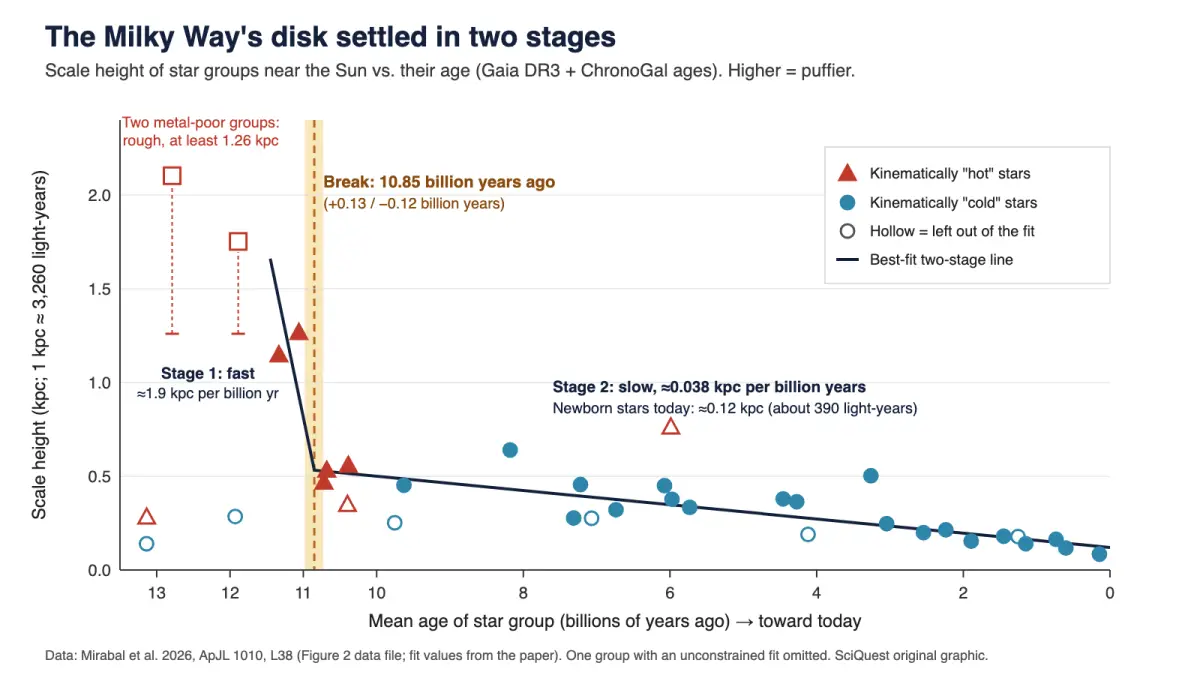
In the best fit, star groups near the Sun that formed before about 10.85 billion years ago get puffier with age about 50 times faster than younger groups, a break the authors read as a turbulent thick disk forming first and a calm thin disk later.
Peer reviewed · Observational study · Stars near the Sun only
Astronomers led by David Mirabal of the Instituto de Astrofísica de Canarias (IAC) dated stellar populations near the Sun with data from ESA’s Gaia mission and found that the Milky Way’s disk settled in two stages. Older star groups spread farther above and below the disk’s mid-plane, and that spread shrank fast until about 10.85 billion years ago, then slowly up to today. The pattern favours “upside-down” formation: a disk born thick that thinned as its gas calmed. The early stage rests on a handful of old groups, the least certain part of the data.
What you need to know
- Finding: The rate at which scale height falls with age changes 10.85 (+0.13/−0.12) billion years ago, from about 1.88 to 0.038 kiloparsecs per billion years.
- Method: Gaia DR3 colour–magnitude diagrams were fitted with stellar models to get ages precise to better than 5%, then sorted into 37 age–metallicity groups.
- Source: Mirabal et al., The Astrophysical Journal Letters 1010, L38, online 16 October 2026 (open access).
- Why it matters: The authors argue it is the first clear observational sign that the thick disk’s height was set at birth, not built up by slow stirring.
- Limitation: The early slope is uncertain (about 1.05 to 3.26 kpc per billion years), and a different grouping of stars gives 0.74.
Evidence at a glance
| Item | Assessment |
|---|---|
| Evidence status | Peer reviewed; observational study of Gaia data within 750 parsecs (about 2,450 light-years) of the Sun. |
| Primary source | “A Two-stage Settling of the Milky Way Disk Revealed by Precise ChronoGal Ages”, ApJL 1010, L38, online 16 October 2026. Full text read on IOPscience. |
| Evidence strength | Moderate: the timing of the break is tight and survives a different grouping, but the early slope is uncertain and only the solar neighbourhood was sampled. |
| Principal limitation | Two old, metal-poor groups have no fitted scale height; the paper gives rough values (2.10 and 1.75 kpc) with a floor of 1.26 kpc. |
| Coverage at a glance | 2 distinct publishers with their own text as of 22 October 2026, 15:15 UTC: the EFE agency (one story, run by ABC Color, Crónica and others, counted once) and Universe Today. The IAC release is not counted. |
Sources: the paper, its Figure 2 data file, the IAC release, Crossref and a SciQuest web search.
Is this a big deal?
A solid step. Whether the thick disk was born thick or puffed up later has long been argued, and precise ages for old stars were the missing tool. But it is one team, one method and one patch of the Galaxy.
What scientists found
A thin disk of mostly younger stars hugs the Milky Way’s mid-plane, and a thicker disk of older stars spreads above and below it. Astronomers measure that spread as a scale height. In the profile the team fitted, a group’s star density falls to about 42% of its mid-plane value one scale height up, and about 7% two scale heights up.
Younger groups have smaller scale heights, as earlier work found. What is new is the shape of the trend. Before the break, scale height drops from more than 1.26 kiloparsecs (kpc), about 4,100 light-years, to roughly 0.5 kpc (1,600 light-years) in around 2 billion years. After 10.85 billion years ago the decline is gentle, reaching about 0.12 kpc (390 light-years) for stars forming today.
How they found it
Gaia measures each star’s brightness, colour and distance. Plot brightness against colour and you get a colour–magnitude diagram, where older populations peel off the main sequence at fainter, redder points. The ChronoGal software compares the observed diagram with synthetic ones built from the BaSTI-IAC stellar models and finds the mix of ages and metallicities that matches best. That gives the age makeup of a population, not an age for each star, with a precision better than 5%: about 0.5 billion years for the oldest stars.
Old populations crowd together on the diagram, so the team split stars by motion into a “cold” sample within 250 parsecs and a “hot” one within 750 parsecs, each cut into eight layers up to 1 kpc from the plane and corrected for stars lost to dust and quality cuts. As a check, the whole hot and cold samples give 0.88 ± 0.04 and 0.27 ± 0.01 kpc, close to the textbook thick- and thin-disk values of about 0.9 and 0.3 kpc.
Why it matters to you
Nothing changes in daily life. It is about origins: how the flat disk the Sun orbits within took its shape. See where Earth sits in the Milky Way for our place in it.
Two ideas, and a snow globe
One idea says stars are born in a thin layer and get kicked upward over time by gas clouds, spiral arms and the central bar. The other, upside-down formation, says early gas was so turbulent that stars were born puffy, each later generation forming in a calmer layer.
Picture a shaken snow globe photographed as it calms: each generation of stars records how stirred-up the gas was at its birth. The analogy has a limit, because kicking still happens. In a simulation by Ma and colleagues (2017), cited in the paper, it supplies 30–40% of the age trend. But slow kicking alone struggles to shrink the oldest groups so fast in a young galaxy still being hit by mergers.
What the evidence does not show
The paper says the trend after 10.85 billion years ago fits either idea, so the thin disk’s story stays open. The early slope of 1.88 kpc per billion years carries an uncertainty of +1.38/−0.83, and an even grid of age bins gives 0.74. The early stage is therefore about 20 to 50 times steeper than the late one.
Two old, metal-poor groups show flat density up to 1 kpc, so their scale heights come from a taller sample reaching 3.5 kpc, and the authors do not trust the fit’s error bars. All ages also rest on one set of stellar models, so a flaw there would shift them together.
How this fits what we already knew
Earlier surveys mostly grouped stars by chemistry, which mixes ages. A 2025 study by Imig and colleagues found both kicking and thick birth at work, without tying either to a period. The new break falls near the Gaia-Sausage-Enceladus merger about 10 billion years ago, and fits an estimate, cited in the paper, that the disk became rotation-supported 12.1 ± 2.9 billion years ago.
Outside view
SciQuest found no comment from an astronomer outside the team as of 22 October 2026, 15:15 UTC, and has not interviewed one. In the IAC release, Mirabal said: “This is the first clear observational evidence favouring one of the two models for the Galaxy’s early stage.”
How other headlines framed it
The IAC release and Universe Today treat the question as answered, and EFE’s story, as run by ABC Color, quotes Mirabal saying it “resolves a classic problem”. Both of the first two call scale height the disk’s “thickness”, though stars extend well beyond it, and none mentions the wide uncertainty on the early slope.
What happens next
A companion paper on one unusual old, metal-poor group is in preparation. Repeating the analysis farther from the Sun would test whether the 10.85-billion-year break holds across the disk.
In one sentence
Precise ages for stars near the Sun suggest the Milky Way’s disk thinned fast for its first couple of billion years and slowly ever since, backing the idea that the thick disk was born thick.
Quick check: did it click?
- Does ChronoGal give each star its own age? No. It fits whole colour–magnitude diagrams to get the age and metal makeup of populations.
- Which part of the result is least certain? How steep the early stage is, which rests on a few old groups.
Read next
- Where is Earth in the Milky Way? Our address in the disk.
- The stages of a star’s life cycle, the clock behind these ages.
- How long does it take to travel one light-year? To feel a 4,100-light-year scale height.
Sources and disclosure
- Mirabal, D., Gallart, C., Ruiz-Lara, T., et al. “A Two-stage Settling of the Milky Way Disk Revealed by Precise ChronoGal Ages.” The Astrophysical Journal Letters 1010, L38, published online 16 October 2026 (received 28 July, accepted 2 October 2026). doi:10.3847/2041-8213/aeb0a3. Open access (CC BY 4.0); full text and Figure 2 data file read on IOPscience.
- Instituto de Astrofísica de Canarias. “Research by the IAC reveals that the Milky Way’s disc formed in two very distinct stages.” Press release, 19 October 2026 (source of the quotes).
- Crossref record for doi:10.3847/2041-8213/aeb0a3 (online date 16 October 2026).
Disclosure: This article was drafted with AI assistance and checked against the sources above. The study was funded by Spain’s State Research Agency, the European Research Council (ChronoGal, grant 101201412) and other agencies listed in the paper. Calculations by SciQuest: 1.26 kpc × 3,262 ≈ 4,100 light-years, 0.5 kpc ≈ 1,600, 0.12 kpc ≈ 390; 1.88 ÷ 0.038 ≈ 49 and 0.74 ÷ 0.038 ≈ 19; 1.88 − 0.83 = 1.05 and 1.88 + 1.38 = 3.26; sech²(1) ≈ 0.42 and sech²(2) ≈ 0.07. The graphic is a SciQuest original plotted from the paper’s published data file. Spotted an error? See our corrections policy.
Discover more from SciQuest
Subscribe to get the latest posts sent to your email.
Leave a comment