

A domestic cat’s purr vibrates about 25 to 30 times a second, and a 2023 experiment found that a cat’s voice box can hold that rhythm with no nerve signals at all, which unsettled a 50-year-old explanation of how the sound is made.
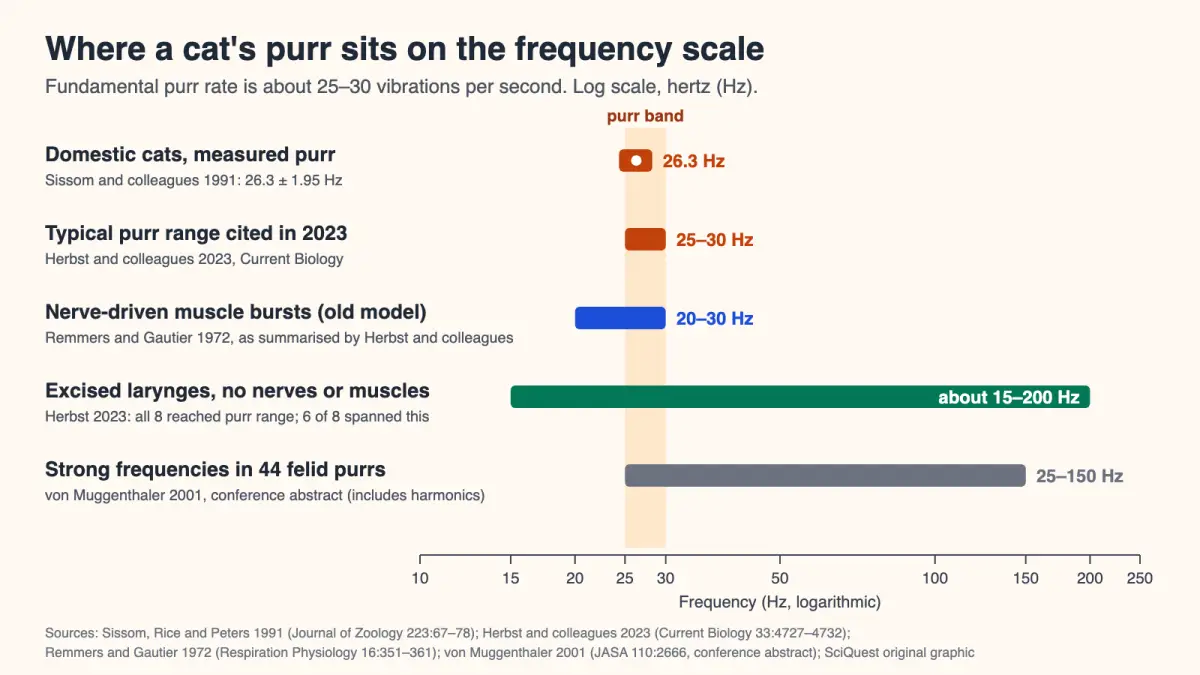
Cats purr to keep in touch with the people and cats around them, most often when they are relaxed and close to someone familiar. But they also purr while nursing, while asking for food, and sometimes when they are hurt or frightened. The sound itself is a low buzz at a fundamental frequency of about 25 to 30 hertz (Hz), meaning 25 to 30 vibrations per second. A 1991 study of unrestrained house cats measured an average of 26.3 Hz.
How the larynx (voice box) makes that buzz is less settled than many guides suggest. For decades the accepted answer was that the brain fires the throat muscles about 25 times a second. In 2023 a team in Vienna showed that cat larynges removed after death can buzz at purring rates when air is blown through them, so the muscle-only story is incomplete.
Explain it like I’m busy:
- A purr is a low buzz at about 25 to 30 Hz, made on both the in-breath and the out-breath.
- Cats purr when content, when nursing, when asking for something and sometimes when in pain, so the setting tells you more than the sound.
- Small pads inside the vocal folds help a cat’s larynx vibrate this slowly; whether nerves also drive each cycle in a living cat is still open.
Key facts about cat purring
- Frequency: house cats purred at 26.3 ± 1.95 Hz in a 1991 study, which also found that an individual cat’s purring frequency does not change with age (Sissom, Rice and Peters, Journal of Zoology).
- Mechanism: all eight cat larynges tested in a 2023 Current Biology study vibrated at or below purring rates without any nerve input or muscle contraction (Herbst and colleagues).
- Anatomy: cat vocal folds contain pads of soft connective tissue up to 4 mm across, which the 2023 team proposes let the folds vibrate unusually slowly.
- Who purrs: true purring is established only in the cat family and the civet family (Viverridae), according to a 2002 review in Mammal Review. Lions, jaguars and leopards do not purr.
| Source | Value | What was measured | Type of evidence |
|---|---|---|---|
| Sissom, Rice and Peters (1991) | 26.3 ± 1.95 Hz (mean ± standard deviation) | Purring of unrestrained domestic cats, also pumas and cheetahs | Peer-reviewed measurement |
| Herbst et al. (2023), citing earlier work | 25 to 30 Hz | Typical fundamental frequency of domestic cat purring | Peer-reviewed summary of earlier measurements |
| Remmers and Gautier (1972), as summarised by Herbst et al. | Typically 20 to 30 Hz | Bursts of electrical activity in the larynx muscles during purring | Peer-reviewed physiology |
| NC State College of Veterinary Medicine (Sherman) | A burst every 30 to 40 ms, about 25 a second | Sound bursts during purring | Veterinary school explainer |
| Herbst et al. (2023) | About 15 to 200 Hz | Range covered by six of eight larynges removed after death, with no nerves or muscles active | Peer-reviewed laboratory experiment |
| von Muggenthaler (2001) | Strong frequencies between 25 and 150 Hz | Purrs of 44 felids, including domestic cats, servals, ocelots, pumas and cheetahs; includes overtones | Conference abstract, not a full paper |
Sources: listed in full at the end of this article. The values agree once you separate the fundamental (the basic buzz rate, about 25 to 30 Hz) from the overtones at whole-number multiples of it, which is why “25 to 150 Hz” appears in some guides. A burst every 30 to 40 ms equals 25 to 33 bursts a second (SciQuest calculation).
What a purr is
A purr is a voiced sound, made in the larynx like a meow, but at an unusually low and steady rate. The cat keeps it going through each breath in and out, so the buzz seems continuous. The 2023 Vienna team recorded that in the purring range the vocal folds stayed in contact for 80% to more than 95% of each vibration cycle.
The closest human comparison is vocal fry, the creaky rattle some people make at the very bottom of their voice. Herbst and colleagues point to it directly: in people, fry appears below about 70 Hz and also features long closed phases. The comparison has limits. A cat purrs far lower than most people can fry, on the in-breath as well as the out-breath, and with tissue pads that humans do not normally have.
At 26.3 Hz each cycle lasts about 38 milliseconds, so a cat on your lap makes roughly 1,580 vibrations a minute. In air at 20 °C, where sound travels at about 343 m/s, one purr wave is about 13 metres long (343 ÷ 26.3 = 13.0 m). That long, low wave is part of why you can feel a purr through your hand as much as hear it.
Show the maths
- Cycle length: 1 ÷ 26.3 Hz = 0.038 s, about 38 ms. At 25 Hz it is 40 ms and at 30 Hz about 33 ms, which matches NC State’s “every 30 to 40 milliseconds”.
- Vibrations per minute: 26.3 × 60 = 1,578, about 1,580.
- Wavelength: speed of sound ÷ frequency. 343 m/s ÷ 26.3 Hz = 13.0 m; the 25 to 30 Hz band gives 13.7 m to 11.4 m.
- Pad size against fold length: 4 mm ÷ 7.5 mm = 0.53, so the largest pads reported are about half the length of the one vocal fold measured by CT.
How cats make the purring sound
The long-standing answer: nerve-driven muscle bursts
In 1972 the physiologists J. E. Remmers and H. Gautier recorded electrical activity in the throat muscles of purring cats. Their work became the basis of the active muscle contraction model: the brain sends bursts of signals, typically 20 to 30 a second, that make the muscles of the larynx open and close the airway in rhythm. Sissom, Rice and Peters reached a matching conclusion in 1991, describing purring as “a centrally driven laryngeal modulation of respiratory flow.”
There was a reason to think cats needed a special trick. Most mammals, including people, make sound with the myoelastic-aerodynamic principle: air pushed from the lungs sets elastic vocal folds vibrating on their own, the way a flag flutters in wind. A small animal’s short vocal folds would normally vibrate far faster than 25 times a second. Herbst and colleagues note, however, that direct evidence for the muscle model was sparse.
The 2023 test: larynges that purr without a brain
Christian Herbst, Tecumseh Fitch and colleagues at the University of Vienna and the University of Veterinary Medicine Vienna set up a direct test. The logic was simple. If purring needs nerve-driven muscle bursts, a larynx removed from the body should not be able to vibrate at purring rates at all, however much air passes through it. They used larynges from eight domestic cats, aged 6 months to 18 years, that had been euthanised in Vienna veterinary clinics because of terminal illness unrelated to the airway. The owners gave consent.
The team mounted each larynx, blew heated, humidified air through it at pressures of about 0.3 to 3 kilopascals, and filmed the folds with a high-speed camera. All eight vibrated at or below 25 to 30 Hz. Six of the eight slid smoothly from about 15 Hz up to about 200 Hz as the air pressure and the stretch of the folds changed, covering both purr-like and meow-like rates with one mechanism.
Under the microscope, the folds held pads of soft connective tissue, made of gel-like (myxoid) tissue with elastic fibres and little collagen, up to 4 mm in diameter. For scale, a CT scan of one larynx in the study measured the vibrating part of the vocal fold at 7.5 mm long. The researchers propose that these pads make the inner edge of the fold much less stiff, and at the low air pressures of purring only that edge vibrates, so it swings slowly. A simple two-mass computer model supported that idea.
What the 2023 study did not show
The authors are careful here. Their results “do not fully reject” the muscle model, and they do not rule out rhythmic nerve control in a living cat. Their proposal is that both mechanisms work together: the folds act as a passive resonator tuned to purring rates, and nerve-driven muscle bursts keep it in step, which may save energy and help the purr continue smoothly as breathing switches direction. That combined model is a hypothesis. The experiment also tested larynges mainly with outward airflow, and eight cats is a small sample, although every one behaved the same way.
Why cats purr
Contentment and staying in contact
Barbara Sherman, director of the Behavioral Medicine Service at North Carolina State University’s veterinary hospital when NC State published her interview in 2012, summarises the leading view: cats are thought to purr to maintain contact with other cats or with people. She describes a study in which one researcher fitted free-ranging cats with throat microphones. They purred when their caretaker was present, when greeting a familiar cat, while rolling or rubbing, and while drowsy in warm, familiar places. Purring tended to stop during fights, mating, hunting and a cat’s first exposure to catnip.
Mother and kittens
Female cats purr while nursing, and kittens purr while they feed, according to the NC State summary. That early pairing of purring with closeness and feeding fits the idea that the purr is first a contact signal between mother and young.
The solicitation purr: asking for food
Some cats have a special purr for breakfast. In 2009 Karen McComb and colleagues at the University of Sussex reported in Current Biology that cats seeking food can embed a high-pitched, cry-like sound within the normal low purr. Owners recorded their own cats, because the cats tended to stop performing when strangers were present.
In the playback test, McComb said in the university’s release, “even those with no experience of cats judged the ‘solicitation’ purrs to be more urgent and less pleasant.” When the team digitally removed the cry-like element and left everything else unchanged, the urgency ratings dropped significantly. The authors suggest the cry may tap into the sensitivity mammals have to the sounds of dependent young. That is an interpretation, and the experiment measured how people rated recordings, not what the cats intended. McComb added that the behaviour seems most common in cats living one-to-one with an owner.
Stress, pain and illness
A purr is not proof of a happy cat. Sherman notes that cats may purr just before sleep and, “surprisingly, when in pain,” and that vets examining cats hit by cars may find them purring. Elizabeth von Muggenthaler’s 2001 conference abstract likewise opens by pointing out that cats purr when severely injured or frightened. Why they do so is not known. Self-soothing and signalling a need for care are both proposed explanations, and neither has been tested directly.
What changes the answer
The setting. A purr in a warm lap, a purr beside an empty food bowl and a purr on a vet’s exam table can carry very different messages. Posture, appetite and everyday behaviour say more than the sound.
Which frequency figure you read. “25 to 30 Hz” is the basic buzz rate, while “25 to 150 Hz” also counts the overtones stacked above it at multiples of that rate. Both are correct. They describe different things.
The strength of the evidence on meaning. The solicitation-purr finding comes from one short report, and SciQuest could read only the university’s account and the journal record, not the paywalled letter itself. The free-ranging observations are summarised second-hand in the NC State explainer.
Which cats can purr and which roar?
In the 1830s the anatomist Richard Owen linked the split between roaring and purring cats to the hyoid, the chain of small bones that supports the larynx. The roaring cats are the genus Panthera, including lions, tigers, jaguars and leopards. House cats, pumas, cheetahs and ocelots purr; the NC State summary notes that Charles Darwin recorded purring in the puma, cheetah and ocelot, and Sissom’s team measured purring in pumas and cheetahs directly.
Later work refined Owen’s picture. As Herbst and colleagues summarise it, a lion’s or tiger’s deep roar depends on the unusual structure of its vocal folds, with an elastic hyoid and a long vocal tract lowering the resonances further. Roaring cats also have soft tissue in their vocal folds, which the 2023 team calls functionally analogous to the domestic cat’s pads. The same kind of anatomy helps one group roar and the other purr. For more on lions and tigers, see our tiger vs lion comparison.
Do purrs heal bones? The healing-frequency hypothesis
Many websites say a purr’s vibrations help cats heal. The idea traces largely to von Muggenthaler’s 2001 abstract in The Journal of the Acoustical Society of America. She recorded 44 felids and reported strong frequencies between 25 and 150 Hz, including peaks at 25 and 50 Hz. She noted that these match vibration frequencies used in treatments for bone growth, fractures, pain and swelling, and proposed that purring could be an internal healing mechanism.
That is a hypothesis built on a frequency match. The abstract did not test whether purring heals cats, and SciQuest found no peer-reviewed study showing that it does. Treat claims that purring “heals bones” or will help your own health as unproven.
Why it matters to you
If you live with a cat, the purr is a signal worth reading in context. A cat purring while relaxed against you is most likely content, but purring alone does not mean a cat is comfortable or well. A cat that purrs while hiding, not eating or moving stiffly may be unwell, and only a vet can judge whether it is in pain. For the human side of the bond, our article on why owning a pet may be good for your health looks at the evidence.
“But wait…”
Didn’t scientists already know how cats purr? Many references stated it confidently, and the muscle-burst model did have recordings behind it. What was missing was a test of whether the larynx could vibrate at purring rates by itself. When the Vienna team ran that test, the answer was yes, and the authors concluded that the consensus “was reached prematurely.” The present position is that both mechanisms may be involved, and how they combine in a living cat still needs to be measured.
Related questions
Why do cats purr when you pet them? Stroking is tactile contact with a familiar companion, two of the situations in which free-ranging cats purred most. The purr is best read as a contact signal; in a relaxed cat it usually goes with contentment.
Can big cats purr? Pumas, cheetahs and ocelots purr. Lions, tigers, jaguars and leopards, the roaring cats of the genus Panthera, do not purr.
Do cats purr when they are hurt? Sometimes. NC State’s Sherman notes that cats may purr when in pain, including after being hit by a car. A purr does not rule out injury or illness.
Do cats purr breathing in and out? Yes. The purr continues through both phases of breathing, with the out-breath purr slightly higher in pitch, by 2.4 Hz on average in Sissom’s measurements.
In one sentence
Cats purr mainly to signal contact and calm, but also to ask for food and sometimes when hurt, making a 25 to 30 Hz buzz that their padded vocal folds can produce on airflow alone, while scientists work out how much the nerves add in a living cat.
Quick check: did it click?
- About how many times a second does a house cat’s purr vibrate? About 25 to 30 times; 26.3 Hz on average in a 1991 study.
- What did the 2023 Vienna experiment show? Cat larynges with no nerve input could vibrate at purring rates when air was blown through them, helped by soft pads in the vocal folds.
- Does a purring cat always feel good? No. Cats also purr when asking for food, when frightened and sometimes when in pain.
Read next
- Speed of sound: about 343 m/s in 20 °C air
- Tiger vs lion: how the two big cats compare
- Why owning a pet may be good for your health
Disclosure: This article was drafted with AI assistance and checked against the sources below. The cycle length, vibrations per minute, wavelength and burst-rate conversions are SciQuest calculations, and the frequency chart is an original SciQuest graphic drawn from the cited values. We read the full 2023 Herbst paper; for the 2009 McComb letter we relied on the journal record and the University of Sussex release, because the full text is paywalled. This article is not veterinary advice. Spotted an error? See our corrections policy.
Sources
- C. T. Herbst, T. Prigge, M. Garcia, V. Hampala, R. Hofer, G. E. Weissengruber, J. G. Švec and W. T. Fitch (2023), Domestic cat larynges can produce purring frequencies without neural input, Current Biology 33, 4727 to 4732 (open access; eight larynges; 25 to 30 Hz; 15 to 200 Hz; pads up to 4 mm; 80% to over 95% contact; specimen details)
- D. E. F. Sissom, D. A. Rice and G. Peters (1991), How cats purr, Journal of Zoology 223, 67 to 78 (26.3 ± 1.95 Hz; 2.4 Hz expiration difference; no change with age; pumas and cheetahs)
- J. E. Remmers and H. Gautier (1972), Neural and mechanical mechanisms of feline purring, Respiration Physiology 16, 351 to 361 (muscle-burst model, as described by Herbst et al.)
- K. McComb, A. M. Taylor, C. Wilson and B. D. Charlton (2009), The cry embedded within the purr, Current Biology 19, R507 to R508 (full text not accessed)
- University of Sussex (2009), Research reveals how cats purrfect the art of exploitation (McComb quote; re-synthesis result; owner recordings; one-to-one households)
- G. Peters (2002), Purring and similar vocalizations in mammals, Mammal Review 32, 245 to 271 (true purring in Felidae and Viverridae)
- NC State College of Veterinary Medicine (2012), Why Do Cats Purr? NC State University College of Veterinary Medicine Behavior Expert Explains (Barbara Sherman; contexts of purring; nursing; pain; bursts every 30 to 40 ms; Darwin; roaring cats)
- E. von Muggenthaler (2001), The felid purr: A healing mechanism?, The Journal of the Acoustical Society of America 110, 2666 (conference abstract; 44 felids; 25 to 150 Hz; healing hypothesis)
Discover more from SciQuest
Subscribe to get the latest posts sent to your email.
Leave a comment