

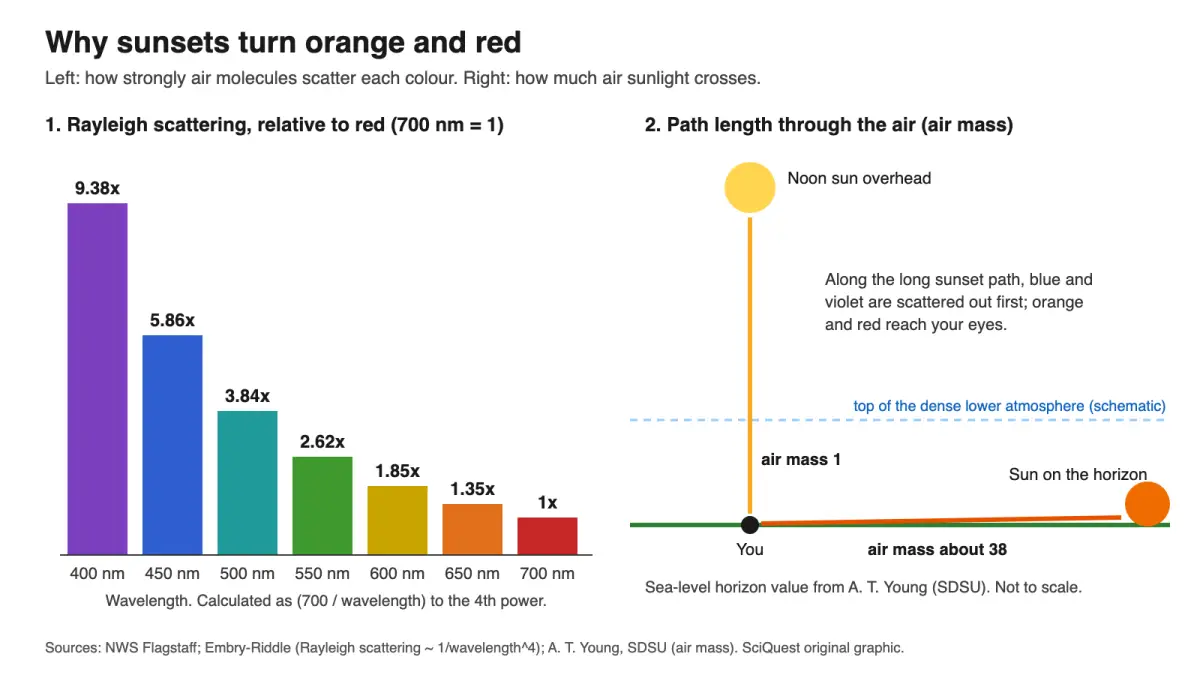
Air molecules scatter 450-nanometre blue light nearly six times more strongly than 700-nanometre red light, and at sunset sunlight crosses roughly 38 times as much air as it does from straight overhead.
The sky turns orange, red, yellow or pink when sunlight has to travel through so much air, or so many particles, that most of its blue light is scattered away before it reaches you. At sunrise and sunset the Sun’s light skims through about 38 times as much atmosphere as at the zenith, so mainly the longer orange and red wavelengths survive the trip.
The same physics explains the everyday blue sky. Air molecules scatter short wavelengths far more than long ones, a process called Rayleigh scattering. Smoke, dust and haze add a second effect that can tint the whole sky orange even in the middle of the day.
Explain it like I’m busy:
- Air scatters blue light much more than red light. That scattered blue is the blue sky.
- When the Sun is low, its light crosses far more air, so the blue is stripped out and orange and red are left.
- Smoke and dust remove even more blue, which is why skies can look orange during wildfires or dust events.
Key facts
- Rayleigh scattering happens when particles are much smaller than the light’s wavelength, and its strength is inversely proportional to the fourth power of the wavelength (Embry-Riddle Aeronautical University).
- Calculated: at 450 nm (blue) air scatters about 5.9 times more strongly than at 700 nm (red); at 400 nm (violet) about 9.4 times more.
- Path length: the relative air mass is 1 with the Sun overhead and about 38 at the horizon at sea level (Andrew T. Young, San Diego State University).
- Colours at sunset: if the path is long enough, the blue and violet are redirected out of your line of sight, leaving mostly pink, orange and red (US National Weather Service).
- Particles matter: smoke and dust are the main sources of Mie scattering, and more of them scatter more blue and violet away (Embry-Riddle).
- Space looks black because there are very few molecules there to scatter light toward your eye (US National Weather Service).
What it means: a sieve that catches blue first
Think of the atmosphere as a sieve that catches blue light far more readily than red. Every bit of air the sunlight crosses pulls out some blue and sends it off in other directions. That redirected blue fills the daytime sky, which is why the sky above you looks blue.
Now make the sieve longer. At sunset the light has to cross dozens of times more air, so the sieve catches nearly all the blue and violet. What comes through is the red, orange and yellow that the air barely touched. The analogy has a limit: a real sieve removes things, but the atmosphere only redirects light. The blue removed from your sunset is still lighting up someone else’s sky further along the beam.
How scientists know: the fourth-power rule, worked out
In the 1870s, Lord Rayleigh described how particles much smaller than a light wave scatter it, according to the National Weather Service. Nitrogen and oxygen molecules fit that description. The scattering strength goes as 1 ÷ wavelength4, so a small change in wavelength makes a big difference.
Worked calculation (blue vs red). Take 450 nm as a representative blue and 700 nm as a representative red:
- Ratio of wavelengths: 700 nm ÷ 450 nm = 1.556
- Raise it to the fourth power: 1.5564 ≈ 5.86
- Result: air molecules scatter this blue light about 5.9 times as strongly as this red light.
For violet at 400 nm the same sum gives (700 ÷ 400)4 = 1.754 ≈ 9.4. Over a short noon path, that difference just makes the sky blue. Over a path about 38 times longer, it removes almost all of the blue from the direct sunlight.
| Wavelength (nm) | Approximate colour | Scattering relative to 700 nm (calculated) |
|---|---|---|
| 400 | Violet | 9.38× |
| 450 | Blue | 5.86× |
| 500 | Blue-green | 3.84× |
| 550 | Green | 2.62× |
| 600 | Orange-yellow | 1.85× |
| 650 | Orange-red | 1.35× |
| 700 | Red | 1.00× |
Source: SciQuest calculation using the inverse-fourth-power law for Rayleigh scattering (Embry-Riddle Aeronautical University). Wavelengths are representative; colour names are approximate. Applies to air molecules only, not to smoke, dust or cloud droplets.
Try it: how much more is one colour scattered than another?
450 nm light is scattered about 5.86 times as strongly as 700 nm light.
How this is calculated: (longer ÷ shorter)4, the Rayleigh law for air molecules. Not valid for smoke, dust or cloud droplets.
What changes the answer: smoke, dust and haze
Rayleigh’s rule applies only to particles much smaller than the light’s wavelength. Smoke and dust particles are closer in size to the wavelength, and they scatter light differently, a process called Mie scattering. Embry-Riddle’s meteorology tutorial names smoke and dust as the main sources of Mie scattering and notes that more of them scatter more violet and blue light away, leaving mostly orange and red.
That is why wildfire smoke or dust can turn the Sun deep red and give the whole sky an orange cast, even at midday. NASA notes that dust, pollution and other aerosols can make the sky look red, and the National Weather Service notes that extra particles, such as those after a major volcanic eruption, can make sunrises and sunsets more vivid.
Much larger particles behave differently again. Cloud droplets and ice crystals, more than about 10 times the wavelength, scatter all visible colours roughly equally, which is why clouds look white rather than blue.
If the orange sky comes from wildfire smoke, the colour itself tells you little about the air at ground level. For health information, check official air-quality sources such as AirNow or your local health authority.
Why is the sky orange, red, yellow or pink? How the colours compare
- Yellow: a modest path through the air, such as the Sun somewhat above the horizon, removes more blue than green, yellow or red, as the table above shows. NASA describes reds and yellows reaching your eyes when the Sun is low.
- Orange and red: a very long path, or extra particles, strip out most of the blue, green and yellow too.
- Pink: the National Weather Service lists pink alongside orange and red as the colours left when the blue is redirected.
Some people report yellow or greenish skies around severe storms. We could not find an authoritative source explaining that effect in enough detail to include here, so this article does not cover it.
Why it matters to you
The next time you see a fiery sunset, you are seeing how much air the light just crossed. An unusually orange daytime sky is a clue that smoke or dust is in the air, which is worth checking against official air-quality reports. The same physics also explains why the Moon turns red during a total lunar eclipse: the only sunlight reaching it has been filtered through Earth’s atmosphere.
“But wait…”
If violet scatters even more than blue, why isn’t the sky violet? The National Weather Service gives two reasons: the Sun emits more energy as blue light than as violet, and our eyes are more sensitive to blue. The calculation above describes scattering strength, not what your eye perceives.
Why is the sky blue if space is black? Colour in the sky needs something to scatter the light. Our atmosphere supplies enormous numbers of gas molecules. In space there are very few, so there is almost nothing to send sunlight toward your eye, and the sky looks black, as the National Weather Service explains. Even at high altitude on Earth, with fewer molecules overhead, the sky looks a darker blue.
Related questions
Why is the sky paler near the horizon? Light from low in the sky passes through more air, so its blue is scattered and rescattered many times, and the colours mix toward white (NASA Space Place).
What colour is the sky on Mars? Mars has a thin, mostly carbon dioxide atmosphere carrying fine dust. NASA reports a daytime sky that looks orange or reddish and a blue-grey glow around the Sun at sunset, the reverse of Earth. Read more about our neighbour in how far Mars is from Earth.
Is the ocean blue for the same reason? Not mainly. Water absorbs red light, which is a different process; see why water is blue.
In one sentence
The sky turns orange, red, yellow or pink when a long path through the air, or a load of smoke and dust, scatters the blue out of sunlight before it reaches you.
Quick check: did it click?
- Roughly how much more strongly does air scatter 450 nm blue light than 700 nm red light? About 5.9 times, because (700 ÷ 450)4 ≈ 5.86.
- Why are sunsets redder than noon light? Sunlight at the horizon crosses about 38 times as much air, so nearly all its blue is scattered away.
- Why can wildfire smoke make the sky orange at midday? Smoke particles cause Mie scattering that removes more blue and violet light, leaving orange and red.
Read next
- Why is water blue in colour? A different route to blue.
- How far is Mars from Earth? Visit the planet with an orange daytime sky.
- Blood Moon 2025: why the Moon turns red in Earth’s shadow.
Sources
- US National Weather Service, Flagstaff. Why is the sky blue?
- NASA Space Place. Why is the sky blue?
- Embry-Riddle Aeronautical University, Meteorology. Scattering tutorial: Rayleigh, Mie and non-selective scattering
- Andrew T. Young, San Diego State University. Airmass: introduction
- US EPA and partners. AirNow (official air-quality information)
Disclosure: This article was drafted with AI assistance and checked against the sources above. The scattering ratios are SciQuest calculations from the inverse-fourth-power law using representative wavelengths, and the graphic is an original SciQuest illustration whose right panel is not to scale. Spotted an error? See our corrections policy.
Discover more from SciQuest
Subscribe to get the latest posts sent to your email.
Leave a comment