

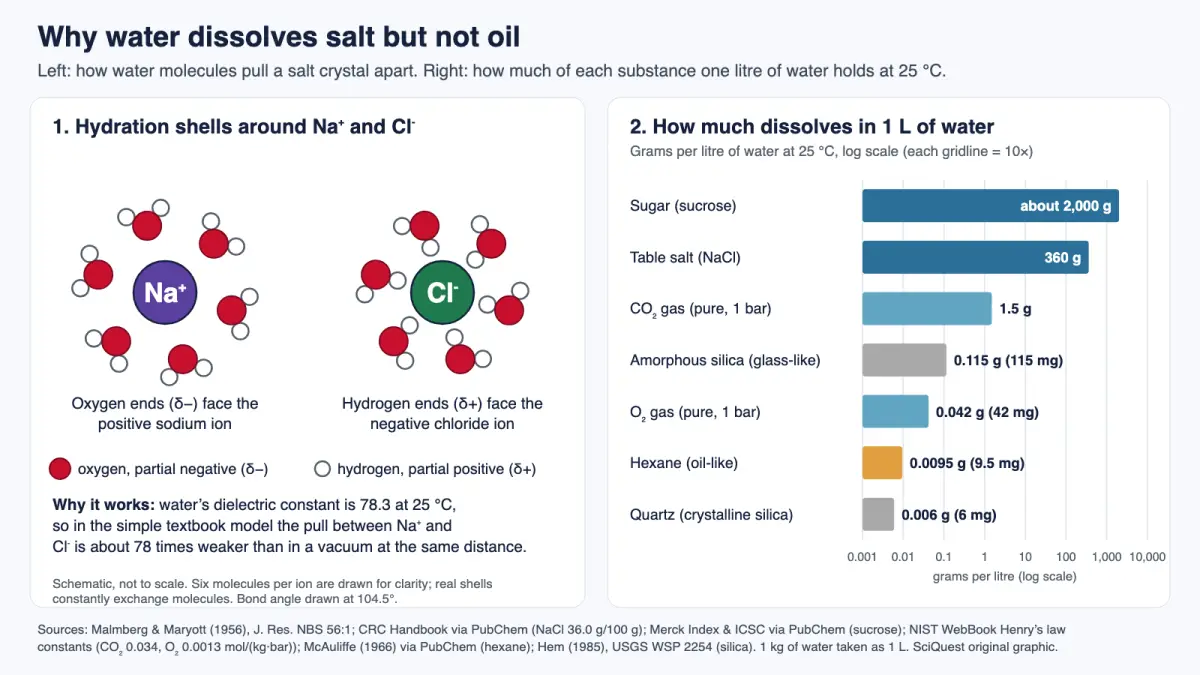
Water’s bent, lopsided molecules and its dielectric constant of 78.3 at 25 °C let one litre hold about 360 g of table salt, yet the same litre takes up only about 9.5 mg of hexane, an oily hydrocarbon.
Water is called the universal solvent because it dissolves a wide variety of substances, especially salts, sugars and other charged or polar compounds, which are the substances that matter most in rocks, oceans and living cells. Three properties do the work: each water molecule is polar (slightly negative at the oxygen end, slightly positive at the hydrogen ends), it forms hydrogen bonds, and liquid water has a high dielectric constant of 78.3 at 25 °C, which weakens the pull between oppositely charged ions about 78-fold in the simple textbook model.
The nickname is an exaggeration. Oils, fats and the plastics in water bottles barely dissolve at all, and even glass, which looks inert, is slowly attacked by water. The real rule is narrower and more useful: water dissolves things that carry electric charge or can share hydrogen bonds with it.
Explain it like I’m busy:
- Water molecules are tiny electrical dipoles. They crowd around charged ions and polar molecules and carry them off into solution.
- Liquid water’s dielectric constant (78.3 at 25 °C) weakens the attraction holding a salt crystal together, so the ions separate easily.
- “Universal” overstates it: one litre of water holds about 360 g of salt but only about 9.5 mg of hexane, roughly 38,000 times less.
Key facts about water as a solvent
- Shape: the angle between water’s two O–H bonds is 104.48°, and each bond is 0.958 Å long (NIST CCCBDB). The bent shape is why the charges do not cancel.
- Polarity: a single water molecule has a measured dipole moment of 1.855 debye in the gas phase (NIST CCCBDB, microwave spectroscopy).
- Dielectric constant: 78.30 at 25 °C, 80.10 at 20 °C and 55.72 at 100 °C, measured by Malmberg and Maryott at the US National Bureau of Standards in 1956.
- Salt: 36.0 g of sodium chloride dissolves in 100 g of water at 25 °C (CRC Handbook), about 550 times more than dissolves in ethanol.
- Oxygen: water open to pure oxygen at 1 bar and 25 °C holds only about 42 mg per kg, calculated from NIST’s Henry’s law constant. That is one reason blood needs haemoglobin.
| Substance | Type of substance | Value as published | Per litre of water (approx.) | Why it does or does not dissolve |
|---|---|---|---|---|
| Sugar (sucrose) | Polar molecule with many –OH groups | 1 g dissolves in 0.5 mL water (Merck Index); 200 g per 100 mL at 25 °C (ICSC) | about 2,000 g | Its –OH groups form hydrogen bonds with water |
| Table salt (NaCl) | Ionic solid | 36.0 g per 100 g water at 25 °C (CRC Handbook) | 360 g (6.16 mol) | Water molecules surround and separate Na+ and Cl− ions |
| Carbon dioxide (CO2), pure gas at 1 bar | Gas that reacts slightly with water | Henry’s law constant 0.034 mol/(kg·bar) at 25 °C (NIST) | 1.5 g | Moderately soluble; only about 0.01% of the dissolved gas exists as carbonic acid (Hem) |
| Amorphous silica (the glassy form of SiO2) | Network solid | 115 mg/L at 25 °C (Hem, USGS) | 0.115 g | Strong silicon–oxygen bonds must be broken by reaction |
| Oxygen (O2), pure gas at 1 bar | Nonpolar gas | Henry’s law constant 0.0013 mol/(kg·bar) at 25 °C (NIST) | 0.042 g (about 8.6 mg from air) | No charge to attract water; dissolves only slightly |
| Hexane (C6H14) | Nonpolar hydrocarbon, like the molecules in oil and petrol | 9.5 mg/L at 25 °C (McAuliffe 1966) | 0.0095 g | Cannot form hydrogen bonds; water molecules stick to each other instead |
| Quartz (crystalline SiO2) | Network solid | about 6 mg/L at 25 °C (Hem, USGS) | 0.006 g | As for silica, but the ordered crystal is even less soluble |
Sources: CRC Handbook of Chemistry and Physics (94th ed.), The Merck Index, ILO-WHO ICSC and McAuliffe (1966), all as compiled in PubChem’s Hazardous Substances Data Bank records; NIST Chemistry WebBook Henry’s law data (compiled by R. Sander); J. D. Hem (1985), USGS Water-Supply Paper 2254. “Per litre” values are SciQuest conversions that treat 1 kg of water as 1 L (water’s density at 25 °C is 0.997 kg/L). Gas values assume pure gas at 1 bar; the “from air” oxygen figure is our calculation using an oxygen partial pressure of 0.206 bar. Values are rounded and vary between references.
What “universal solvent” really means
A solvent is the liquid that does the dissolving; the solute is what gets dissolved. Water earns its reputation because the solutes that matter most in daily life, such as salts, sugars and the ions in rock, are exactly the kinds of substances it handles well.
Here is a picture to keep in mind. When salt dissolves, each sodium and chloride ion is pulled out of the crystal and wrapped in a coat of water molecules, called a hydration shell. The coat keeps the ions from finding each other and snapping back together. The comparison has a limit: a real coat stays put, but the molecules in a hydration shell are held only by electrical attraction and swap places with the surrounding water all the time.
A litre takes up about 360 g of salt but only about 9.5 mg of hexane, which is less than 10 parts per million by mass. That is a factor of about 38,000 (our calculation from the published values).
How water dissolves salt: three properties working together
1. Polarity: a molecule with a positive and a negative end
Oxygen pulls on shared electrons more strongly than hydrogen does. OpenStax Biology 2e, an open university textbook from Rice University, explains that this leaves a slight positive charge on each hydrogen and a slight negative charge on the oxygen. Because the molecule is bent at 104.48° rather than straight, those charges do not cancel. The result is a measurable dipole: 1.855 debye for a single molecule, according to NIST’s Computational Chemistry Comparison and Benchmark Database.
When salt meets water, the negative oxygen ends turn toward each positive sodium ion, and the positive hydrogen ends turn toward each negative chloride ion. OpenStax names the resulting cluster a sphere of hydration, or hydration shell. Chemists call the attraction between an ion and a polar molecule an ion–dipole attraction, as the OpenStax Chemistry 2e textbook puts it.
2. Hydrogen bonds: why sugar dissolves
Sugar is not made of ions, so it dissolves a different way. A sucrose molecule carries many –OH groups, and each can form hydrogen bonds with water, the same attraction that holds water molecules to one another. The Chemistry LibreTexts textbook for Chemistry for Changing Times describes sucrose dissolving this way: water breaks the attractions between sugar molecules, not the bonds inside them.
3. The dielectric constant: weakening the grip between ions
The third property is less familiar but explains why salt falls apart so easily. A material’s dielectric constant measures how much it weakens an electric field passing through it. The OpenStax University Physics text explains that polar molecules line up against an applied field and so reduce it, and it singles out water as a molecule that aligns easily.
In 1956, C. G. Malmberg and A. A. Maryott of the US National Bureau of Standards (now NIST) measured water’s dielectric constant from 0 °C to 100 °C with an electrical bridge accurate to better than 0.1%. At 25 °C they found 78.30.
Worked calculation: in the simple textbook model, the force between two charges sitting in a medium is the force they would feel in a vacuum divided by the dielectric constant.
- Force in a vacuum: Fvacuum = k q1q2 ÷ r2.
- Force in water at 25 °C: Fwater = Fvacuum ÷ 78.3.
- So at the same distance, Na+ and Cl− attract each other about 78 times more weakly in water than in empty space.
The model has a limit: it treats water as a smooth background, which is least accurate for the few molecules touching an ion. It still captures why a crystal held together by electrical attraction comes apart in water.
Why “universal” is an exaggeration
OpenStax Biology 2e states it plainly: nonpolar molecules such as oils and fats do not interact well with water. They carry no net charge and cannot form hydrogen bonds, so water molecules stay attached to each other and push the oily molecules together. An oil slick on a puddle is a daily demonstration.
Hexane is a clean test case. It is a hydrocarbon, a molecule of only carbon and hydrogen like those in petrol and oil, and only about 9.5 mg dissolves in a litre of water at 25 °C, according to a 1966 study by C. McAuliffe in the Journal of Physical Chemistry.
Other solvents beat water on their own ground. Hexane mixes freely with ethanol, chloroform and ether, according to The Merck Index. The rule chemists teach is “like dissolves like”: polar solvents for polar and ionic solutes, nonpolar solvents for nonpolar ones. Water simply sits at the extreme polar end, which happens to suit salts, sugars and most of biology.
The salt numbers show the same rule from the other side. At 25 °C, 100 g of water dissolves 36.0 g of sodium chloride (CRC Handbook), 100 g of methanol dissolves 1.40 g and 100 g of ethanol only 0.065 g (Kirk-Othmer Encyclopedia). By that measure water dissolves about 550 times more salt than ethanol does (our calculation).
What changes how much dissolves
Temperature, for gases: warm water holds less gas. Using the temperature factors in NIST’s Henry’s law data, water at 5 °C holds about 1.5 times as much oxygen and about 1.8 times as much carbon dioxide as water at 25 °C (our calculation). Henry’s law makes the same point at home: a warm fizzy drink can hold less dissolved carbon dioxide than a cold one.
Temperature, for salt: table salt barely cares. One gram dissolves in 2.8 mL of water at 25 °C and in 2.6 mL of boiling water (Merck Index), so going from room temperature to boiling raises the amount by only about 8%.
Temperature, for the dielectric constant: water’s dielectric constant falls from 87.74 at 0 °C to 55.72 at 100 °C (Malmberg and Maryott). Hot water is therefore a somewhat weaker screen between charges than cold water.
Pressure, for gases: Henry’s law says the amount of gas dissolved is proportional to the pressure of that gas above the water. A sealed soda bottle uses extra carbon dioxide pressure to force more gas in; opening it lets the gas escape. The same gas-solubility rules apply where the ocean meets the air, part of the story in our explainer on how carbon sinks work.
Acidity: rainwater in equilibrium with the carbon dioxide in clean air has a pH of about 5.6 rather than 7, according to John D. Hem of the US Geological Survey. NOAA’s National Ocean Service notes that because rainwater is slightly acidic, it erodes rocks.
Why it matters to you
Your blood. Plasma, the liquid part of blood, is about 92% water and carries dissolved sodium, potassium and calcium ions, glucose, amino acids and wastes, according to OpenStax Anatomy and Physiology 2e. Oxygen is the exception: only about 1.5% of the oxygen in blood travels dissolved in plasma, and most rides on haemoglobin in red blood cells. Carbon dioxide dissolves better; about 7 to 10% travels dissolved and about 70% as bicarbonate ions.
Your cells. Water’s dislike of oily molecules is what holds cells together. OpenStax Biology 2e explains that phospholipids in water line up with their water-avoiding tails facing each other and their water-loving heads facing out, forming the two-layer membrane around every cell. A truly universal solvent would dissolve that membrane.
Rocks and the ocean. NOAA’s National Ocean Service explains that slightly acidic rainwater erodes rocks on land, releasing ions that rivers carry to the sea. Sodium and chloride make up about 85% of the dissolved ions in seawater, and the average salinity is about 35 parts per thousand, roughly 35 g of salt in every kilogram of seawater. Our explainer on why the Dead Sea is so salty shows what happens when that water evaporates with no outlet.
Your sink. Water alone cannot lift grease off a pan. Soap fixes that: the OpenStax Organic Chemistry text explains that each soap molecule has an ionic, water-loving end and a long hydrocarbon tail. The tails coat grease and oil droplets, the charged ends face the water, and the coated droplets rinse away.
“But wait… if water dissolves so much, why doesn’t it dissolve its glass container?”
It does, very slowly, and only a little. Ordinary glass is made largely from silica sand, which is silicon dioxide; the International Agency for Research on Cancer describes glassmaking as the most ancient and principal use of silica sand. Silica is a network solid: every silicon atom is bonded to oxygen atoms in a continuous framework, so water cannot simply surround and carry off separate pieces the way it does with salt. Bonds have to break by chemical reaction first.
Even when that happens, the limit is low. Hem’s USGS reference work gives the solubility of amorphous silica, the glassy form, as 115 mg per litre at 25 °C, and the solubility of crystalline quartz as about 6 mg per litre. For comparison, a litre of water dissolves about 360,000 mg of salt.
Real glass is not pure silica, and it does corrode. A 2008 review in the Journal of the American Ceramic Society by R. Conradt notes that glass exposed to water does corrode and forms an altered zone just beneath its surface. In still water the reaction slows down, and the review proposes that diffusion through pores in that altered zone probably controls the slowdown. The amounts involved are tiny, which is why a glass of water on your desk looks unchanged.
Related questions
Is water the best solvent there is? No single liquid is best for everything. Water is outstanding for salts and polar molecules, while ethanol, ether and chloroform dissolve oily compounds that water cannot.
Does hot water dissolve more? It depends on the substance. Table salt gains only about 8% from 25 °C to boiling, and gases go the other way: warm water holds less oxygen and carbon dioxide than cold water.
Where is all of Earth’s water? Our guide to how much of Earth is water breaks down how it is split between oceans, ice, groundwater and rivers.
In one sentence
Water dissolves salts, sugars and other charged or polar substances unusually well because its bent molecules are polar, form hydrogen bonds and give liquid water a dielectric constant of 78.3 at 25 °C, but it is far from universal, since oils, fats, plastics and even glass dissolve in it only slightly or very slowly.
Quick check: did it click?
- Which end of a water molecule faces a sodium ion? The oxygen end, which carries a slight negative charge.
- Roughly how much weaker is the attraction between Na+ and Cl− in water than in a vacuum, in the simple model? About 78 times, the value of water’s dielectric constant at 25 °C.
- Why does most of the oxygen in your blood ride on haemoglobin? Oxygen is a nonpolar gas that dissolves only slightly in water, so plasma carries only about 1.5% of it.
Read next
- Where did Earth’s water come from?
- Why is water blue?
- How do carbon sinks work, including the ocean’s uptake of carbon dioxide?
Disclosure: This article was drafted with AI assistance and checked against the sources below. The per-litre conversions, the gas solubilities from Henry’s law constants, the temperature factors and the ratios are SciQuest calculations, and the hydration-shell and solubility graphic is an original SciQuest graphic. Several handbook values are cited through PubChem’s compilation of the original references. Spotted an error? See our corrections policy.
Sources
- C. G. Malmberg and A. A. Maryott (1956), Dielectric Constant of Water from 0° to 100 °C, Journal of Research of the National Bureau of Standards 56(1), 1 to 8 (78.30 at 25 °C; table 2 values at 0, 20 and 100 °C; bridge method, accuracy better than 0.1%)
- NIST Computational Chemistry Comparison and Benchmark Database, Experimental data for H2O (bond angle 104.4776°, O–H 0.958 Å, dipole moment 1.855 D)
- NIST Chemistry WebBook, Henry’s law data for carbon dioxide and oxygen, compiled by R. Sander (0.034 and 0.0013 mol/(kg·bar) at 298.15 K; temperature constants 2,400 and 1,700 K)
- PubChem, Sodium chloride: solubility (CRC Handbook 94th ed.: 36.0 g/100 g at 25 °C; Merck Index: 1 g in 2.8 mL at 25 °C, 2.6 mL boiling; Kirk-Othmer: ethanol 0.065 g and methanol 1.40 g per 100 g)
- PubChem, Sucrose: solubility (Merck Index: 1 g in 0.5 mL water; ICSC: 200 g/100 mL at 25 °C)
- PubChem, Hexane: solubility (9.5 mg/L at 25 °C, citing C. McAuliffe, Journal of Physical Chemistry 70, 1267 to 1275, 1966; Merck Index: miscible with alcohol, chloroform and ether)
- J. D. Hem (1985), Study and Interpretation of the Chemical Characteristics of Natural Water, 3rd ed., U.S. Geological Survey Water-Supply Paper 2254 (amorphous silica 115 mg/L and quartz about 6 mg/L at 25 °C; rainwater pH about 5.6; about 0.01% of dissolved CO2 present as H2CO3)
- R. Conradt (2008), Chemical Durability of Oxide Glasses in Aqueous Solutions: A Review, Journal of the American Ceramic Society 91, 728 to 735 (glass corrodes in water; altered subsurface zone; slower rates in static conditions, probably diffusion-controlled)
- PubChem, Silicon dioxide: uses (IARC Monographs: glass manufacture as the principal use of silica sand)
- OpenStax, Biology 2e, 2.2 Water and 5.1 Components and Structure (partial charges; hydration shells; oils and fats; phospholipid bilayer)
- OpenStax, Chemistry 2e, 11.2 Electrolytes (ion–dipole attraction; dissociation)
- OpenStax, University Physics Volume 2, 8.5 Molecular Model of a Dielectric (dielectrics weaken the field; water molecules align easily)
- Chemistry LibreTexts, 14.1 Water: Some Unique Properties (sucrose dissolving through hydrogen bonds)
- OpenStax, Anatomy and Physiology 2e, 18.1 An Overview of Blood and 22.5 Transport of Gases (plasma 92% water; oxygen 1.5% dissolved; carbon dioxide 7 to 10% dissolved, about 70% as bicarbonate)
- OpenStax, Organic Chemistry, 27.2 Soap (how soap molecules coat grease)
- NOAA National Ocean Service, Why is the ocean salty? (rainwater erodes rock; sodium and chloride about 85% of dissolved ions; average salinity about 35 parts per thousand)
Discover more from SciQuest
Subscribe to get the latest posts sent to your email.
Leave a comment