

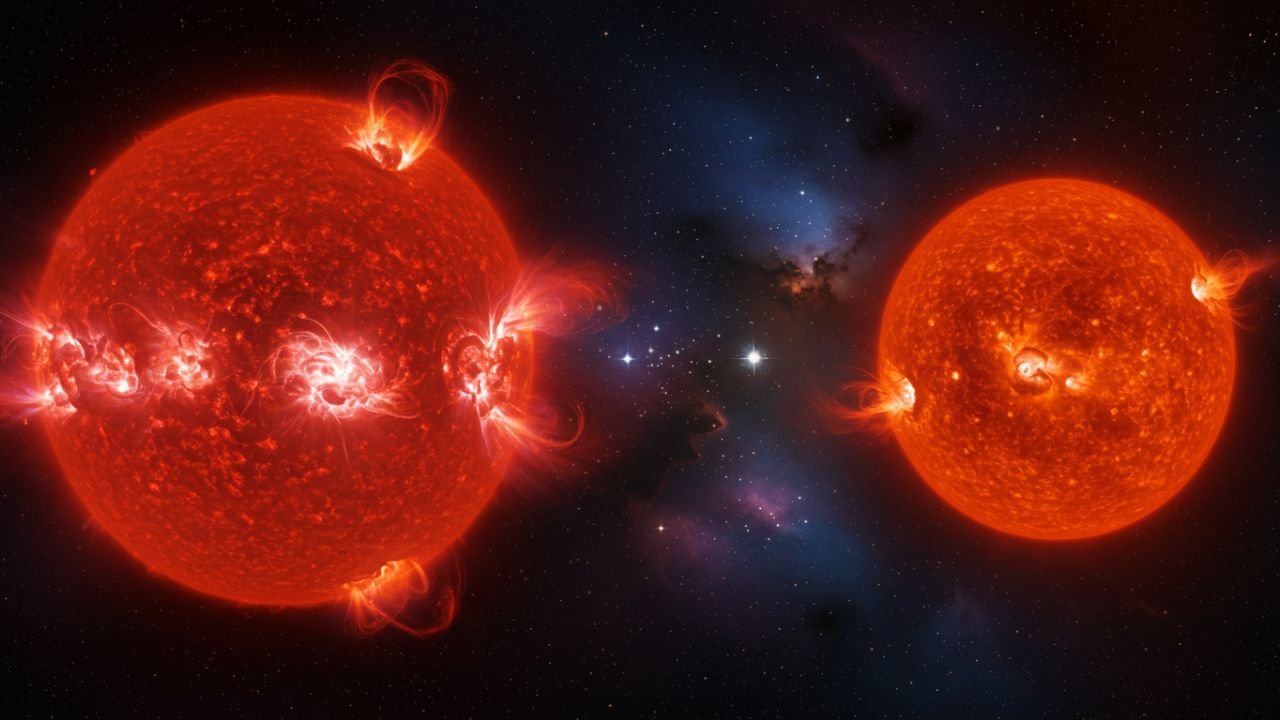
Stephenson 2-18 is often declared the larger star online, but the evidence does not support a confident winner. WOH G64 has been observed in much greater detail, while the viral size quoted for Stephenson 2-18 depends on uncertain distance, temperature, brightness and cluster membership estimates.
Both objects are red supergiants—evolved, cool, extremely luminous stars with extended outer atmospheres. Neither has a sharp solid surface, so even the word “radius” requires a model.
Comparison at a glance
| Property | WOH G64 | Stephenson 2-18 |
|---|---|---|
| Type | Red supergiant | Candidate red supergiant associated with the Stephenson 2 region |
| Location | Large Magellanic Cloud | Milky Way, toward the Stephenson 2 cluster region |
| Approximate distance | About 160,000 light-years | Often estimated near 6 kiloparsecs, or about 20,000 light-years, but association and extinction matter |
| Frequently quoted radius | Roughly 2,000 solar radii in ESO’s 2024 public summary | Roughly 2,150 solar radii online |
| Confidence in that simple number | Still model-dependent; dust complicates the view | Especially uncertain and not a secure direct measurement |
| Notable recent result | First detailed image of a star outside the Milky Way; an elongated dust cocoon was resolved | No comparably direct resolved image establishing the viral radius |
The numbers in this table should not be treated as measurements made with equal methods or precision.
How big is WOH G64?
WOH G64 lies in the Large Magellanic Cloud, a satellite galaxy of the Milky Way. In 2024, astronomers used the European Southern Observatory’s Very Large Telescope Interferometer to obtain the first detailed close-up image of a star in another galaxy.
ESO described WOH G64 as roughly 2,000 times the Sun’s radius. If placed at the centre of our Solar System, a star of that nominal size would extend beyond Jupiter’s orbit.
The observation also revealed something more informative than a single radius: a compact, egg-shaped cocoon of dust surrounding the star. The star had dimmed during the previous decade. Researchers proposed that it may have expelled material, while also considering the possible influence of an unseen companion.
Dust absorbs and re-emits starlight, making the underlying star harder to measure. WOH G64’s quoted radius is therefore an estimate based on observations and models, not the edge of a solid sphere.
How big is Stephenson 2-18?
Stephenson 2-18 is the informal name often used online for a red supergiant candidate in the direction of the massive Stephenson 2 cluster. A radius near 2,150 Suns is widely repeated, which would make it larger than WOH G64’s commonly quoted value.
The problem is that this is not a clean, direct size measurement. Astronomers infer a red supergiant’s radius from its luminosity and effective temperature. Each depends on difficult quantities such as distance, interstellar extinction and whether the star truly belongs to the cluster used to estimate its distance.
Research on the Stephenson 2 region has found an unusually rich red-supergiant population, but it also documents complex membership and extinction. Small changes in the adopted inputs can produce a large change in calculated radius. The extreme viral estimate should therefore be labelled highly uncertain, not presented as a confirmed record.
Which star is larger?
Using the two popular headline estimates alone, Stephenson 2-18 appears about 7.5% larger in radius. That apparent difference is much smaller than the underlying uncertainties.
The scientifically responsible answer is:
Current observations do not establish a definitive size winner between WOH G64 and Stephenson 2-18.
WOH G64 has the better observational story because astronomers have resolved its dusty environment using interferometry. That does not automatically make it larger; it makes its physical state better constrained. Stephenson 2-18 may be enormous, but its most spectacular quoted radius is less secure.
Why are red-supergiant sizes so difficult to measure?
Red supergiants are not scaled-up versions of rocky planets. Their visible layers are turbulent and diffuse. Giant convection cells, pulsation, molecules and surrounding dust all change the apparent edge at different wavelengths.
Astronomers may estimate size using:
- Angular diameter: how wide the star appears on the sky, combined with distance
- Luminosity and temperature: applying the Stefan–Boltzmann relation to calculate an effective radius
- Interferometry: combining several telescopes to resolve details too small for one telescope
- Atmosphere and dust models: separating light from the star, its extended atmosphere and surrounding material
Results based on different methods are not always directly comparable.
Are either of these stars about to explode?
Both are evolved massive stars, and red supergiants can end their lives as core-collapse supernovae. That does not let astronomers predict an explosion date. “Soon” in stellar evolution can still mean thousands or far more years, and a star’s final outcome depends on properties that remain uncertain.
WOH G64’s dimming and expelled dust are evidence of change, not proof that a supernova is imminent. The same caution applies to Stephenson 2-18.
The short answer
Stephenson 2-18 wins only if we accept two simplified radius estimates as equally reliable. We should not. WOH G64 is an exceptionally large, closely studied red supergiant; Stephenson 2-18 may be similarly large or larger, but its headline figure is substantially more uncertain. For now, there is no confirmed winner.
Update note: This article was substantially revised and fact-checked on August 23, 2026, following ESO’s resolved observations of WOH G64 and a review of the uncertainty surrounding Stephenson 2-18.
Sources
- European Southern Observatory, First close-up picture of a star outside our galaxy (2024)
- Ohnaka et al., Imaging the dusty environment of WOH G64 with VLTI/GRAVITY, Astronomy & Astrophysics (2024)
- Negueruela et al., Red supergiants around the obscured open cluster Stephenson 2, Astronomy & Astrophysics (2012)
Discover more from SciQuest
Subscribe to get the latest posts sent to your email.
Leave a comment