

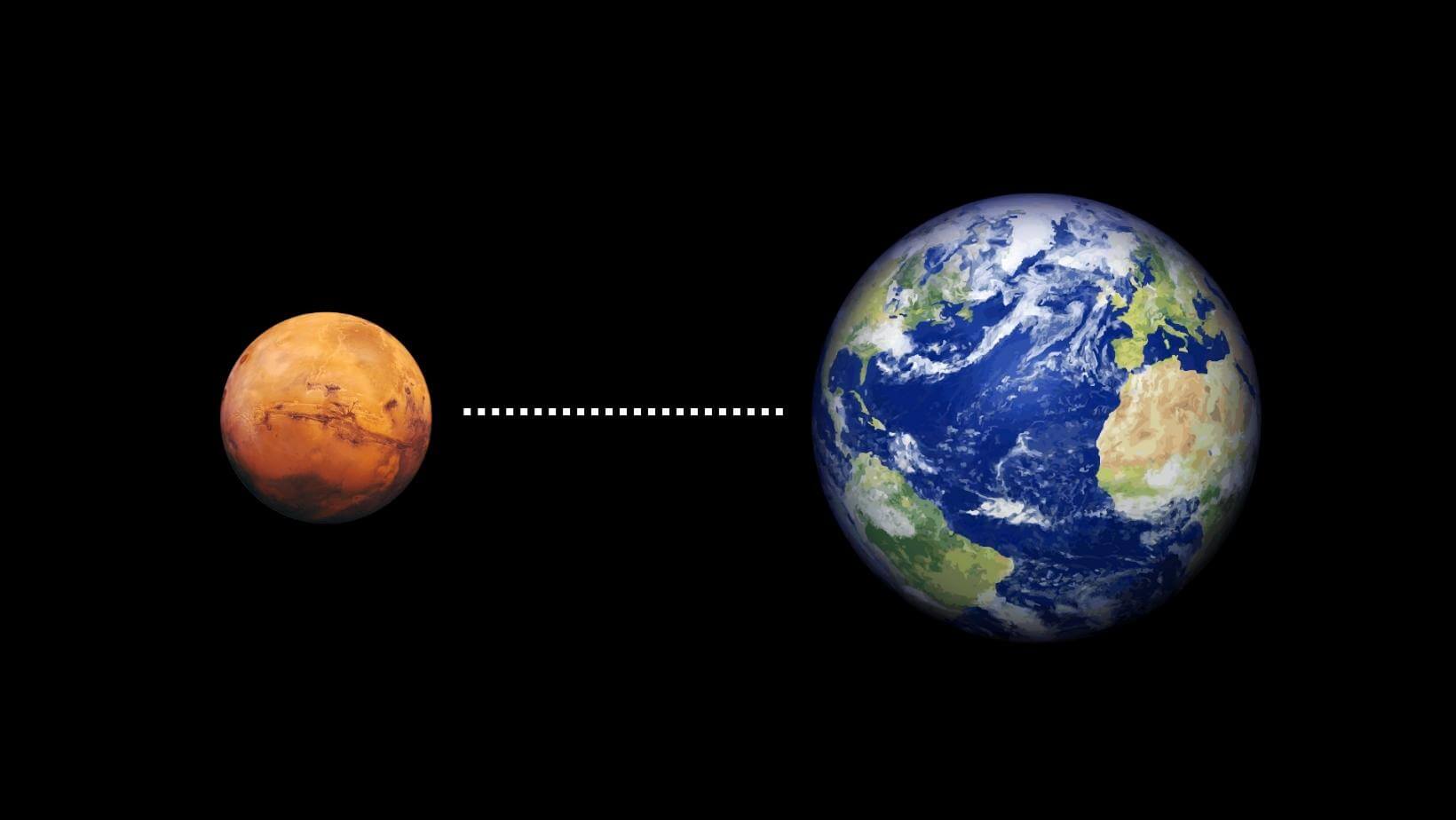
Mars is between 54.6 million km (33.9 million miles) and 401.4 million km (249.4 million miles) from Earth, depending on where the two planets are in their orbits. Averaged over time, the separation is about 254 million km (158 million miles), or 1.70 astronomical units (AU). At that distance, a radio signal takes about 14 minutes to cross from one planet to the other.
The distance never stays fixed for long. On October 12, 2026, Mars is about 237 million km (148 million miles) away and closing at roughly 12.7 km every second. The next close approach comes on February 20, 2027, at 101.4 million km.
Key facts about the Earth–Mars distance
- Closest possible: about 54.6 million km (33.9 million mi), or 3.0 light-minutes.
- Farthest possible: about 401.4 million km (249.4 million mi), or 22.3 light-minutes.
- Long-run average: about 254 million km (158 million mi), calculated by SciQuest from NASA JPL ephemeris data for 1900–2100.
- Close-approach cycle: every 768 to 799 days, or about 26 months.
- Closest in recorded history: August 27, 2003, at about 55.76 million km (34.65 million mi), Mars’s nearest pass in almost 60,000 years.
How far is Mars from Earth in km and miles?
| Situation | Distance (million km) | Distance (million miles) | Distance (AU) | One-way light time (minutes) |
|---|---|---|---|---|
| Closest possible | 54.6 | 33.9 | 0.365 | 3.0 |
| Closest in nearly 60,000 years (Aug. 27, 2003) | 55.76 | 34.65 | 0.373 | 3.1 |
| Typical distance at opposition | 78.3 | 48.7 | 0.524 | 4.4 |
| Average over time (1900–2100) | 254 | 158 | 1.70 | 14.1 |
| Farthest possible | 401.4 | 249.4 | 2.683 | 22.3 |
Sources: closest, farthest and typical opposition distances from the NASA NSSDCA Mars Fact Sheet; 2003 value from NASA Hubble image releases and JPL Horizons; long-run average calculated by SciQuest from daily NASA JPL Horizons Earth–Mars distances for January 1, 1900, to January 1, 2100. Miles, AU and light-times were converted using 1 mile = 1.609344 km, 1 AU = 149,597,870.7 km and the speed of light, 299,792.458 km/s.
Many websites quote an “average” of about 225 million km (140 million miles). We could not trace that figure to a NASA dataset. It is lower than the time-averaged separation in JPL’s ephemeris, which is 1.70 AU. A 2019 Physics Today analysis by Tom Stockman, Gabriel Monroe and Samuel Cordner explains why simple subtraction of orbital radii understates average planet-to-planet distances. Planets spend much of their time on opposite sides of the Sun.
When is Mars closest to Earth?
Mars is closest around opposition. At opposition, the Sun, Earth and Mars line up with Earth in the middle. Mars then sits opposite the Sun in our sky, rising at sunset and shining all night.
The reverse alignment is conjunction. Then the Sun lies between Earth and Mars, and the planets are near their maximum separation. The most recent conjunction was on January 9, 2026, when Mars was about 360 million km away.
Closest approach does not always fall on the opposition date. Because Mars’s orbit is noticeably elongated, the minimum distance can come several days before or after opposition. In 2020, for example, NASA noted that closest approach came about a week before the October 13 opposition.
Upcoming close approaches
| Opposition (UT) | Closest approach (UT) | Distance (million km) | Distance (million miles) | Light time (minutes) |
|---|---|---|---|---|
| Feb. 19, 2027 | Feb. 20, 2027 | 101.4 | 63.0 | 5.6 |
| Mar. 25, 2029 | Mar. 30, 2029 | 96.8 | 60.2 | 5.4 |
| May 4, 2031 | May 12, 2031 | 82.8 | 51.4 | 4.6 |
| June 28, 2033 | July 5, 2033 | 63.3 | 39.3 | 3.5 |
| Sept. 15–16, 2035 | Sept. 12, 2035 | 56.9 | 35.4 | 3.2 |
Predicted values calculated by SciQuest from NASA JPL Horizons geocentric ephemerides (DE441), sampled hourly around the 2027 event and daily otherwise, so other dates may differ by up to a day. Opposition dates are when Mars’s ecliptic longitude is 180° from the Sun’s. BBC Sky at Night Magazine independently lists the February 19, 2027, and March 25, 2029, opposition dates.
The February 2027 approach is unusually distant. In SciQuest’s analysis of JPL data for 1900–2100, it is the farthest of all 94 close approaches, narrowly beating February 1948. Mars will look small through a telescope. The planets then draw progressively closer at each encounter until 2035, which NASA identified in 2020 as the closest approach after that year.
Why does the distance between Earth and Mars change?
Two effects work together. The main one is that the planets travel at different speeds. Earth completes an orbit in 365.25 days, Mars in 687 days. Earth catches up with Mars and laps it, like a runner on an inside track, once every 780 days on average. That interval is called the synodic period.
The second effect sets how close each pass gets. Mars’s orbit has an eccentricity of 0.093, more than five times Earth’s. Its distance from the Sun ranges from 206.7 million km at perihelion to 249.3 million km at aphelion. When opposition happens near Mars’s perihelion, the planets come within about 56 million km. When it happens near aphelion, as in 2027, they stay about 100 million km apart. Astronomers call these perihelic and aphelic oppositions.
The pattern of near and far approaches repeats every 15 or 17 years. In the JPL data, the very close passes, within 60 million km, came or will come in 1956, 1971, 1988, 2003, 2018, 2035 and 2050. The four closest of 1900–2100 (1924, 2003, 2050 and 2082) all fall between mid-August and early September. Around then, Earth overtakes Mars close to Mars’s perihelion.
How long does light, or a radio signal, take to reach Mars?
Light and radio signals travel at 299,792.458 km/s. Dividing the distance by that speed gives the one-way delay:
Light time = distance ÷ speed of light
54,600,000 km ÷ 299,792.458 km/s ≈ 182 s ≈ 3.0 minutes
401,400,000 km ÷ 299,792.458 km/s ≈ 1,339 s ≈ 22.3 minutes
That delay is why rovers such as Perseverance cannot be driven with a joystick. A command and its confirmation need between about 6 and 45 minutes for a round trip, depending on the date. The light time on October 12, 2026, is about 13 minutes each way.
In light-years, Mars is between about 0.0000058 and 0.000042 light-years away. Light-minutes are far more practical at this scale. For comparison, SciQuest explains how long it would take to travel one light-year.
How long does it take to get to Mars?
The missions below took between about 4 and 8.5 months. Spacecraft do not fly straight across the gap. They follow a curved path around the Sun and aim for where Mars will be on arrival, so the route is much longer than the distance at launch.
Perseverance shows the effect. When it launched on July 30, 2020, Mars was about 98 million km from Earth. By landing day, the planets were about 203 million km apart, and NASA says the rover had travelled 472 million km (293 million miles) along its trajectory.
| Mission | Launch (UT) | Arrival at Mars (UT) | Travel time (days) |
|---|---|---|---|
| Mariner 7 (flyby) | Mar. 27, 1969 | Aug. 5, 1969 (closest approach) | 131 |
| Mariner 6 (flyby) | Feb. 25, 1969 | July 31, 1969 (closest approach) | 156 |
| Perseverance (rover) | July 30, 2020 | Feb. 18, 2021 (landing) | 203 |
| Mars Reconnaissance Orbiter | Aug. 12, 2005 | Mar. 10, 2006 (orbit insertion) | 210 |
| Mariner 4 (first successful flyby) | Nov. 28, 1964 | July 15, 1965 (closest approach) | 229 |
| Curiosity (rover) | Nov. 26, 2011 | Aug. 6, 2012 (landing) | 254 |
Sources: NASA NSSDCA spacecraft catalog entries for each mission; NASA Science mission pages for Perseverance and Curiosity. Travel times were counted by SciQuest from the listed dates. Mariner 6 launched on the evening of Feb. 24, 1969, local time.
Flybys are often faster because they do not need to slow down to enter orbit or land. Mariner 4’s flight took 229 days. At its closest approach, NASA records that the spacecraft was 216 million km from Earth. For more on spacecraft speeds and propulsion, see SciQuest’s guide to how fast we can travel in space with current technology.

Is Mars the closest planet to Earth?
No. Venus comes closest: NASA’s Venus fact sheet gives a minimum distance of 38.2 million km, well inside Mars’s 54.6 million km.
On average over time, the answer changes again. The 2019 Physics Today analysis found that Mercury, not Venus, is Earth’s nearest planet on average, at about 1.04 AU. Venus averages 1.14 AU. Mars, at 1.70 AU on SciQuest’s calculation, is neither the closest at its nearest nor on average.
How do scientists measure the distance to Mars?
Modern Earth–Mars distances come from planetary ephemerides, which are mathematical models of where each planet will be. NASA JPL’s DE440 and DE441 ephemerides, published in 2021, were built by fitting computed orbits to observations. For Mars, the main data are radio ranging measurements to spacecraft orbiting the planet, which time how long a signal takes to make the round trip. Very-long-baseline interferometry (VLBI) measurements of the same spacecraft fix the orbit’s orientation in space.
JPL’s Horizons system turns those ephemerides into distances for any date. That is how the current distance, the long-run average and the upcoming close approaches in this article were calculated.
What the numbers do not show
The “closest possible” figure of 54.6 million km is a theoretical minimum for the current orbits, not a scheduled event. The 2003 approach came within about 1.2 million km of it. Future values are predictions. They are highly reliable for the next few decades, but they are still model outputs, so dates and distances can differ slightly between sources that use different ephemerides or time zones.
“Average distance” also depends on how it is defined. The time average of 254 million km is the most useful answer to “how far is Mars from Earth on a typical day?” It is not the distance at any particular moment.
Related reading
- How strong is gravity on Mars? Value, calculation and Earth comparison
- What is the atmosphere of Mars made of?
- Can humans survive on Mars?
Update note: This article was substantially revised on October 12, 2026, to correct the description of opposition (Earth, not the Sun, lies between the planets), separate the closest, average and farthest distances in km and miles, replace a single light-time with the full 3- to 22-minute range, correct the mission travel times and remove the false caption calling Mars the closest planet. It adds upcoming close approaches through 2035. It was drafted with AI assistance and checked against the sources listed below.
Sources
- NASA NSSDCA, Mars Fact Sheet
- NASA NSSDCA, Venus Fact Sheet
- NASA JPL Solar System Dynamics, Horizons System (Earth–Mars ephemerides, queried October 12, 2026)
- Park, R. S., et al. (2021), The JPL Planetary and Lunar Ephemerides DE440 and DE441, The Astronomical Journal 161:105
- NASA Science, Mars oppositions Solar System diagram (Hubble release with captions on the August 2003 close approach)
- NASA Watch the Skies, It’s All About Mars in October (2020)
- BBC Sky at Night Magazine, Mars opposition 2027
- Stockman, T., Monroe, G., and Cordner, S. (2019), Venus is not Earth’s closest neighbor, Physics Today
- NASA JPL, Touchdown! NASA’s Mars Perseverance Rover Safely Lands on Red Planet
- NASA Science, Mars 2020 Perseverance and Mars Science Laboratory: Curiosity
- NASA NSSDCA spacecraft catalog: Mariner 4, Mariner 6, Mariner 7, Mars Reconnaissance Orbiter, Mars Science Laboratory, Mars 2020
Discover more from SciQuest
Subscribe to get the latest posts sent to your email.
Leave a comment