
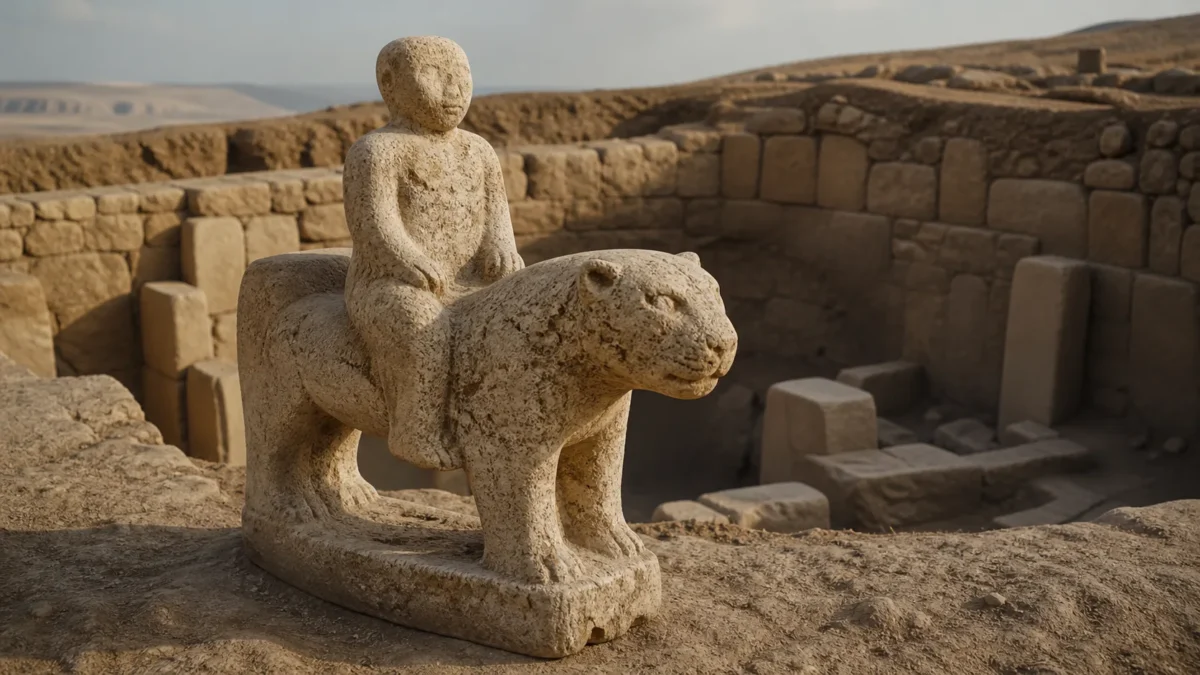
Archaeologists at Karahantepe in southeastern Türkiye have uncovered an approximately 11,000-year-old stone sculpture showing a human figure seated on a leopard. The 70-centimetre composition was found where it had apparently been left on a bench inside a small, stone-floored structure. Its imagery is extraordinary; its meaning remains unknown.
Key facts
- The sculpture was announced by Türkiye’s Ministry of Culture and Tourism on August 25, 2026.
- It stands about 70 centimetres (28 inches) high and combines human and leopard figures.
- It was found on a wall-side bench inside a round structure about 3 metres (10 feet) across.
- Archaeologists have not yet published a detailed interpretation of what the scene meant.
A human and a predator carved into one composition
The newly announced work is unusual not simply because it is old, but because it binds two figures into a single narrative scene. According to the ministry’s description, a human sits on the back of a leopard. The sculpture’s vertical scale—about the height of a small child—would have given it a visible presence in the compact building where it stood.
Excavators found it on a bench that continued along the wall of a roughly circular, 3-metre-wide structure. Flat stones covered the floor. That context matters: the sculpture was not reported as a loose object displaced in later soil, but as an element positioned within an architectural setting.
The ministry described the style as unlike anything previously encountered at the site. A formal excavation report will be needed to document the object’s stone, carving technique, dating evidence, condition and relationship to the building in full.
Karahantepe belongs to a landscape that changed prehistory
Karahantepe lies near Şanlıurfa and forms part of the Taş Tepeler, or “Stone Hills,” group of early Neolithic sites. Communities in this region created substantial communal buildings, carved human figures and powerful animal imagery during a period when farming and settled life were emerging.
The broader setting is important because it challenges the once-simple picture of monument building as something that followed cities, states and metal tools. At sites such as Karahantepe and nearby Göbekli Tepe, hunter-gatherer and early farming communities invested extensive labor in architecture and symbolic art thousands of years before Stonehenge or the Egyptian pyramids.
That does not make every carved animal a god or every building a temple. “Ritual,” “domestic” and “communal” are modern categories that may overlap poorly with how Neolithic people organized their world.
What could the leopard scene mean?
Leopards appear repeatedly in early Anatolian imagery, sometimes alongside human figures. Predators could have communicated danger, power, identity, protection or a story now lost. The seated pose might represent control, alliance, movement or something that has no modern equivalent.
For now, those are possibilities—not conclusions. The official announcement identifies what the carving depicts but does not establish whether the figure represents a particular person, an ancestor, a supernatural being or a myth. The sculpture alone cannot tell us the sex, status or purpose of the human figure with certainty.
Researchers can narrow the possibilities by comparing the carving with other objects at Karahantepe, analyzing where it stood relative to entrances and activity areas, and reconstructing when the building was used, modified and abandoned. Microscopic examination may also reveal tool marks, pigments or residues that are invisible in ordinary photographs.
Why this discovery matters
Most artifacts from 11,000 years ago are fragments: a tool, a bone or a broken piece of stone. A composed scene placed inside a building offers something rarer—a glimpse of how one early community chose to represent the relationship between humans and a formidable animal.
The discovery’s value lies in the questions it makes possible, not in pretending that those questions are already answered. A peer-reviewed excavation report and continued work in the surrounding structure should reveal whether this was a unique artwork or part of a larger visual program.
Sources
- Republic of Türkiye Ministry of Culture and Tourism, official discovery announcement, August 25, 2026.
- Independent English-language report summarizing the announcement and archaeological context.
Editorial disclosure: The lead image is an artistic reconstruction and does not show the excavated artifact itself. SciQuest received no payment to cover this discovery. To report a possible error, contact SciQuest.