

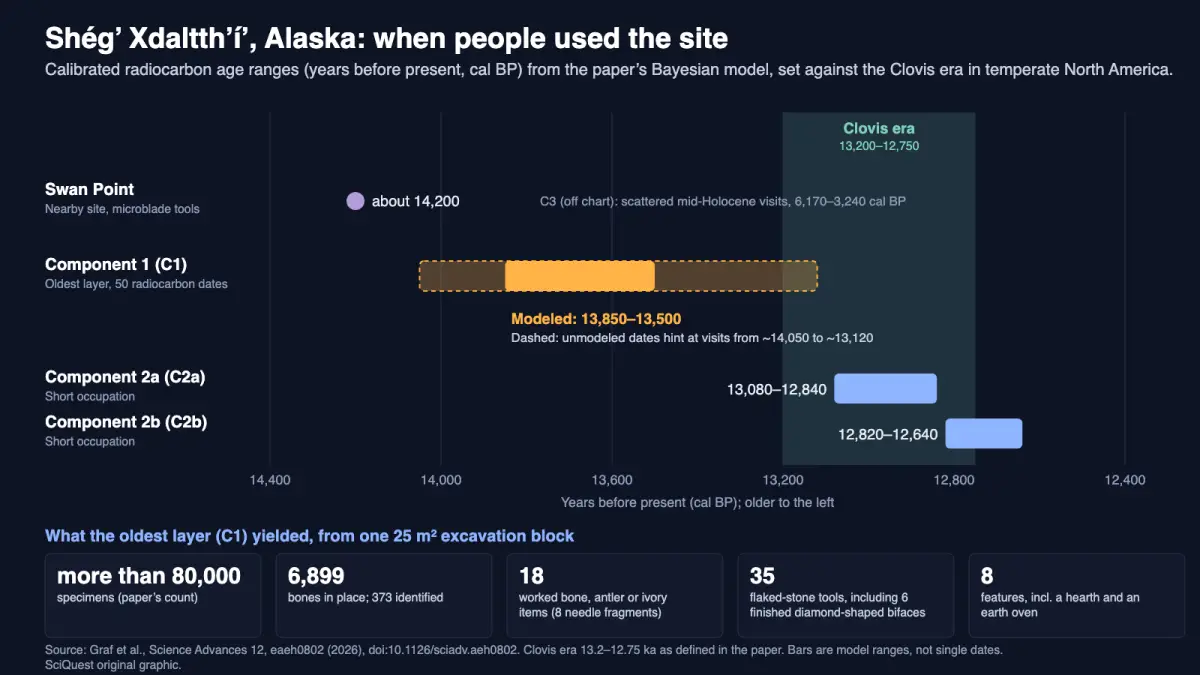
Sixty-six radiocarbon dates place the oldest layer at about 13,850 to 13,500 years ago, and 80,000-plus specimens from a single 25 m² block show where people cooked, sewed and discarded bone, but the “base camp” label and the Siberian link are interpretations from one site.
Peer reviewed · Archaeological excavation · One site
Archaeologists led by Kelly Graf of the University of Kansas report that a ridge above the Tanana River, 55 km south-southeast of Fairbanks, Alaska, was used as a camp about 13,800 years ago. The site, named Shég’ Xdaltth’í’, has an oldest layer with an earth oven, a likely lean-to, bone needles and diamond-shaped stone tools like those from two Siberian sites. The team calls it the earliest known Nenana Complex occupation east of the Bering Land Bridge. It is one excavated block, and “base camp” is the authors’ reading of the evidence.
What you need to know
- Finding: The oldest layer (component 1) at Shég’ Xdaltth’í’ dates to 13,850 to 13,500 calendar years ago and holds more than 80,000 specimens, including a hearth, a probable dwelling, an earth oven and eight needle fragments.
- Method: A 25 m² excavation block opened from 2016, 66 AMS radiocarbon dates run through a Bayesian model, plus analysis of stone, bone and animal remains.
- Source: Graf et al., Science Advances 12(42): eaeh0802, released 14 October 2026 (open access).
- Why it matters: Beringia’s record is sparse, and this site pairs a dense, well-dated household record with a stone-tool form otherwise known from the Russian side of the former land bridge.
- Limitation: Everything comes from one block of a site covering at least 4,800 m², with no human remains or DNA reported, so the dwelling, the base-camp label and the cross-Beringia link are inferences.
Evidence at a glance
| Item | Assessment |
|---|---|
| Evidence status | Peer reviewed; archaeological excavation of a single site (one 25 m² block), with radiocarbon chronology, stone, bone and faunal analysis. |
| Primary source | “Highlights from an early base camp in Beringia 13,800 years ago: Shég’ Xdaltth’í’ and the Late Pleistocene peopling of Alaska”, Science Advances 12(42): eaeh0802, released 14 October 2026 (issue dated 16 October), CC BY-NC. Full text read via PubMed Central. |
| Evidence strength | Moderate to strong for the dating and the finds: 50 radiocarbon dates from the oldest layer, a clear stratigraphy and a stated treatment of outliers. Limited for the interpretations: the “base camp” reading, the structure and the link to Siberian sites rest on features, one new stone-tool form and published descriptions of other sites. |
| Principal limitation | One excavated block at one site. The authors have not yet run use-wear studies on the diamond-shaped bifaces, and no human remains or ancient DNA are reported to tie the occupants to any known population. |
| Coverage at a glance | 5 distinct credible publishers with their own write-ups as of 17 October 2026, 15:20 UTC: Gizmodo, Live Science, Ancient Origins, Archaeology Magazine and La Brújula Verde (Live Science and La Brújula Verde confirmed by headline only; their pages would not load in full). Excluded: Phys.org, EurekAlert and Mirage News, which republished releases, and aggregator copies. |
Sources: the full paper, the University of Kansas release and a SciQuest search of news coverage. The count measures reach, not correctness.
Is this a big deal?
A solid step for Alaskan archaeology, and a cautious one for the bigger migration story. The site is not the oldest in the region, and the authors say so. What is new is the combination: a precisely dated layer with domestic features, rich animal and bone-tool remains, and a distinctive biface that has no match elsewhere in Alaska. Whether it changes how we think about the first Americans depends on ancient DNA, which the paper says is needed and does not report.
What scientists found
The Tanana River basin holds a dense cluster of early sites. The paper counts 19 of the 28 known Beringian occupations from before and during the Clovis era (13.2 to 12.75 thousand years ago, as the paper defines it) in an area of about 32,375 km², slightly larger than the US state of Maryland. None contains fluted points, the hallmark of Clovis technology, and at least ten pre-date Clovis. The oldest is Swan Point, at about 14,200 years.
Shég’ Xdaltth’í’ sits on a bluff about 35 m high over the Tanana floodplain, sheltered from northwesterly winds by a bedrock knob. The paper reports three Late Pleistocene components: C1 at 13.8, C2a at 13 and C2b at 12.7 thousand years ago. A fourth, C3, is a scatter of mid-Holocene visits from roughly 6,170 to 3,240 years ago.
The oldest layer, C1, is 10 cm thick. Within it, the authors describe a charcoal-stained oval 3 m or more across that likely marks a lean-to or similar ephemeral dwelling, with a 70 cm hearth inside it, an 80 cm pit and a possible post hole. Outside lay a second hearth, a bone-discard pile and, farther away, a charcoal feature over 1.2 by 1.7 m with 230 fire-cracked rocks and a possible earthen cap, interpreted as an earth oven for slow-cooking meat.
Of 6,899 bones found in place, 373 could be identified at least to order. Bison dominates, with 164 identified specimens (44% of the identified bones). Caribou (16), mammoth (12), horse (2), hare, wolf, foxes, a lynx and many birds, from grouse to swans, are also there. Eighteen worked bone, antler or ivory pieces include eight needle fragments, an awl tip and a pendant with a drilled hole.
Among the 35 flaked-stone tools, six finished or nearly finished bifaces share a bipointed, diamond-shaped outline and ground stems that suggest they were hafted. The authors call them hafted bifaces and decline to label them projectile points or knives until microscopic wear studies are done. All 25 obsidian pieces come from the Batza Téna source about 370 km to the northwest.
How they found it
A cultural-resource survey found the site in 2010, and Graf’s team tested it from 2013 and opened a 25 m² block in 2016. The site covers at least 4,800 m², so the block is about half a percent of it, or less. About 51,000 items in the block were mapped in three dimensions.
The chronology rests on 66 accelerator mass spectrometry radiocarbon dates, 50 of them from C1, mostly on willow charcoal and on bone from bison, mammoth, horse, wolf, hare and birds. Radiocarbon measures leftover carbon-14, and “calendar years ago” (cal BP, counted back from 1950) means the raw ages were corrected against known calibration records. The team fed all dates into a Bayesian model that respects the layers’ order and dropped four C1 dates that disagreed with the rest. The result is a modeled range of 13,850 to 13,500 cal BP, which the abstract rounds to 13.8 thousand years.
Sourcing the stone is like reading shipping labels on boxes: it shows where goods travelled, not who carried them or why. Obsidian from 370 km away shows access to a wide area, and the analogy fails where it matters, because a label cannot tell trade from movement.
Outlets quote different dates, so here is how they fit. The abstract says 13.8 thousand years. The model gives C1 a range of 13,850 to 13,500 cal BP and a duration of 284 ± 34 years, while the discussion speaks of “up to two centuries” of repeated use. The authors also note that the model may have narrowed things too far, since some dates suggest visits from about 14,050 to about 13,120. Reports of a possible 14,000-year age echo that hedge, not a separate measurement.
Why it matters to you
Nothing here changes your week. The appeal is wonder, and a reminder that our knowledge of the first people in the Americas rests on a few places where bone and charcoal happened to survive. The site’s name, explained below, comes from the elders of a community whose land it is on.
What the evidence does not show
The base-camp label is the authors’ judgment, not a measurement. They infer it from repeated use over up to two centuries, a larger group than a hunting party and the effort that went into the oven. They also note that storage pits and heavy semi-subterranean houses, signs of permanent settlement elsewhere, are absent. “Semisettled” is their own word.
The structure is likewise a probable one. The paper says the oval “likely represents an ephemeral structure or dwelling” and describes it elsewhere as the earliest potential habitation structure in North America. A headline calling it the oldest dwelling in the Western Hemisphere is stronger than that wording. Likewise, the University of Kansas release suggests the diamond-shaped points may have been weapon tips, while the paper itself withholds a function. The stone slab called an anvil is described in the paper as “possibly” one.
The Siberian link is a similarity in form, not a proven connection between groups. The diamond-shaped bifaces resemble ones from Nikita Lake and Berelekh in western Beringia, which the authors take from earlier publications, and both lack microblades. Lead author Graf told the University of Kansas that the points suggest “people traveled across the Bering Land Bridge to and possibly from this location,” so the direction of travel is open. The paper also floats that the inhabitants “may have been dog owners”, based on wolf remains, then notes that early dogs and wolves are hard to tell apart.
On ancestry the paper is equally careful. Genetic studies describe several Late Glacial populations in Beringia, and the authors ask whether these people were Ancient Beringians or another group. Resolving that, they write, needs ancient genomes.
How this fits what we already knew
Swan Point, about 14,200 years old, has microblades, a tradition tied to northeast Asia. Shég’ Xdaltth’í’ lacks them and matches the Nenana Complex, a toolkit of small hafted bifaces, scrapers and planes that many archaeologists had folded into a broader Beringian Tradition. The authors argue that the two toolkits reflect cultural differences, not only seasonal or activity differences. They hypothesize that the microblade line traces to migration from the subarctic Lena River basin and the Nenana line to migration from the Arctic of northeast Asia.
The Clovis question is where headlines diverge most. The paper does not say these people founded Clovis. It lists seven traits found both here and in later temperate-North-American Paleoindian sites, among them hafted bifaces, eyed needles, red ochre and hunting of mammoth, bison and horse, and writes of “the strong cultural connection between early Beringians and Americans”. By its dates, C1 begins roughly 300 to 650 years before the start of the Clovis era; counting from the unmodeled 14,050 gives closer to 850. Outlets that quote “800 years older” are using one end of that range. The paper also notes that only two other sites, Yana RHS and Bluefish Caves, hint at humans in Beringia well before 14,000 years ago.
Mammoth is a small part of the animal record. Only 12 of the 373 identified bones are mammoth (for the animal itself, see our piece on efforts to bring back woolly mammoths), against 164 for bison, so the identified bones read far more like a bison camp.
Naming, land and community
The name is pronounced “shehg xuh-tuhl-TTH’EE” and means “They were there” in Alaska Native Athabascan, according to the paper. The paper’s acknowledgments say the elders of Healy Lake Village named it. The site was previously recorded as McDonald Creek, site number FAI-02043. It lies on the traditional lands of the Mendas Cha’ag and Nenana communities of Tanana Athabaskan peoples.
The authors thank the elders of Nenana Native Association for continued support and acknowledge “an unpaid debt of land and knowledge” to these communities. Two co-authors are listed with Indigenous organisations: Evelynn Combs with the Healy Lake Tribal Council and Donald Charlie with the Nenana Native Association. The paper’s diversity and ethics statement says two authors hold leadership roles in descendant Indigenous communities and that members of these communities took part in discussions on planning and carrying out project goals. The University of Kansas release names the language only as Alaska Native Athabascan and does not say who chose the name. SciQuest has not contacted the communities and does not speak for them.
Independent perspective
SciQuest found no published comment on the paper from an archaeologist outside the research team by 17 October 2026, and has not yet interviewed one. The journal published a Focus article by Spencer Pelton of the University of Wyoming alongside the paper, titled “Shég’ Xdaltth’í’ and the enduring value of old ideas”, but it would not open for us, so we have not read or characterised it.
How other headlines framed it
- Gizmodo led with the possibility of an even older human presence in the Americas, which the paper treats as an open question; it also gave the dig area as under 11 square feet, whereas the paper’s block is 25 m² (about 270 square feet).
- Live Science chose the oldest-dwelling angle, a stronger claim than the paper’s “earliest potential case” wording.
- La Brújula Verde put the comparison with Clovis in the headline, at about 800 years.
- Ancient Origins emphasised daily life and a more human picture of the first Americans, and stated that the points do not prove a single migration route.
- Archaeology Magazine stressed the Siberian connection but hedged the direction of travel, quoting Graf’s “possibly from this location”.
Two of these framings, Clovis and a Siberian link, lean on comparisons that the paper makes as cultural connections, not as lineages.
What happens next
The authors say studies are under way on bone identification, plant remains in the hearths, use-wear on the hafted bifaces and the wolf remains. Ancient genomes from the Nenana Complex would address the ancestry question. Whether people were in Beringia long before 14,000 years ago stays open.
In one sentence
A well-dated 13,800-year-old layer at Shég’ Xdaltth’í’ in interior Alaska gives an unusually detailed picture of a repeatedly used camp, with a stone-tool form that echoes Siberian sites, though the camp, the dwelling and the cross-Beringia link all come from one excavated block.
Why it matters to you: it is a reminder that the early history of the Americas is written from a handful of well-preserved places, and that the name on this one comes from the people whose land it is on.
Quick check: did it click?
- How old is the oldest layer, and why do sources quote different numbers? The model gives 13,850 to 13,500 cal BP, rounded to 13.8 thousand years in the abstract; some unmodeled dates hint at visits from about 14,050.
- What does the paper not claim? That this is the oldest site in Beringia, that its people founded Clovis, or that the Siberian link is proven ancestry; it leaves that to ancient DNA.
- What does “Shég’ Xdaltth’í'” mean, and who named it? “They were there” in Alaska Native Athabascan; the paper’s acknowledgments credit the elders of Healy Lake Village.
Read next
- Neanderthal wooden spears and a possible club survive as moulds in Spain, another case of reading ancient daily life from a few traces.
- 6,500-Year-Old Czech Enclosure May Have Tracked the Sun and Moon, a site where dating and purpose are still being worked out.
- Are scientists trying to bring back woolly mammoths? On the Ice Age animals that people here hunted.
Sources and disclosure
- Graf KE, Goebel T, Henry A, Hockett B, Shelley N, Antonosyan M, Meachen J, Sewing M, Harbort M, Esdale JA, Allaun SA, Gore AK, Rasic JT, Roberts P, Combs E, Charlie D. “Highlights from an early base camp in Beringia 13,800 years ago: Shég’ Xdaltth’í’ and the Late Pleistocene peopling of Alaska.” Science Advances 12(42): eaeh0802, 2026. doi:10.1126/sciadv.aeh0802. Full text: PubMed Central.
- University of Kansas News Service (Jon Niccum). “Bering Land Bridge base camp reveals what life was like nearly 14,000 years ago.” 14 October 2026.
- AAAS/EurekAlert. “Late Pleistocene site in Alaska yields evidence of a trans-Beringian cultural connection.” 14 October 2026.
- Pelton S. “Shég’ Xdaltth’í’ and the enduring value of old ideas.” Science Advances, eaem6534 (accompanying Focus article; not read).
- Press coverage consulted for the headline comparison: the Gizmodo, Live Science, La Brújula Verde, Ancient Origins and Archaeology Magazine pages linked above.
Disclosure: This article was drafted with AI assistance and checked against the sources above, including the full open-access paper and the University of Kansas release. The authors declare no competing interests; the work was funded mainly by National Science Foundation awards, with additional support from the Elfrieda Frank Foundation and university funds. The graphic is a SciQuest original built from the dates and counts in source 1; the Clovis band uses the paper’s definition. Quotes are verbatim from the paper and the University of Kansas release. Percentages and area conversions are SciQuest calculations (164 of 373 is 44%; 25 m² is about 270 square feet; 80,000 specimens in 25 m² is about 3,200 per square metre). Spotted an error? See our corrections policy.
Discover more from SciQuest
Subscribe to get the latest posts sent to your email.
Leave a comment