

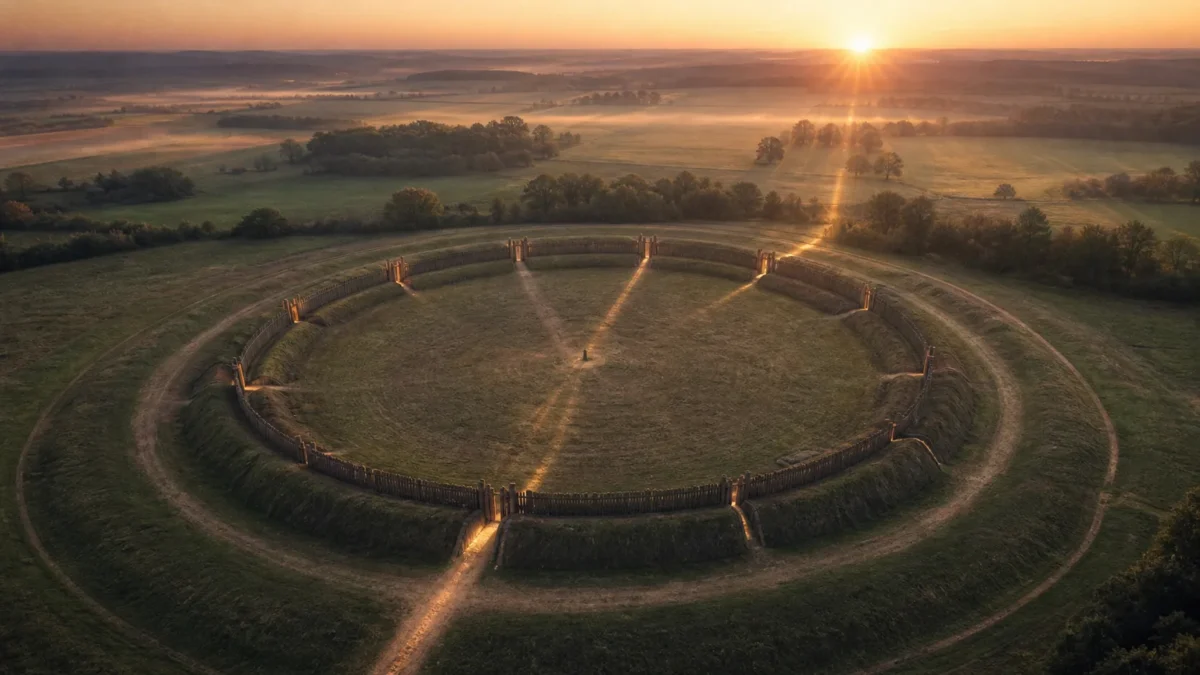
A vast enclosure built near Chleby in today’s Czech Republic between about 4200 and 4000 BCE had 12 entrances, several oriented toward significant positions of the Sun and Moon, archaeologists report. The roughly 6,500-year-old earth-and-timber complex predates Stonehenge’s earliest major earthworks by about a millennium. The alignments are evidence of deliberate planning, but they do not prove that the site functioned solely as an observatory.
Key facts
- The enclosure dates to approximately 4200–4000 BCE.
- It was defined by a large ditch, an inner wooden palisade and 12 entrances.
- Researchers report entrance axes associated with solar and lunar events.
- The monument survives mainly as traces below a modern field, not as standing stones.
A monument hidden beneath an ordinary field
There are no towering stones at Chleby. From ground level, the field in Central Bohemia gives little indication that one of the region’s earliest monumental constructions lies underneath it.
Archaeological excavation and geophysical survey revealed the negative imprint of a large, nearly circular enclosure. Its boundary included a ditch about 4 metres wide and up to 2 metres deep, with a wooden palisade on the inner side. Twelve openings interrupted that boundary, creating routes toward the center.
Building the complex with stone and wooden tools would have required coordinated labor: felling trees, shaping posts, excavating a long ditch and maintaining the site. That investment makes the enclosure evidence of organized communal action even before its precise purpose is known.
The entrances appear to mark events in the sky
The 12 entrances are not evenly spaced like marks on a clock. Archaeologists led by Petr Krištuf of the University of West Bohemia report that selected axes connect central observation points with significant rising and setting positions of the Sun and Moon, including the summer-solstice sunrise and winter-solstice sunset.
For farming communities, those cycles could help organize seasonal gatherings and agricultural work. They could also carry ceremonial meaning. The two roles need not have been separate: watching the sky, planning the year and gathering as a community may have belonged to the same social system.
“Possible astronomical alignment” is the careful description. To demonstrate that the arrangement was intentional, researchers must account for the local horizon, the monument’s reconstructed geometry, uncertainty in entrance positions and the range of alignments that could occur by chance.
Older than Stonehenge—but not a Czech Stonehenge
The comparison with Stonehenge is useful for time, not appearance. Construction at Chleby began around 4200–4000 BCE. The earliest major earthwork at Stonehenge is generally dated to around 3000 BCE, while its famous large stones were erected later.
Chleby was an earth-and-timber enclosure. Stonehenge developed through multiple phases into a very different monument. Calling Chleby “older than Stonehenge” therefore means its construction began earlier; it does not imply that one community copied the other or that the two sites served identical functions.
The place remained meaningful for thousands of years
The enclosure’s history did not end when its ditch began to fill. In the Early Bronze Age, people placed a multiple burial containing at least 18 individuals at the location. By the Iron Age, ordinary settlement activity occupied the area.
That changing use is a reminder that archaeological sites are not frozen moments. Later communities encountered, remembered or repurposed places made by people who had lived millennia before them.
What archaeologists still need to establish
Continued excavation can clarify the monument’s construction sequence, how long it remained in use and what happened at its entrances and central spaces. Radiocarbon dates from secure contexts will refine its chronology. Analysis of animal bone, pottery, stone tools, botanical remains and soil chemistry may reveal whether people feasted, exchanged goods, buried the dead or performed other repeated activities there.
The strongest conclusion today is also the most interesting: 6,500 years ago, a Central European community organized enough labor and astronomical knowledge to reshape a large area of its landscape around a carefully planned enclosure.
Sources
- Archaeological Institutes of the Czech Academy of Sciences, Chleby excavation description and chronology.
- Archaeology Magazine report, August 24, 2026.
Editorial disclosure: The lead image is a hypothesis-based reconstruction; the actual monument survives below ground. SciQuest received no payment to cover this research. To report a possible error, contact SciQuest.
Discover more from SciQuest
Subscribe to get the latest posts sent to your email.
Leave a comment