
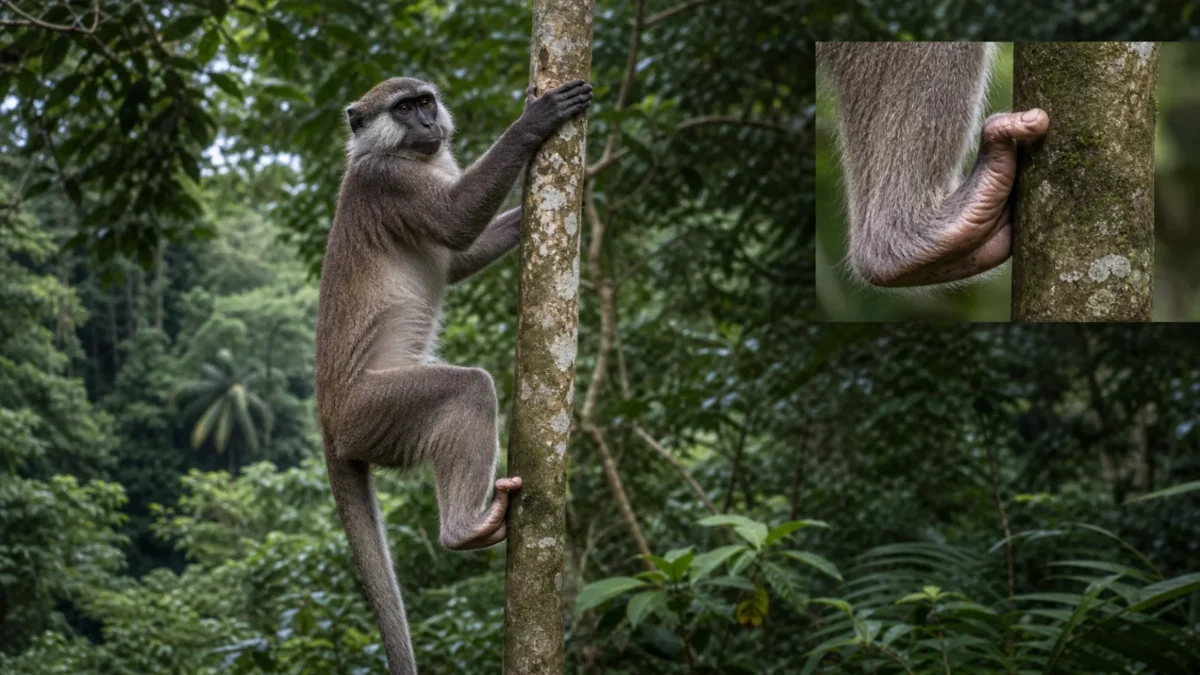
Wild sooty mangabeys flexed the middle of their feet by as much as 46 degrees while climbing vertical trunks, showing that a primate does not need a chimpanzee-like ankle to climb with ape-like effectiveness.
Published: August 31, 2026, 10:20 p.m. PKT · Reporting cutoff: August 31, 2026, 9:45 p.m. PKT
What you need to know
- Researchers recorded wild sooty mangabeys climbing narrow trees in Côte d’Ivoire.
- The monkeys flexed their midfeet by as much as 46 degrees during vertical climbs.
- Chimpanzees achieve roughly comparable movement mainly through the ankle.
- The result challenges attempts to infer climbing ability from fossil foot bones alone.
- Living monkeys cannot reveal exactly what the human–chimpanzee last common ancestor looked like.
A fossil foot can show where bones connected. It cannot show every way soft tissues allowed that foot to bend in life. Video from a West African forest has now demonstrated how large that interpretive gap can be.
Sooty mangabeys—Old World monkeys without the highly mobile ankles of chimpanzees—were filmed scaling narrow vertical trunks. Measurements showed that they obtained the required bend somewhere else: through the middle of the foot. That functional workaround means a monkey-like fossil foot cannot automatically be classified as a poor vertical climber.
Two different joints can solve the same climbing problem
Luke Fannin and W. Scott McGraw of Ohio State University analyzed high-resolution recordings from the Taï Forest Monkey Project in Côte d’Ivoire. The animals climbed to forage, hide or find sleeping positions.
During a climb, a chimpanzee ankle can flex upward by about 45 degrees. Most human ankles manage roughly 20 degrees. The mangabeys reached as much as 46 degrees of movement through their midfeet instead, placing a broad section of the sole against the trunk.
Biomechanically, the animals reached a similar outcome through a different structure. Evolution often produces this kind of functional convergence: bodies that are built differently arrive at comparable solutions to the same physical challenge.
Why this complicates the fossil record
Humans and chimpanzees diverged from a shared ancestor around 6–7 million years ago. Researchers debate whether that ancestor moved primarily along branches, climbed vertical trunks from the ground, or combined both strategies.
Foot fossils contribute to that debate because ape-like ankle anatomy has been treated as evidence for vertical climbing. The mangabey observations show why the reverse inference is unsafe. A foot that lacks the expected ape feature may still flex elsewhere and perform the same behavior.
This does not establish that the common ancestor had a monkey-like foot. It widens the set of anatomies compatible with capable climbing and increases the importance of finding more complete fossils.
How other headlines framed it
- PNAS emphasized kinematic convergence and the implications for early hominin arboreal behavior.
- Ohio State News focused on the last common ancestor remaining a plausible vertical climber regardless of foot type.
- ScienceDaily used the sharper fossil-interpretation angle: feet may be misleading scientists about human evolution.
What scientists need next
Researchers need more field measurements across primates, including synchronized views of feet, ankles and whole-body force. Fossils preserving several linked bones would also narrow how much motion ancient joints permitted.
Bottom line: the study does not redraw the human family tree. It removes a shortcut. Climbing ability cannot be read from one expected ankle feature when a flexible midfoot can accomplish nearly the same movement.
Sources
- Fannin, Pape and McGraw, PNAS, 2026.
- Ohio State University research explanation.
- Primate Info Net species background: sooty mangabey.
Editorial disclosure: The lead image is an original natural-history concept illustration, not field documentation from the study. SciQuest received no payment for this coverage. To report a possible error, contact SciQuest.