

A laser locked to thorium-229 nuclei in a 3-millimetre crystal ran for a day without anyone touching it, and its frequency wandered by only about 2 parts in 100 trillion within a run, though it still trails the best atomic clocks by several orders of magnitude.
Peer reviewed · Laboratory experiment · Prototype
Physicists at TU Wien in Vienna and Germany’s national metrology institute, PTB, have built a clock whose laser is steered by the nuclei of thorium-229 atoms rather than by electrons. Reported in Nature on 7 October 2026, the prototype held its laser on the nuclear “tick” for a full day without intervention. That matters because nuclei are tiny and well shielded, so nuclear clocks could one day beat today’s best. The catch is that this one doesn’t yet: its steadiness and its day-to-day reproducibility are well short of leading atomic clocks.
What you need to know
- Finding: A continuous ultraviolet laser was locked to the 148-nanometre thorium-229 nuclear transition by a feedback loop and ran for one day without intervention.
- Method: The team measured how much laser light the nuclei absorbed, corrected the laser every 20 seconds or every 30 minutes, and compared it with an ytterbium-ion atomic clock over a fibre link.
- Source: Toscani De Col, Riebner, Morawetz and colleagues, Nature, 7 October 2026 (open access).
- Why it matters: A clock referenced to a nucleus is a candidate successor to atomic clocks and an unusually sensitive probe for some proposed kinds of dark matter.
- Limitation: Measured wander within a run reached the low 10−14 range, and runs on different days agreed only to about 5 × 10⁻¹³.
Evidence at a glance
| Item | Assessment |
|---|---|
| Evidence status | Peer reviewed; laboratory experiment with one prototype clock and one crystal |
| Primary source | “A thorium-229 optical nuclear clock with feedback loop”, Nature, published online 7 October 2026, DOI 10.1038/s41586-026-11084-4. Full text, peer-review file and data are openly available. |
| Evidence strength | Strong for the core demonstration (a working nuclear feedback loop, independently confirmed in principle by a separate Beijing team the same day); limited for the dark-matter limits, which depend on a sensitivity factor that cannot yet be calculated precisely |
| Principal limitation | Performance is far from the best atomic clocks, and the clock’s frequency shifted by up to 1.7 kHz depending on where the laser passed through the crystal |
| Coverage at a glance | 6 distinct publishers found as of 13 October 2026, 13:50 UTC: Reuters, Popular Science, Interesting Engineering, Tech Times, ingenieur.de and Vienna.at. Counted: outlets with their own article on the published paper that SciQuest opened. Excluded: press-release reposts (ScienceDaily, idw), the journal’s own material, aggregators and preprint-stage coverage. Science Media Centre Spain’s expert reactions are cited separately below. |
Sources: the Nature paper and its peer-review file; TU Wien news release; SciQuest search of news coverage.
Is this a big deal?
It is a genuine milestone in a young field, not a world record. Holding a laser on the nucleus itself turns spectroscopy into a clock, and a Tsinghua University team reported a second one in the same issue of Nature. In reproducibility, though, the Vienna prototype trails the caesium clocks that define the second by about a thousandfold, and the best optical clocks by far more.
What scientists found
The clock ticks at a nuclear transition of about 2.02 × 10¹⁵ Hz, vacuum-ultraviolet light with a wavelength of 148 nm. Its stability is given as an Allan deviation: how much the frequency wanders, as a fraction, over a chosen averaging time.
The paper reports 3 × 10⁻¹² divided by the square root of the averaging time in seconds, so the clock gets steadier the longer you average. The last plotted point, after roughly 4.5 hours, sits near 2 × 10⁻¹⁴. The paper’s text calls this “the low 10−14 range”, while its abstract describes the instability as approaching 10−15 over a day.
One limitation stood out: runs on different days agreed only to about 5 × 10⁻¹³. Moving the beam to four spots in the crystal shifted the line centre by up to 1.7 kHz, against 0.13 kHz expected from noise. The authors suspect strain in the crystal.
How they found it
The work builds on a 2003 proposal by Ekkehard Peik of PTB and Christian Tamm, and on the groups’ first laser excitation of the nucleus in April 2024. An ordinary optical atomic clock locks its laser to a narrow transition of an atom’s electrons, as our explainer on how an atomic clock works describes. Here the nucleus takes the electrons’ place, and the missing piece was a fast signal to steer the laser.
The team found it in absorption. Their calcium fluoride crystal, doped with thorium-229, is 3.1 mm across and 4.2 mm long and sits at room temperature (about 294.7 K, or 21.5 °C) in a vacuum chamber. A detector behind it counted how much 148 nm light got through. Only 0.75% was absorbed and just 65 picowatts reached the detector, yet that gave a usable signal within a second.
Think of tuning an old radio by ear, nudging the dial until the station is strongest. Here a computer nudged the laser toward the frequency the nuclei absorbed most. The analogy has a limit: the clock cannot hear the peak directly, so it compares light on either side of it and corrects only after counting enough photons.
Absorption was the key choice: excited nuclei take about 10 minutes to glow back down, but absorption allowed corrections every 20 seconds. The team then compared the clock with an ytterbium-ion clock at Austria’s metrology office (BEV) over a fibre link for about 23 hours.
“The basic idea is simple: you have a laser and you have thorium. The laser changes the energy state of the thorium nuclei, and the thorium nuclei are used to stabilize the frequency of the laser,” Thorsten Schumm of TU Wien said in the university’s release.
Show the maths behind the “1 second in…” numbers
A clock whose rate is off by a fraction y gains or loses 1 second after 1/y seconds. One year is about 3.156 × 10⁷ s.
- 10−15 (the headline figure): 1 ÷ 10−15 = 1015 s ≈ 32 million years, which matches the release’s “one second in 30 million years”.
- 2 × 10⁻¹⁴ (measured within one run): 5 × 10¹³ s ≈ 1.6 million years.
- Extending the paper’s 3 × 10⁻¹²/√τ trend to a full day (τ = 86,400 s) gives about 1 × 10⁻¹⁴, or about 3 million years.
- 5 × 10⁻¹³ (agreement between days): 2 × 10¹² s ≈ 63,000 years.
These are illustrations. Instability describes random wander, not a steady error, so no clock in this study was tested for millions of years.
Why it matters to you
Nothing changes for you this year. Your phone’s clock and GPS rely on atomic clocks, and this prototype is not ready to replace any of them. Schumm told Reuters he sees future uses in satellite navigation, data-network synchronisation and surveying. Precise clocks also sense gravity, as our guide to whether gravity slows down time explains.
One more thing to clear up: “nuclear” here means the atomic nucleus. There is no splitting of atoms and no reactor; the crystal holds microgram amounts of radioactive thorium-229. Nor is it related to the Doomsday Clock, a symbol of global risk rather than a timekeeper.
The dark-matter test, explained
Some theories propose that dark matter is a wave of extremely light particles filling space. If it nudged the strength of electromagnetism or the strong nuclear force, the “constants” of physics would wobble in rhythm with it.
Thorium-229 is unusually exposed to such a wobble. Its 8.4 eV transition is the small leftover of two nearly cancelling contributions, electric and strong-force, each worth millions of electronvolts. Shift either slightly and the leftover shifts by a much larger fraction, an amplifier atomic clocks lack.
The team searched the thorium-to-ytterbium frequency ratio for wiggles lasting 20 seconds to about 23 hours, and for slow drift. They found neither (drift: (2 ± 4) × 10−14 per day), which sets upper limits on how strongly such particles could couple to ordinary matter.
According to the paper, the limits on coupling to light match those from the best atomic clocks, and the limits on coupling to the strong force and to quark masses reach 10 to 1,000 times deeper than earlier atomic-clock experiments. Underneath sits an assumption: the size of thorium’s amplifier, the sensitivity factor, cannot yet be calculated precisely, so the paper shows results for values of 1,000, 10,000 and 100,000. For the wider search, see where dark matter is found.
What the evidence does not show
It does not show a clock better than atomic clocks. “This is not yet at the level of the world’s best optical atomic clocks, but for a first prototype it is a fantastic result,” Schumm said in TU Wien’s release.
Nor does it show a measured error of one second in 30 million years. That conversion corresponds to 10−15, the abstract’s description of the trend after a day; the plotted data stop near 2 × 10⁻¹⁴. Several outlets repeated the 30-million-year figure without that context.
The paper does not report a full accuracy evaluation, meaning how close the clock sits to the true transition frequency once every known shift is accounted for; the day-to-day spread shows that work is still ahead. And according to the authors’ reply to reviewers, laser power fell from 70 to 30 picowatts during the 23-hour run.
How this fits what we already knew
The thorium-229 transition was pinned down in stages: its existence was confirmed in 2016, its light detected directly in 2022 and laser excitation achieved in 2024. Later in 2024, a JILA team in Boulder, Colorado, using crystal from the same Vienna-grown batch, measured its frequency against a strontium clock. In those experiments an external reference held the laser steady; now the nucleus does the steering.
The rival Beijing clock, from a team including Shiqian Ding of Tsinghua University, used a 10-microwatt laser and reports an instability of 5 × 10⁻¹³/√τ, about six times lower than Vienna’s, with two separately grown crystals agreeing to about 3 × 10⁻¹³. Vienna’s distinctive additions are the day-long comparison against a separate atomic clock and the dark-matter search.
Outside views on the result
Three researchers not involved in the work commented through Science Media Centre Spain on 7 October 2026. José R. Crespo López-Urrutia of the Max Planck Institute for Nuclear Physics judged both papers to be of very high standard; he disclosed past collaboration with some of the groups. Dolores del Campo of Spain’s metrology centre (CEM) said there is still a long way to go, and doubted nuclear clocks would shape a redefinition of the second in 2030. Daniel Rodríguez Rubiales of the University of Granada singled out using the nuclear signal to correct the laser itself.
Nature‘s anonymous peer reviewers were broadly positive. One challenged the dark-matter claims for resting on an assumed sensitivity factor; the authors added the more conservative factor of 1,000 and kept their conclusion. SciQuest has not interviewed an independent physicist for this article.
How other headlines framed it
- Reuters (via KSL) framed it as a two-team result and said plainly the clocks do not yet beat atomic clocks.
- Popular Science declared a nuclear age of timekeeping while noting the prototype trails caesium clocks.
- Interesting Engineering led with the self-stabilising 24-hour run and presented 10−15 as the precision achieved over a day.
What happens next
The authors project that about a microwatt of laser power and a light path ten times longer could bring the instability to about 10−15/√τ. Narrower lines, from crystals such as thorium fluoride, plus a narrower laser could reach about 10−16/√τ, which the paper says would match today’s best optical clocks. None of this has been demonstrated. Schumm told Reuters that combining Vienna’s crystals with Beijing’s stronger laser could already give a significantly better clock.
In one sentence
A thorium crystal in Vienna has steered a laser by itself for a day, proving a nuclear clock can run, but it is still a prototype that wanders far more than the best atomic clocks.
Why it matters to you: not yet; it is an early step toward clocks that might one day be simpler and steadier than the ones behind GPS.
Quick check: did it click?
- What steers the laser in this clock? The thorium-229 nuclei: the laser is nudged toward the frequency they absorb most strongly.
- Is the new clock more precise than today’s best atomic clocks? No. Its measured wander and its day-to-day agreement are both far worse than the best optical clocks.
- Did the experiment detect dark matter? No. It found no signal and set upper limits, which depend on an assumed sensitivity factor.
Read next
- How does an atomic clock work? The electron-based clocks this prototype hopes to beat.
- Does gravity slow down time? How precise clocks reveal relativity.
- LUX-ZEPLIN recorded one unexplained flash, a very different search for dark matter.
Sources and disclosure
- Toscani De Col L, Riebner T, Morawetz I, … Peik E, Schumm T. “A thorium-229 optical nuclear clock with feedback loop.” Nature, published online 7 October 2026. doi:10.1038/s41586-026-11084-4. Includes the peer-review file; data at Zenodo.
- TU Wien. “The First Stand-Alone Nuclear Clock is Ticking in Vienna”, news release, 8 October 2026.
- Huang B, Yan G, Xiao Q, et al. “A nuclear clock synchronized to 229Th.” Nature, published online 7 October 2026. doi:10.1038/s41586-026-11122-1
- Springer Nature. Press release on the two nuclear clock papers, 8 October 2026.
- Science Media Centre Spain. “The first thorium-229-based nuclear clocks are unveiled” (expert reactions), 7 October 2026.
- Peik E, Tamm C. “Nuclear laser spectroscopy of the 3.5 eV transition in Th-229.” Europhysics Letters 61, 181 (2003). doi:10.1209/epl/i2003-00210-x
- Tiedau J, et al. “Laser excitation of the Th-229 nucleus.” Physical Review Letters 132, 182501 (2024). doi:10.1103/PhysRevLett.132.182501
- Zhang C, et al. “Frequency ratio of the 229mTh nuclear isomeric transition and the 87Sr atomic clock.” Nature 633, 63–70 (2024). doi:10.1038/s41586-024-07839-6
- NIST. “A Walk Through Time: Revolution in Timekeeping” (Riefler pendulum clock).
- Lombardi MA. “The Accuracy and Stability of Quartz Watches.” Horological Journal, February 2008.
- Heavner TP, et al. “First Accuracy Evaluation of NIST-F2.” Metrologia 51 (2014).
- Aeppli A, et al. “Clock with 8 × 10⁻¹⁹ systematic uncertainty.” Physical Review Letters 133, 023401 (2024). doi:10.1103/PhysRevLett.133.023401
- Dunham W. “Scientists in Vienna and Beijing create world’s first nuclear clocks.” Reuters, 7 October 2026, as republished by KSL.
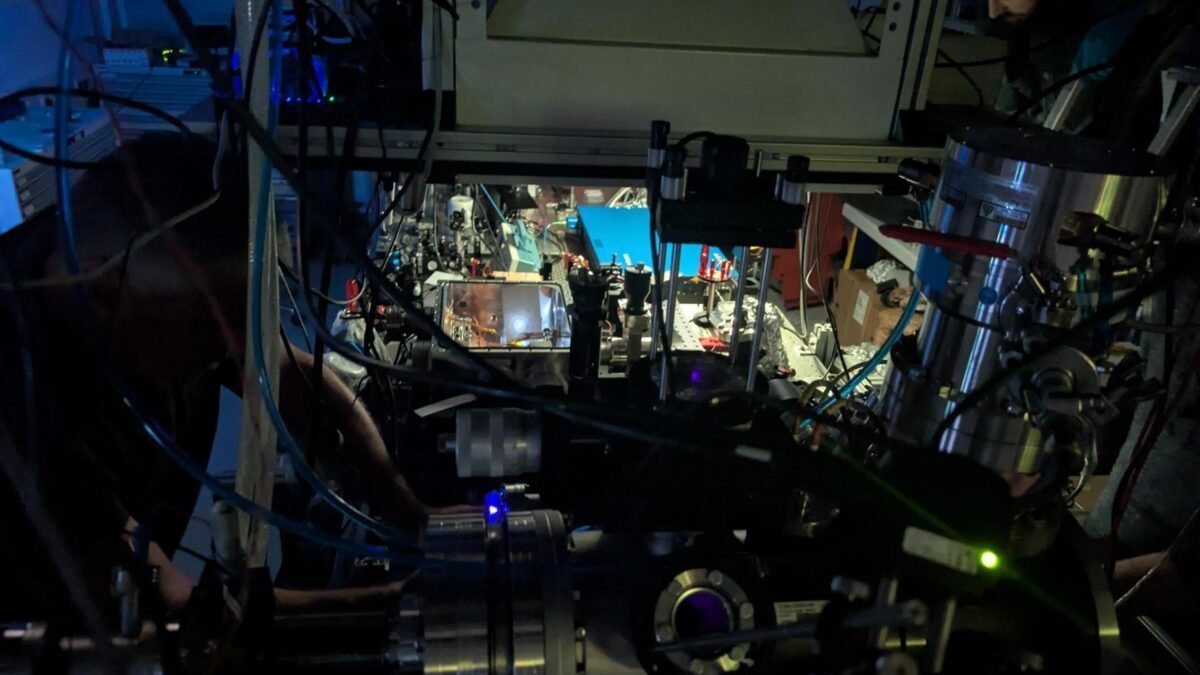
Featured photo: the vacuum chamber holding the thorium crystal at TU Wien, © Matthias Heisler, TU Wien (press photo supplied with the TU Wien release).
Disclosure: This article was drafted with AI assistance and checked against the sources above, including the full open-access paper and its peer-review file. The “within one run” value of about 2 × 10⁻¹⁴ is SciQuest’s reading of the paper’s Fig. 2; the NIST-F2 total uncertainty combines the reported statistical and systematic parts; all “1 second in…” conversions are SciQuest calculations. The clock-ladder graphic is a SciQuest original. Quotes are taken verbatim from TU Wien’s release; outside experts are paraphrased from Science Media Centre Spain. SciQuest has no conflicts of interest. Spotted an error? See our corrections policy.
Discover more from SciQuest
Subscribe to get the latest posts sent to your email.
Leave a comment