

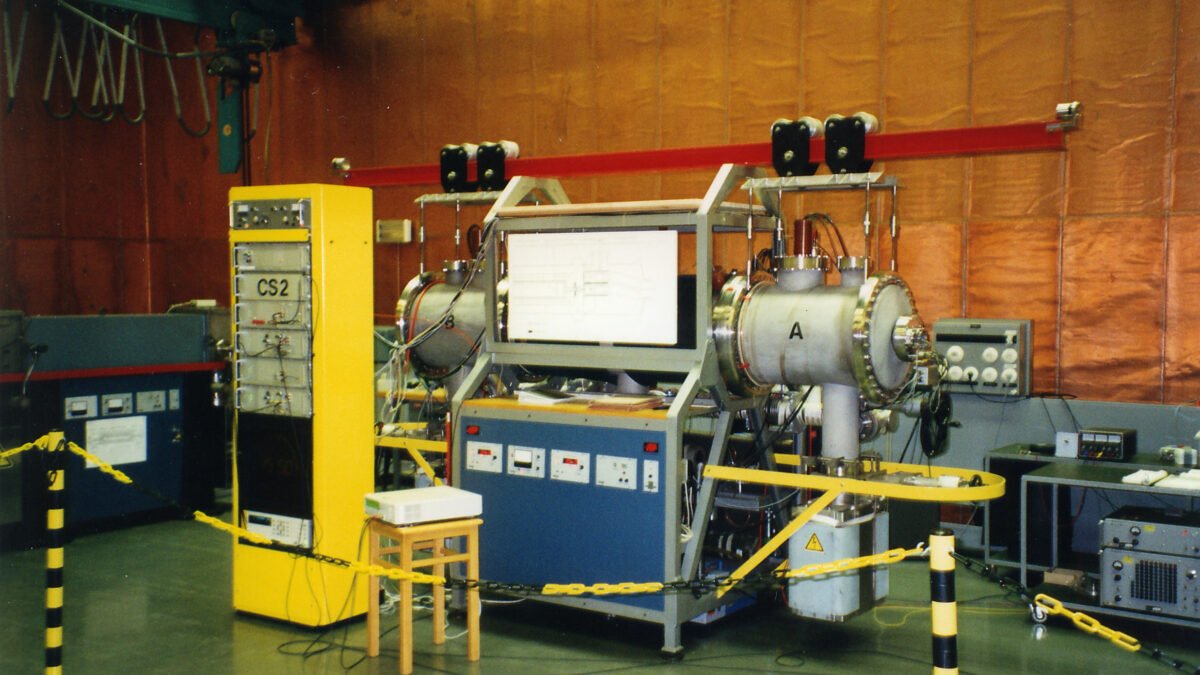
The official second is 9,192,631,770 cycles of a microwave signal matched to caesium-133 atoms, and the caesium clocks that count them now agree with that definition to about 2 parts in 1016.
An atomic clock works by tuning an electronic oscillator until it matches a natural frequency inside atoms, then counting its cycles. In a caesium clock, that frequency is exactly 9,192,631,770 hertz (cycles per second), the value the International System of Units uses to define the second. When the oscillator has completed 9,192,631,770 cycles, one second has passed.
The atoms don’t tick by themselves. They act as a reference: a detector checks how many atoms respond to the microwaves, and a feedback loop keeps correcting the oscillator so it stays locked to them. NIST’s newest caesium fountain clock, NIST-F4, is accurate to 2.2 parts in 1016, which NIST describes as off by less than a second if it had started running 100 million years ago.
Explain it like I’m busy:
- Atoms of caesium-133 absorb microwaves at one exact frequency; the clock keeps its oscillator locked to it.
- Counting 9,192,631,770 of those cycles makes one second, by international definition.
- GPS satellites carry atomic clocks because a timing error of one billionth of a second equals about 30 cm of distance at light speed.
Key facts
- The SI second is defined by fixing the caesium-133 ground-state hyperfine frequency at exactly 9,192,631,770 Hz (BIPM).
- In NIST’s fountain clocks, lasers cool about 100,000 caesium atoms to near absolute zero and toss them about a metre upward; about one second passes between two microwave pulses.
- NIST-F4, announced in April 2025, has a measured uncertainty of 2.2 parts in 1016.
- Optical clocks use light instead of microwaves. NIST’s aluminium-ion clock reported a systematic uncertainty of 5.5 × 10⁻¹⁹ in July 2025, about 400 times smaller than NIST-F4’s.
- Caesium clocks are not radioactive: natural caesium is the stable isotope caesium-133 (US CDC/ATSDR).
- A “radio-controlled” wall clock holds no atoms of its own; in North America it sets itself from NIST radio station WWVB, which broadcasts on 60 kHz from near Fort Collins, Colorado.
What it means: tuning to a note that never changes
Think of tuning a guitar string against a tuning fork. You tighten or loosen the string until the two notes match, and then you know exactly how fast the string vibrates. An atomic clock does the same thing thousands of times over, with caesium atoms playing the tuning fork and an electronic oscillator playing the string.
The difference is the reference. A tuning fork warms, wears and varies slightly from one fork to the next. Every caesium-133 atom has the same internal frequency, set by physics rather than by manufacturing. That is why a clock in Colorado and a clock in Paris can agree without being compared against a master object.
The analogy breaks down in one place. Nobody listens for the match. The clock fires microwaves at the atoms, counts how many of them switch energy state, and lets electronics make the correction automatically, again and again.
How an atomic clock works, step by step
The “tick” comes from the structure of the caesium atom. Its outermost electron and its nucleus each behave like tiny magnets, and the atom’s lowest-energy state splits into two very close levels depending on how those magnets line up. Moving an atom between the two levels takes a precise amount of energy, delivered by microwaves at 9,192,631,770 Hz. Physicists call this the hyperfine transition.
NIST’s fountain clocks in Boulder, Colorado, turn that fact into a timekeeper in five steps:
- Prepare the atoms. Laser beams from six directions slow about 100,000 caesium atoms and chill the cloud to near absolute zero. Slow atoms can be measured for longer.
- Toss and probe. Two vertical lasers launch the cloud about a metre upward. On the way up the atoms pass through a microwave pulse, and on the way down they meet a second one. About one second separates the two, compared with milliseconds in older beam clocks, where atoms fly straight through a tube.
- Detect. A detector counts the atoms that ended up in the higher-energy state. The closer the microwaves are to the true caesium frequency, the more atoms switch.
- Correct. Electronics use that count to nudge the microwave frequency toward the peak. The loop repeats with each new toss of atoms.
- Count. A counter tallies the cycles of the steered signal. Every 9,192,631,770 cycles marks one second.
The microwaves involved have a wavelength of about 3.3 cm (a SciQuest calculation: the speed of light, 299,792,458 m/s, divided by 9,192,631,770 Hz). Over one day of 86,400 seconds, the clock counts about 794 trillion cycles.
What limits an atomic clock
- Its surroundings. Magnetic fields and temperature nudge atomic frequencies slightly. NIST notes that its record optical clock benefits from using an aluminium ion, which is less sensitive to both.
- Gravity and height. General relativity predicts, and experiments confirm, that clocks deeper in a gravitational field tick more slowly than clocks higher up. Laboratories comparing clocks at different heights have to allow for it. Our article on whether gravity slows down time explains the effect.
- Measurement time. Each toss of atoms in a fountain gives a slightly noisy reading. Precision improves as results are averaged over hours and days, which is why clock performance is quoted over a stated averaging time.
- The steering electronics. Between corrections, the quartz-based oscillator runs freely, so the quality of that oscillator and the speed of the feedback loop matter as well.
How accurate are atomic clocks?
Accuracy is usually reported as a fractional uncertainty: how far, as a share of the true rate, the clock’s frequency might be off. NIST-F4’s 2.2 × 10⁻¹⁶ means its rate could be wrong by at most about 2 parts in 10 million billion.
Getting there took a rebuild. NIST’s first fountain, NIST-F1, ran for more than 15 years, but after a 2016 move to a new building it had to be restored and retested before it could serve as a primary standard again. Physicist Vladislav Gerginov, who investigated NIST-F1’s measurements, led the rebuild of NIST-F4’s core. He, Greg Hoth and colleagues published the new clock’s accuracy evaluation in Metrologia in April 2025, and NIST has submitted NIST-F4 to the BIPM so its data can help calibrate Coordinated Universal Time (UTC). It now runs alongside a sister fountain, NIST-F3, so that at least one is operating at any time.
| Clock | Type | Reported figure (what was measured) | In everyday terms (SciQuest conversion) |
|---|---|---|---|
| GPS time at a user’s receiver | Signals from satellite atomic clocks | Time to within 100 billionths of a second (GPS.gov) | Light travels about 30 m in 100 ns |
| NASA Deep Space Atomic Clock (in orbit 2019–2021) | Mercury-ion microwave clock | Deviation under 4 ns after more than 20 days (NASA) | Roughly 2 parts in 1015 over 20 days |
| NIST-F4 (2025) | Caesium fountain (defines the second) | Uncertainty 2.2 × 10⁻¹⁶ (NIST) | About 1 s in 144 million years |
| NIST aluminium-ion clock (2025) | Optical clock | Systematic uncertainty 5.5 × 10⁻¹⁹ (NIST) | About 1 s in 58 billion years |
| Thorium-229 nuclear clock prototype (2026) | Optical nuclear clock | Frequency instability approaching 10−15 over one day (Nature abstract) | A different measure (steadiness, not accuracy); not directly comparable with the rows above |
Sources: GPS.gov “GPS and Telling Time”; NASA JPL, Deep Space Atomic Clock mission summary (October 2021); NIST news releases of 28 April 2025 (NIST-F4) and 14 July 2025 (aluminium-ion clock); Toscani De Col et al., Nature (7 October 2026). Conversions: 1 ÷ (fractional uncertainty) ÷ 31,557,600 s per year; 4 ns ÷ (20 × 86,400 s). Checked 13 October 2026.
You will see different “one second in N years” numbers on the web, sometimes for the same clock, often with no date. They come from different evaluations made years apart, and each clock generation has improved on the last. The conversion itself is simple: divide 1 by the fractional uncertainty to get seconds, then divide by the 31,557,600 seconds in a year. For NIST-F4 that gives about 144 million years. NIST rounds conservatively and says less than a second in 100 million years; our calculation puts the worst case at about 0.7 s over that span. Any such figure should come with the clock’s name and the year it was measured.
There is one more caveat. A fractional uncertainty is a bound on how wrong the rate could be, not a prediction that the clock will slip by exactly that much. Real clocks are compared with one another constantly and steered, so the “N years” figure is a way to picture the precision rather than a forecast.
Optical and nuclear clocks: the next generation
Optical clocks follow the same recipe with a higher note. Instead of microwaves, they lock a laser to a transition in an atom or ion. Visible light oscillates roughly 47,000 to 82,000 times faster than caesium’s microwaves (a SciQuest calculation for wavelengths of 700 to 400 nanometres), so each second is sliced into far more cycles. NIST’s aluminium-ion clock, reported in July 2025, reached a systematic uncertainty of 5.5 × 10⁻¹⁹, and NIST says that work feeds the international effort to redefine the second. For now, the official second is still the caesium one.
Nuclear clocks go one step further by using a transition inside the nucleus rather than in the electrons around it. On 7 October 2026, Toscani De Col and colleagues reported in Nature a thorium-229 nuclear clock that locks a laser to the 148-nanometre transition of thorium-229 nuclei held in a calcium fluoride crystal. In the paper’s abstract, the authors describe its frequency instability as approaching 10−15 over one day of operation. It is not yet better than the best optical atomic clocks; the authors present the thorium transition as a candidate that might one day outperform them. Our news report on the thorium-229 nuclear clock with a feedback loop explains what the team measured within each run, how that compares with the abstract’s day-long figure, and what remains to be done.
Why GPS needs atomic clocks
GPS is, at heart, a timing system. Each GPS satellite carries multiple atomic clocks and transmits signals giving its position and the time (GPS.gov). A receiver works out its distance from each satellite from how long the signal took to arrive. It is solving for four unknowns (three for position, one for time), so it needs signals from at least four satellites.
Those signals travel at the speed of light, 299,792,458 m/s. That fixes the trade-off between time and distance:
| Timing error | Distance light travels in that time |
|---|---|
| 1 nanosecond (one billionth of a second) | 0.30 m (about 1 foot) |
| 100 nanoseconds | 30 m |
| 1 microsecond (one millionth of a second) | 300 m |
SciQuest calculation: distance = 299,792,458 m/s (exact, BIPM SI definition of the metre) × time. These are ranging errors to one satellite; the final position error also depends on satellite geometry.
Try it: how far does light travel during a timing error?
In 1 nanosecond, light travels about 0.30 m.
How this is calculated: distance = 299,792,458 m/s (the exact speed of light in the SI) × time. This is the ranging error to one satellite, not the final GPS position error.
GPS satellites orbit about 20,200 km up (GPS.gov), so a signal from a satellite directly overhead takes about 67 milliseconds to arrive (20,200 km ÷ the speed of light). A clock good only to a millisecond would put each distance out by about 300 km. The satellites have to hold time to within billionths of a second, which calls for atomic clocks. Even so, NASA’s Jet Propulsion Laboratory notes that GPS satellite clocks receive updates from the ground twice a day to correct their drift.
Deep space pushes the same problem further. NASA’s Deep Space Atomic Clock, a mercury-ion clock flown from June 2019 to September 2021, showed a deviation of less than four nanoseconds after more than 20 days, more than ten times better than GPS atomic clocks according to NASA. The aim was to let future spacecraft work out their own position without waiting minutes or hours for instructions from Earth. Light covers distance at the same fixed speed out there, as our explainer on how long it takes to travel one light-year sets out.
Why it matters to you
You use atomic time many times a day without seeing a single atomic clock. GPS.gov notes that wireless carriers use GPS time to keep their base stations synchronised, banks use it to timestamp transactions, and power companies use it to keep the grid in step. The location on your phone’s map comes from the same nanosecond timing.
There is nothing you need to do about any of this. The useful takeaway is knowing what the word “atomic” on a clock actually promises, and what it doesn’t.
“But wait…”
Are atomic clocks radioactive? No. The “atomic” refers to using atoms as a frequency reference, not to radioactive decay. Natural caesium is caesium-133, the element’s only stable form, and the US Agency for Toxic Substances and Disease Registry states that naturally occurring caesium is not radioactive. The radioactive forms people worry about, caesium-134 and caesium-137, are produced by nuclear fission and play no part in timekeeping. Optical clocks, such as NIST’s aluminium-ion clock, work on the same principle: they measure a transition, not decay.
Related questions
Does my “atomic” wall clock contain an atomic clock? No. NIST is blunt about it: “Some manufacturers refer to their radio controlled clocks as ‘atomic clocks’, which isn’t really true.” These clocks contain a radio receiver and a quartz oscillator, not an atomic one. In North America they listen for NIST station WWVB, a 60 kHz signal from near Fort Collins, Colorado, that carries a time code from NIST. Most decode it once a day, usually at night when reception is best, and run on quartz in between.
Why caesium, if optical clocks are better? Because caesium-133 is the reference written into the SI definition of the second. Fountain clocks such as NIST-F4 realise that definition directly, and their data help calibrate UTC. Optical clocks are more precise, but until the second is redefined, the caesium count is the official one.
Who uses atomic clocks besides scientists? Satellite navigation systems, telecommunications networks and national time services all run on them. NASA has also tested one for deep-space navigation.
In one sentence
An atomic clock is an electronic oscillator kept honest by caesium atoms (or, in newer designs, by atoms, ions or nuclei probed with light), and it marks a second each time it counts 9,192,631,770 cycles of the steered signal.
Quick check: did it click?
- Do the atoms in an atomic clock do the ticking? No. They are the reference; an electronic oscillator is steered to match them, and its cycles are counted.
- How many cycles of the caesium frequency make one second? Exactly 9,192,631,770.
- Why does a GPS clock need nanosecond timing? Because light travels about 30 cm in one nanosecond, so small timing errors become distance errors.
Read next
- Thorium nuclear clock runs for a day, but still trails atomic clocks
- Does gravity slow down time?
- If time is the fourth dimension, what is the fifth?
Sources
- BIPM, SI base unit: second, and SI base unit: metre; The International System of Units (SI Brochure), 9th edition.
- NIST, Fountains of Atoms: Exquisite Timekeepers (updated 22 August 2025).
- NIST, New Atomic Fountain Clock Joins Elite Group That Keeps the World on Time (28 April 2025); paper: Gerginov et al., Metrologia (2025), doi:10.1088/1681-7575/adc7bd.
- NIST, NIST Ion Clock Sets New Record for Most Accurate Clock in the World (14 July 2025).
- Toscani De Col et al., A thorium-229 optical nuclear clock with feedback loop, Nature (7 October 2026).
- GPS.gov, GPS and Telling Time; GPS; Space Segment.
- NASA, Working Overtime: NASA’s Deep Space Atomic Clock Completes Mission (5 October 2021).
- NASA JPL, What Is an Atomic Clock? (19 June 2019).
- NIST, Radio Station WWVB (updated 17 December 2025) and Help with WWVB Radio Controlled Clocks (updated 24 June 2026).
- Featured photo: CS2 caesium-beam clock at PTB, Braunschweig, by Jörg Behrens, CC BY-SA 3.0, via Wikimedia Commons.
- US CDC/ATSDR, ToxFAQs: Cesium.
- NIST, Atomic Weights and Isotopic Compositions: Cesium.

Disclosure: This article was drafted with AI assistance and checked against the sources above. Wavelength, cycle counts, “one second in N years” conversions, light-travel distances and the GPS signal time are SciQuest calculations from the cited figures; the step diagram is a SciQuest original graphic and is simplified; the light-travel calculator uses the same formula shown beneath it. Featured photo: Jörg Behrens, CC BY-SA 3.0, via Wikimedia Commons (unmodified). Spotted an error? See our corrections policy and editorial standards.
Discover more from SciQuest
Subscribe to get the latest posts sent to your email.
Leave a comment