

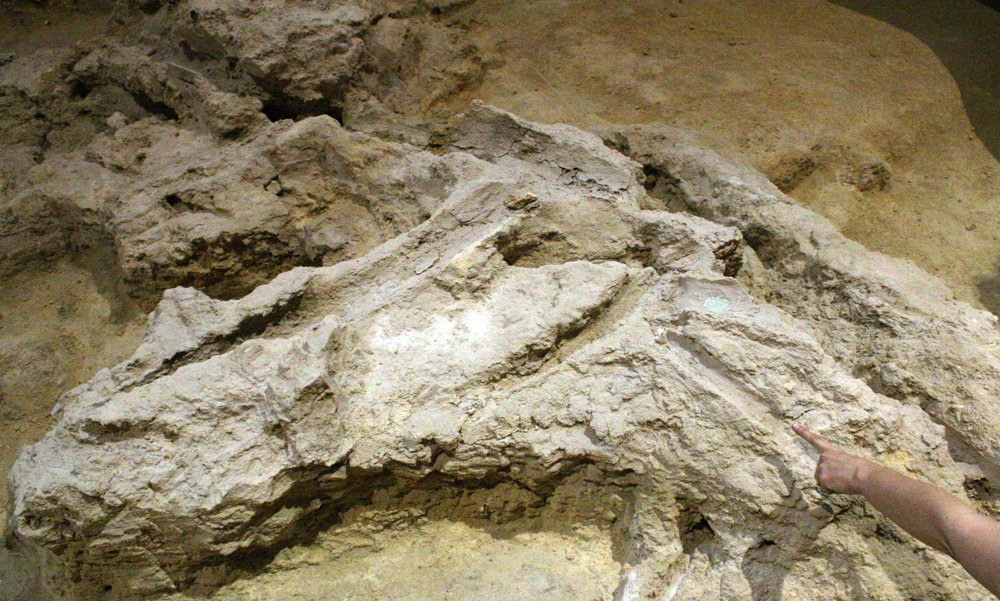
Hollow moulds in the rock at Abric Romaní, near Barcelona, preserve 13 wooden objects Neanderthals made or used about 62,000 to 40,000 years ago, including a 2.45 m spear and a unique club-like tool, though their uses are read from shape and context.
Peer reviewed · Archaeological site study · Functions inferred from shape and context
Neanderthals at a rock shelter near Barcelona shaped spears, bark trays, a long pole and what looks like a club. The wood rotted away, but its outline stayed in stone. In Science Advances (7 October 2026), a team led by Palmira Saladié of IPHES-CERCA and Rovira i Virgili University catalogues 597 wooden remains and imprints from 16 levels at Abric Romaní, and identifies 13 objects that Neanderthals worked or used. Wood almost never lasts this long, so the find shows a side of their technology that stone tools hide. The catch: most functions are interpretations.
What you need to know
- Finding: Of 597 wooden specimens, 13 were worked or used by Neanderthals: two spears (2.45 m, and 1.99 m as preserved), four bark trays, a crossed-pole structure, a 5.10 m branch-free pole, four pointed sticks and a club-like object.
- Method: The team measured hollow moulds left in travertine, a limestone deposited from carbonate-rich water, plus charred remains, and compared their shapes with wooden finds from other sites and with tools of recent foragers.
- Source: Saladié and colleagues, Science Advances 12, eaeh2287, published 7 October 2026 (open access).
- Why it matters: Few Palaeolithic sites keep any wood. This one shows Neanderthals using it for weapons, containers and probable structures inside a single lived-in shelter.
- Limitation: The wood itself is gone. Uses such as thrusting, carrying food or building a windbreak are inferred, and worn stone-tool surfaces could not confirm the woodworking.
Evidence at a glance
| Item | Assessment |
|---|---|
| Evidence status | Peer reviewed; descriptive and comparative study of one archaeological site; functions inferred from shape, wood type and location |
| Primary source | Saladié P. et al., “Neanderthal woodworking at Abric Romaní: Insights into the role of wood in a Middle Palaeolithic domestic context”, Science Advances 12(41), eaeh2287. Received 16 March 2026, accepted 31 August 2026, published online 7 October 2026 (issue dated 9 October). SciQuest read the full open-access text via PubMed Central. |
| Evidence strength | Moderate for the objects’ existence, size and shaping, because they were excavated in place, measured and in three cases 3D-scanned; limited for what they were used for, because no use-wear or residue evidence is reported |
| Principal limitation | Interpretations such as “spear”, “club”, “tray” and “hut pole” rest on form and context; the authors call their functional readings cautious and note that similar shapes served many purposes among recent foragers |
| Coverage at a glance | 7 distinct credible publishers found (Gizmodo, ScienceAlert, Nautilus, Ara, Archaeology Magazine, Courthouse News, GreekReporter) as of 14 October 2026, 13:00 UTC. Counted: outlets with their own article on this paper, opened by SciQuest or (Courthouse News, GreekReporter) confirmed by headline and summary in search results. Excluded: university releases, aggregators and outlets SciQuest could not check. |
Sources: Science Advances paper (full text); Universidad Autónoma de Madrid news release, 8 October 2026.
Is this a big deal?
It is a solid step, though not a record. Older wooden spears are known, notably from Schöningen in Germany. What Abric Romaní adds is variety. Weapons, containers, a possible shelter pole and a one-of-a-kind club all come from the same shelter, found alongside hearths, stone tools and animal bones. That is a rare look at wood in Neanderthal daily life. It remains one site, and most uses are educated readings.
What scientists found
Most of the 597 specimens are ordinary wood: trunks, branches, twigs, roots and stacks of firewood, the largest log 7.2 m long. Scots pine makes up more than 90% of the charcoal identified at the site. Among all this, the team picked out 13 pieces with signs of deliberate shaping or use. Francesca Romagnoli of the Universidad Autónoma de Madrid, a co-author, summed it up in her university’s release: “Most of the remains are trunks, branches, roots and piles of firewood, but we have also identified 13 elements worked or used by Neanderthals” (translated from Spanish by SciQuest).
The two spears come from level R, the deepest layer excavated so far. One is 245 cm long and 3.66 cm across at its thickest point, almost exactly halfway along. Its tip end is poorly preserved, and the other end broke, probably while it was being made. The second survives in three pieces with a preserved length of 199 cm, ending in a point just 0.6 cm wide. The authors say the first one’s shape “can be consistent with” a thrusting spear, the kind held rather than thrown.
The strangest object came from level P. It is a single piece of wood with a 16 cm handle and a pointed, roughly triangular head measuring 14.2 cm. Added together, that makes it about 30 cm, the length of a school ruler. The handle widens slightly at its end, and the head meets it at a sharp right-angle step, details the authors read as planned shaping to stop the hand slipping. The paper’s abstract says it has “no clear parallel in the prehistoric record”.
The rest of the set is domestic. Four flattened, charred pieces of bark, up to 55 cm long, sat close to hearths; one is juniper, unlike the pine used for almost everything else. Level I held three poles, two of them crossed, the longest 170 cm, lying over a thick hearth. Level N held a 5.10 m pole with every branch removed. Four more pointed sticks, from 12.2 cm to 94 cm long, may have been awls or digging sticks.
How they found it
Abric Romaní was discovered in 1909, and the current excavations began in 1983. The shelter covers about 300 m² under a travertine cliff in Capellades, in the province of Barcelona. Water rich in calcium carbonate kept depositing fresh rock over the floor. When the Neanderthals left wood behind, the carbonate coated it, the wood rotted, and a hollow was left in its exact shape.
Think of a key pressed into clay: the key is gone, but the hollow keeps its outline, sometimes in fine detail. Here that detail can reach individual wood cells. The comparison has limits, though. A mould records the outside of an object, so wear marks inside the wood, or residues on its surface, are mostly lost, and some moulds formed only partly.
Every find was plotted with coordinates as it was dug. Fragile moulds were hardened with consolidants before lifting, and one pointed stick was recorded by pouring polyurethane resin into its hollow during the dig. The team measured lengths and cross-sections, identified wood species under a microscope where charcoal survived, and compared the pointed objects with published finds from sites in Europe, Africa and China. 3D models of the club and both spears are publicly available.
Why it matters to you
This changes nothing in your daily life. It touches the “wonder” question of who our closest extinct relatives were. Textbooks picture Neanderthals mainly through stone tools, because stone survives. If wood was this common in one shelter, it was probably common in many others where it simply rotted. For another study that complicates a simple story of human origins, see how monkey feet complicate a key assumption about human evolution.
What the evidence does not show
It does not show the spears were used to hunt. The 245 cm spear lay among three red deer skulls with antlers, but the bones carry no weapon marks, and the Madrid release states that being close by does not establish the spear killed those animals. No study of wear or residue on the wood is reported, because the wood no longer exists.
The other functions are also open. The authors concede that bark containers are hard to tell apart from bark that peeled off naturally. Their case rests on size, regular shape, position by hearths and the unusual choice of juniper. The 5.10 m pole is read as part of a windbreak or small hut leaning against the shelter wall, but the paper notes a wider debate about how to recognise Neanderthal building at all. The 94 cm pointed object from level J might be a fragment of a structure rather than a tool.
Two more cautions. Small wood chips in many layers suggest on-site woodworking, but use-wear studies of the stone tools did not support that, partly because their surfaces are patinated and eroded. And the 62,000 to 40,000 year range covers the whole 16-level sequence; the main text does not give a separate age for each object.
How this fits what we already knew
Wooden artefacts from the Palaeolithic are rare but not new. The biggest set comes from Schöningen, where a 2024 study counted 187 wooden artefacts, including at least 20 hunting weapons, at a site it dated to about 300,000 years. A 2025 study in Science Advances re-dated those spears to about 200,000 years, so their age is disputed. ScienceAlert’s report, for one, gives only the older figure. Wooden tools about 300,000 years old have also been reported from Gantangqing in southwest China.
Against that record, Abric Romaní is young. Its distinction is range and setting. The authors compare the level R spear with Spear VII from Schöningen, and the pointed sticks with digging sticks from Poggetti Vecchi and Aranbaltza III. At Poggetti Vecchi, Neanderthals used fire to char boxwood before scraping it; at Abric Romaní, the charring on some objects seems to have happened after they were discarded, not during manufacture. For a club, the only possible Palaeolithic comparison is a find from Kalambo Falls, about 400,000 years old.
The site already had a reputation for organic finds. In 2024, a team including several of the same researchers reported a Neanderthal spear point made of bone from level Ja.
Outside views so far
SciQuest has not yet obtained comment from an archaeologist outside the study, and none of the reports we read quoted an independent specialist. The paper itself lists alternative readings for nearly every object, so treat the functional labels as the team’s best interpretations, not settled facts.
How other headlines framed it
- Gizmodo led with the club and the “invisible” side of Neanderthal life, using interviews with the authors. It gives the end of the range as 42,000 years ago; the paper says about 40,000.
- ScienceAlert called the evidence of woodworking skill “unprecedented”, a stronger word than its own text supports.
- Nautilus played on the club-wielding caveman stereotype, then argued they were skilled woodworkers.
- GreekReporter described the weapons as 62,000 years old, the oldest end of the whole sequence rather than a date for the spears.
- Ara, the Catalan daily, focused on how the finds reveal the way Neanderthals organised space around fire.
What happens next
Level R is the deepest layer excavated so far. It has yielded the most wooden specimens (140) and the most varied worked objects of any level, so further digging could add more. The public 3D models let other archaeologists test the club and spear readings for themselves. For another archaeological find where context does much of the interpreting, read about the 11,000-year-old human-on-leopard sculpture at Karahantepe.
In one sentence
Travertine moulds at Abric Romaní show Neanderthals making spears, trays, poles and a unique club-like tool from wood, though what each object was used for is still the researchers’ interpretation.
Quick check: did it click?
- How did the wood survive for tens of thousands of years? Mostly it didn’t. Carbonate rock built up around each piece, and once the wood decayed, a hollow mould kept its exact shape.
- How many of the 597 wooden specimens were worked or used by Neanderthals? Thirteen: two spears, four bark trays, a crossed-pole structure, a long pole, four pointed sticks and a club-like object.
- Does the spear found beside red deer skulls prove Neanderthals hunted deer with it? No. The bones carry no weapon marks, and closeness alone cannot show how the spear was used.
Read next
- Monkey feet complicate a key assumption about human evolution, more on how new evidence reshapes the human story
- A 6,500-year-old Czech enclosure may have tracked the Sun and Moon, another case of reading purpose from layout and context
Sources and disclosure
- Saladié P, Chacón MG, Solé A, et al. “Neanderthal woodworking at Abric Romaní: Insights into the role of wood in a Middle Palaeolithic domestic context.” Science Advances 12(41), eaeh2287, published online 7 October 2026. doi:10.1126/sciadv.aeh2287; full text at PubMed Central (CC BY-NC 4.0).
- Universidad Autónoma de Madrid. “La madera formaba parte de la vida cotidiana de los neandertales”, 8 October 2026 (in Spanish).
- 3D models of the club and both spears, CORA Research Data Repository. doi:10.34810/DATA3430
- Leder D, et al. “The wooden artifacts from Schöningen’s Spear Horizon and their place in human evolution.” PNAS 121, e2320484121 (2024). doi:10.1073/pnas.2320484121
- Hutson, et al. “Revised age for Schöningen hunting spears indicates intensification of Neanderthal cooperative behavior around 200,000 years ago.” Science Advances (2025). doi:10.1126/sciadv.adv0752
- Liu J-H, et al. “300,000-year-old wooden tools from Gantangqing, southwest China.” Science 389, 78–83 (2025). doi:10.1126/science.adr8540
- Mateo-Lomba P, et al. “First identification of a Neanderthal bone spear point through an interdisciplinary analysis at Abric Romaní (NE Iberian Peninsula).” Scientific Reports 14, 19160 (2024). doi:10.1038/s41598-024-67817-w
Disclosure: This article was drafted with AI assistance and checked against the sources above. The graphic is a SciQuest original drawn from the paper’s measurements; the club’s 30 cm length is SciQuest’s sum of the published handle and head lengths, and the Romagnoli quote is SciQuest’s translation from the Spanish release. The authors declare no competing interests, and SciQuest has none. Spotted an error? See our corrections policy.
Discover more from SciQuest
Subscribe to get the latest posts sent to your email.
Leave a comment