

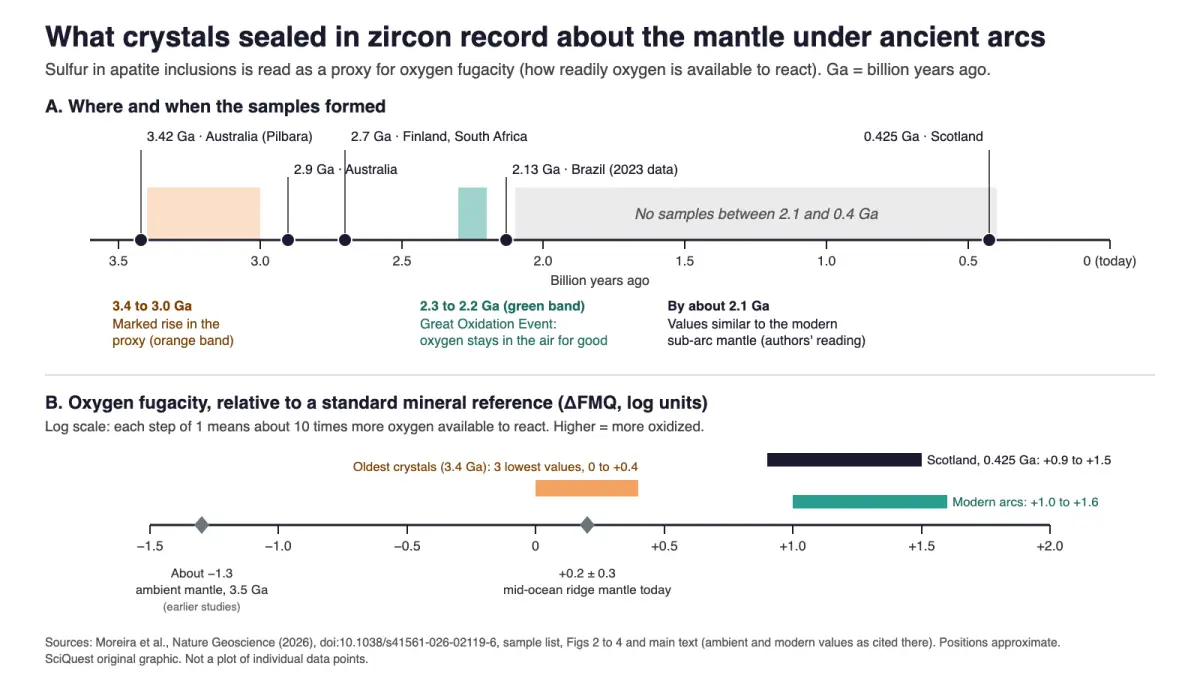
Sulfur in 39 newly analysed apatite crystals sealed inside dated zircons, from rocks 3.42 billion to 425 million years old, points to a mantle under ancient volcanic arcs that grew more oxidized between 3.4 and 3.0 billion years ago, although only 11 of those crystals are Archaean.
Peer reviewed · Mineral-proxy study · Interpretation of the cause is proposed, not shown
Sulfur locked inside microscopic crystals suggests that the mantle beneath Earth’s earliest volcanic arcs was becoming more oxidized between 3.4 and 3.0 billion years ago. That is more than a billion years before oxygen built up for good in the air. Hugo Moreira of the University of Portsmouth and eight colleagues report the result in Nature Geoscience, published on 14 October 2026. If they are right, surface chemistry was reaching the mantle through early subduction long before the atmosphere changed. The catch: the signal is a chemical proxy, read from only 11 Archaean crystals.
What you need to know
- Finding: A proxy for oxygen fugacity in magmas from above ancient subduction zones rose markedly between 3.4 and 3.0 billion years ago and sat 1.0 to 1.5 log units above the ambient mantle throughout.
- Method: X-ray spectroscopy at the European Synchrotron Radiation Facility measured the share of oxidized sulfur in apatite crystals trapped inside zircons, which were dated separately.
- Source: Moreira and colleagues, Nature Geoscience, published online 14 October 2026 (open access).
- Why it matters: It is the first evidence, the authors argue, that oxidized surface material was being recycled into the mantle before oxygen became a permanent part of the atmosphere.
- Limitation: Oxygen itself was not measured, the Archaean record rests on 11 crystal inclusions from a few rock samples, and there are no samples between 2.1 billion and 425 million years ago.
Evidence at a glance
| Item | Assessment |
|---|---|
| Evidence status | Peer reviewed; laboratory measurements on natural rock samples; mineral proxy for oxygen fugacity, not a direct oxygen measurement |
| Primary source | “Progressive oxidative weathering raised sub-arc mantle fugacity on the Archaean Earth”, Nature Geoscience, published online 14 October 2026, DOI 10.1038/s41561-026-02119-6. SciQuest read the full open-access paper, including Methods. |
| Evidence strength | Moderate for the rising trend in the proxy, because alteration, temperature, crystal fractionation and degassing were each tested; preliminary for the proposed cause, because weathering-driven sulfate recycling is an interpretation, not something the crystals record directly |
| Principal limitation | Only 11 Archaean apatite inclusions, a sulfur-in-apatite calibration made for basaltic melts at 1,000 °C, and a 1.7-billion-year gap with no samples |
| Coverage at a glance | 1 distinct credible publisher as of 15 October 2026, 04:45 UTC: the University of Portsmouth release. Counted: outlets with their own article on this paper that SciQuest opened. Excluded: reposts of the release on Phys.org and Newswise. No independent news reporting found. |
Sources: Nature Geoscience article page and Methods; University of Portsmouth release via Newswise, 14 October 2026.
Is this a big deal?
It is a solid step for a narrow question, not a rewrite of Earth history. The team used a single rock type across 3 billion years, which removes one big source of doubt when comparing ancient and young magmas. The measured trend looks sturdy against the checks the authors ran. The explanation for it, that early weathering fed oxidized sulfur into subduction zones, is a proposal, and the paper says so in its abstract.
What scientists found
The study tracks oxygen fugacity, which is the effective pressure of oxygen in a hot melt or rock. Think of it as how ready oxygen is to react, even when almost no free oxygen gas is present. Geologists report it against a reference reaction among three minerals (fayalite, magnetite and quartz), written ΔFMQ. Each step of 1 on that scale means about ten times more reactive oxygen.
Apatite crystals from the oldest rocks, 3.42 billion years old from the Pilbara Craton in Western Australia, gave the three lowest values in the study, all below +0.4. Inclusions overall ranged from 0 to +1.5. A curve fitted to all 53 inclusions, including 14 published in 2023, climbs by about 1.0 log unit between 3.4 billion and 400 million years ago. Rocks from Scotland, about 425 million years old, gave +0.9 to +1.5, close to the +1.0 to +1.6 estimated for the mantle under modern arcs.
The authors read their data as reaching modern-like values by about 2.1 billion years ago, using Brazilian samples from their 2023 study. That is shortly after the Great Oxidation Event. The paper dates that event, when oxygen rose permanently above one hundred-thousandth of today’s level, to 2.3 to 2.2 billion years ago.
How they found it
The team worked with sanukitoids, granite-like rocks thought to form when melts from a sinking slab mix with the mantle wedge above it. Samples came from five countries: Australia (3.42 and 2.9 billion years), Finland and South Africa (2.7 billion), Brazil (2.13 billion, from the 2023 study) and Scotland (425 million). “Using the same rock type throughout gives us a much more robust result,” Moreira said in the University of Portsmouth release.
The clever part is where they looked. Apatite, a calcium phosphate mineral, takes sulfur into its structure in different forms, and the share of the most oxidized form, sulfate (S6+), rises with oxygen fugacity. Apatite loose in the rock is like a postcard in the mail: anyone along the way can write on it. Apatite sealed inside a zircon crystal is more like a letter in an envelope.
The data back that up. Loose apatite in the 3.4-billion-year-old rocks gave uranium-lead ages near 3.0 billion years, about 400 million years too young. Across all the samples, loose grains showed uniformly high sulfate shares (averages of 0.75 to 0.94), while the sealed inclusions ranged far more widely, from 0.20 to 0.96. In one 3.4-billion-year-old inclusion, a crack carried an oxidized signal while the intact crystal stayed more reduced. That is where the analogy breaks: envelopes can tear, so each inclusion had to be checked.
The measurements used beamline ID21 at the European Synchrotron Radiation Facility in Grenoble, France, in sessions in October 2020 and January 2025. Its X-ray beam was focused to about 0.3 micrometres across. “These crystals are tiny, often narrower than a human hair, and they contain only small amounts of sulphur,” said co-author Marine Cotte, the scientist in charge of ID21, in the release. The team logged 337 measurements in 39 inclusions and 213 in 65 loose grains.
Why it matters to you
It won’t change anything in your daily life, and Moreira says as much. It speaks to the same “where did we come from” question as the evidence on life’s origins. Oxygen in the air, plate-tectonic recycling and the chemistry of the rocks under our feet look linked earlier than the atmospheric record alone suggests. Even 1.1 billion years, the gap between the oldest samples and the start of the Great Oxidation Event, is more than 2.5 times the age of the youngest rocks in the study.
What the evidence does not show
The crystals do not measure oxygen gas in the air or the mantle. They record the share of oxidized sulfur, which a lab calibration converts into oxygen fugacity. That calibration was made for basaltic melts at 1,000 °C and 300 megapascals. The authors argue that correcting for the cooler, deeper conditions of these magmas would push values higher, so their trend is a minimum.
The ancient record is thin. Only 11 inclusions come from Archaean zircons, and there are gaps between sample ages. The authors also stress that “sub-arc” here does not have to mean modern-style plate subduction; it could include earlier forms of sinking crust.
The cause is the biggest open question. The team ruled out temperature differences (within 100 °C), crystal fractionation and degassing (at most 0.4 log units) as explanations. That leaves recycling of oxidized surface material as the most plausible remaining process in their view. The specific source, sulfate made by small amounts of oxidative weathering, is proposed, not observed.
How this fits what we already knew
In 2023, the same group used apatite inclusions from Brazilian zircons to argue that the mantle under arcs shifted to more oxidized conditions across the Great Oxidation Event. The new paper extends that record back to 3.42 billion years, using the same rock type.
Researchers already disagreed about the wider mantle. Some models have it oxidizing slowly on its own, without help from the surface. A 2024 Nature Communications paper by Zhang and colleagues argued for a constant oxidation state since the Hadean. The new study does not settle that debate. It concludes that the mantle wedge under arcs sat 1.0 to 1.5 log units above the ambient mantle for at least 3.4 billion years, which requires extra oxidized input. Brief “whiffs” of atmospheric oxygen are recorded from 3.0 billion years ago, and the authors suggest even smaller, local sources earlier on.
Outside view
SciQuest found no public comment on the paper from an independent researcher as of 15 October 2026. The journal lists Nicholas Arndt and Jesse Walters among its peer reviewers, but their reports are not published. The University of Portsmouth release is the only coverage so far, and its quotes come from study authors.
How other headlines framed it
- The University of Portsmouth release on Newswise said the mantle was “breathing” oxygen billions of years before it reached the atmosphere.
- Phys.org, reposting the same release, gave the gap as a billion years.
The paper supports the smaller figure: from 3.4 billion years to the 2.3-to-2.2-billion-year Great Oxidation Event is about 1.1 to 1.2 billion years. The release also says the dating pinned some samples to exactly 3.4 billion years; the paper lists them as 3.42 billion years, with measurement uncertainties. And where the release speaks of the “deep mantle”, the paper’s subject is the mantle wedge under arcs, which it finds was more oxidized than the deeper ambient mantle.
What happens next
The paper lists its supporting data on Figshare, although that record did not yet resolve publicly when SciQuest checked on 15 October. Once it does, other groups can test the trend. The obvious targets are more Archaean inclusions and samples from the 1.7-billion-year gap between 2.1 billion and 425 million years ago. Moreira holds a Royal Society fellowship, awarded in 2024 for eight years, to study the origins of plate tectonics. For more on the layers involved, see our guide to the layers of Earth, from crust to core, and for how arc magmas reach the surface, what triggers volcanic eruptions.
In one sentence
Sulfur sealed in ancient crystals suggests the mantle under Earth’s early arcs grew more oxidized more than a billion years before the air held lasting oxygen, though the cause is still a proposal built on a handful of Archaean samples.
Quick check: did it click?
- Did the team measure oxygen gas directly? No. They measured the share of oxidized sulfur in apatite and converted it to oxygen fugacity with a lab calibration.
- Why use apatite trapped inside zircon? Zircon shields it from later alteration; loose apatite in the same old rocks had been reset about 400 million years later.
- Roughly how long before the Great Oxidation Event do the oldest samples date? About 1.1 to 1.2 billion years.
Read next
- From crust to core: the layers of Earth, where the mantle wedge sits
- The Grand Canyon’s missing billion years, another deep-time puzzle read from rocks
- Are humans aliens? What the evidence says about life’s origins, on the bigger “where did we come from” question
Sources and disclosure
- Moreira H, Bruand E, Storey C, Darling J, Fowler M, Cotte M, Parat F, Tual L, Dhuime B. “Progressive oxidative weathering raised sub-arc mantle fugacity on the Archaean Earth.” Nature Geoscience, published online 14 October 2026. doi:10.1038/s41561-026-02119-6. Full text and Methods read.
- Moreira H et al. “Sub-arc mantle fugacity shifted by sediment recycling across the Great Oxidation Event.” Nature Geoscience 16, 922–927 (2023). doi:10.1038/s41561-023-01258-4
- Zhang F et al. “The constant oxidation state of Earth’s mantle since the Hadean.” Nature Communications 15, 6521 (2024). doi:10.1038/s41467-024-50778-z
- University of Portsmouth. “Earth was ‘breathing’ oxygen billions of years before it hit the atmosphere”, Newswise, 14 October 2026.
Disclosure: This article was drafted with AI assistance and checked against the sources above. The graphic is a SciQuest original built from values in the paper; the 1.1-billion-year gap and the comparison with the youngest samples are SciQuest calculations. Quotes come from the University of Portsmouth release, not SciQuest interviews. This story makes no climate or health claims. SciQuest has no conflicts of interest. Spotted an error? See our corrections policy.
Discover more from SciQuest
Subscribe to get the latest posts sent to your email.
Leave a comment