

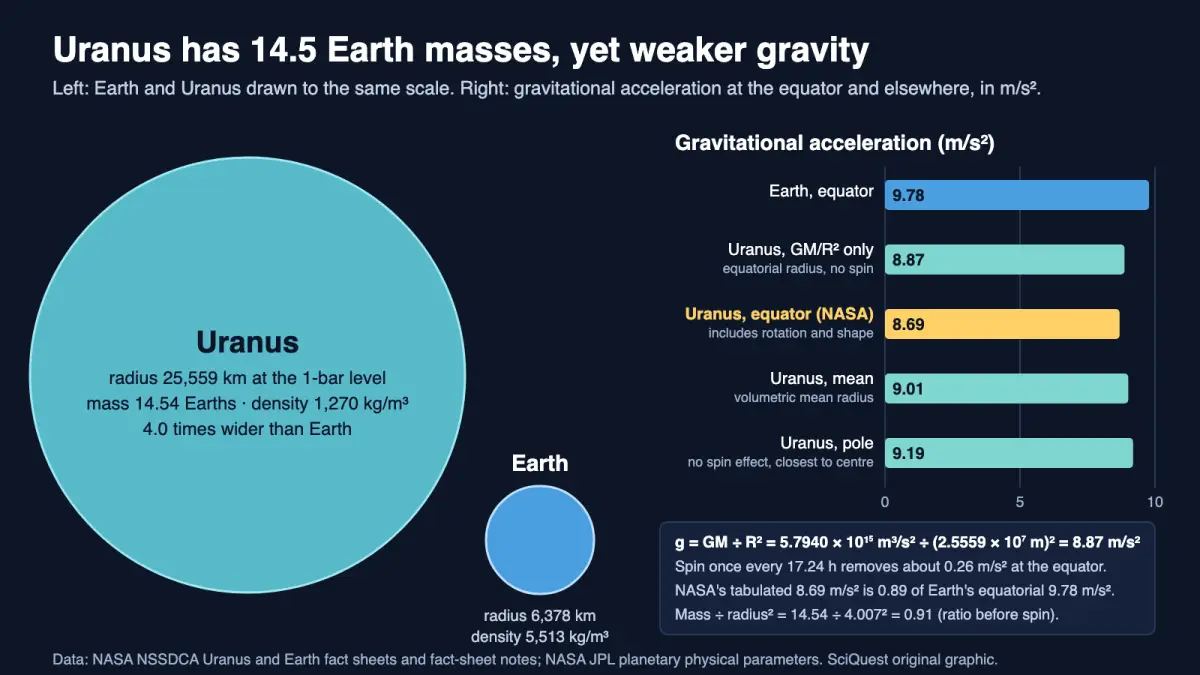
Uranus carries 14.5 times Earth’s mass, but it spreads that mass through a ball four times wider and less than a quarter as dense, so a visitor at its 1-bar cloud level would feel about 11% less pull than at home.
Gravity on Uranus is 8.69 m/s² at the equator, about 0.89 times Earth’s 9.78 m/s², according to NASA’s Uranus fact sheet. Averaged over the whole planet, NASA lists 9.01 m/s², or 0.92 of Earth’s mean 9.82 m/s². A person whose bathroom scale reads 70 kg on Earth would see about 62 kg on the same scale at Uranus’s equator.
The word “surface” needs a footnote. Uranus has no solid ground, so these values apply at the height in its atmosphere where the pressure equals 1 bar, close to sea-level air pressure on Earth. Everything below that is thickening gas and hot fluid.
Explain it like I’m busy:
- Uranus’s gravity is 8.69 m/s² at the equator and 9.19 m/s² at the poles, with a planet-wide mean of 9.01 m/s² (0.89 to 0.94 of Earth’s).
- It has 14.5 times Earth’s mass but 4.0 times Earth’s radius, and gravity falls with the square of the radius: 14.54 ÷ 4.007² = 0.91.
- The 1-bar level is cold hydrogen and helium at about −197 °C with no floor beneath it, so “standing” there means floating.
Key facts about Uranus’s gravity
- Equatorial gravity: 8.69 m/s² at the 1-bar level, 0.889 of Earth’s equatorial value (NASA NSSDCA). This is the figure NASA’s planetary comparison table rounds to 8.7.
- Mean and polar values: 9.01 m/s² averaged over the planet and 9.19 m/s² at the poles. The equator-to-pole spread is about 5.5%, against 0.5% on Earth.
- Mass and size: 8.6811 × 10²⁵ kg (14.54 Earths), equatorial radius 25,559 km (4.007 Earths), mean density 1,270 kg/m³ (0.230 of Earth’s).
- Escape velocity: 21.3 km/s, 1.9 times Earth’s 11.19 km/s.
- Among the giants: Uranus has the weakest mean gravity of the four giant planets (9.01 m/s², against Saturn’s 11.19, Neptune’s 11.27 and Jupiter’s 25.92).
What 8.69 m/s² would feel like
Drop a ball near Uranus’s equatorial 1-bar level and it gains 8.69 m/s of downward speed every second, against 9.78 m/s on Earth’s equator. A ball falling 2 m would take about 0.68 s to land instead of 0.64 s. You would notice the difference, but only just.
For a 70 kg adult the pull drops by roughly the weight of 8 kg, about the weight of a packed cabin bag you no longer have to carry. The analogy has a limit. Setting down a bag unloads your arms and shoulders, while weaker gravity lightens every part of you at once, from your feet to the fluid in your inner ear, so standing, walking and balance would all feel slightly different.
Your mass stays 70 kg wherever you go. Weight, the force gravity exerts on that mass, is what changes: about 608 newtons at Uranus’s equator against 687 newtons on Earth (70 kg × 8.69 m/s² and 70 kg × 9.82 m/s²).
| Location | Gravity (m/s²) | Weight (N) | Earth-calibrated scale reading (kg) |
|---|---|---|---|
| Earth, mean | 9.82 | 687 | 70.0 |
| Uranus, equator | 8.69 | 608 | 62.2 |
| Uranus, mean | 9.01 | 631 | 64.2 |
| Uranus, poles | 9.19 | 643 | 65.5 |
Source: NASA NSSDCA Uranus and Earth fact sheets. Weight = 70 kg × g. Scale readings are SciQuest calculations: 70 kg × (Uranus g ÷ Earth g at the same latitude type; the equator row uses Earth’s equatorial 9.78 m/s² and the pole row Earth’s polar 9.83 m/s²).
Why 14.5 Earth masses gives less than 1 Earth gravity
Surface gravity follows Newton’s law of gravitation:
g = GM/R²
G is the gravitational constant, M the planet’s mass and R the distance from its centre. Mass raises gravity in direct proportion. Radius lowers it with its square, so a planet 4.007 times wider than Earth dilutes its pull by 4.007², or about 16.1.
Using NASA’s Uranus-to-Earth ratios: 14.54 ÷ 4.007² = 14.54 ÷ 16.06 ≈ 0.91. That is the no-spin ratio at the equator, and it is why 14 Earths’ worth of material ends up pulling a little less than one Earth does.
Density tells the same story from a different angle. For a sphere, g is proportional to average density times radius. Uranus is 3.981 times wider than Earth (by mean radius) but only 0.230 times as dense (1,270 against 5,513 kg/m³), and 3.981 × 0.230 ≈ 0.92, matching NASA’s mean-gravity ratio of 0.918. NASA describes the interior as a hot, dense fluid of “icy” materials, meaning water, methane and ammonia, making up 80% or more of the planet’s mass above a small rocky core, all wrapped in an atmosphere that is 82.5% hydrogen and 15.2% helium by volume. Light materials, spread wide, make for a gentle pull.
How scientists know Uranus’s gravity
No probe has ever dropped a ball through Uranus’s clouds. Instead, scientists measure the planet’s gravitational parameter, GM, from the orbits of its moons and from spacecraft tracking, then divide by the radius squared.
Step 1: weigh Uranus with its moons
Titania, the largest Uranian moon, circles the planet every 8.705867 days at an average distance of 436,300 km, according to NASA’s Uranian satellite fact sheet. Kepler’s third law, as refined by Newton, turns those two numbers into GM:
GM = 4π²a³ ÷ T² = 4π² × (4.363 × 10⁸ m)³ ÷ (752,187 s)² ≈ 5.795 × 10¹⁵ m³/s²
That SciQuest check lands within 0.02% of NASA’s published value of 5.7940 × 10¹⁵ m³/s² (listed as 5.7940 × 10⁶ km³/s² on the fact sheet). NASA’s figure comes from a fuller fit to all the moons, the rings and spacecraft data; NASA JPL credits its Uranus mass to R. A. Jacobson’s 2014 analysis of the Uranian satellites and rings in The Astronomical Journal. The only spacecraft tracking data so far came from Voyager 2, which passed about 81,500 km from Uranus on 24 January 1986.
Step 2: divide by the radius squared
Using NASA’s GM and 1-bar radii (1 km = 1,000 m):
| Where | Radius at 1 bar (m) | GM ÷ R² (m/s²) | NASA tabulated value (m/s²) |
|---|---|---|---|
| Mean radius | 2.5362 × 10⁷ | 9.01 | 9.01 (mean) |
| Equatorial radius | 2.5559 × 10⁷ | 8.87 | 8.69 (with spin) |
| Polar radius | 2.4973 × 10⁷ | 9.29 | 9.19 |
Source: NASA NSSDCA Uranus fact sheet (GM = 5.7940 × 10¹⁵ m³/s²; radii at the 1-bar level). The middle column is a SciQuest calculation; check: 5.7940 × 10¹⁵ ÷ (2.5559 × 10⁷)² = 5.7940 × 10¹⁵ ÷ 6.5326 × 10¹⁴ = 8.87. Using G = 6.674 × 10⁻¹¹ m³ kg⁻¹ s⁻² and M = 8.6811 × 10²⁵ kg instead of GM gives the same 8.87.
The mean value matches NASA exactly. At the equator and poles the simple formula misses by 0.1 to 0.2 m/s², for two reasons covered next: the planet’s spin, and the way a flattened planet’s mass is arranged.
What changes the answer: 8.69, 8.87 or 9.01?
Search for Uranus’s gravity and you will meet several numbers. All of them are defensible; they answer slightly different questions.
- 8.69 m/s² is NASA NSSDCA’s equatorial value including rotation. The fact-sheet notes define the gravity column as “the gravitational acceleration on the surface at the equator … including the effects of rotation”, and add that “for the gas giant planets the gravity is given at the 1 bar pressure level in the atmosphere”. Divided by Earth’s equatorial 9.78 it gives NASA’s ratio of 0.889; divided by the standard gravity of 9.80665 m/s² it gives the 0.886 g seen in many reference tables.
- 8.87 m/s² is GM divided by the equatorial radius squared with no allowance for spin. NASA JPL’s planetary physical parameters page lists this as Uranus’s equatorial gravity and notes that its gravity values were computed from mass and equatorial radius. Against Earth’s 9.80 on the same page it gives 0.905, so “about 90%” is the no-spin answer.
- 9.01 m/s² is NSSDCA’s mean value: GM over the volumetric mean radius squared. It is the best single “average” figure and gives the ratio 0.918.
- 9.19 m/s² is the value at the poles, where spin has no effect and you sit 586 km closer to the centre than at the equator.
A practical rule: quote 8.69 m/s² (0.89 g) for the equator, which is what NASA’s comparison tables use, or 9.01 m/s² (0.92 g) for the planet-wide average. Keep the method consistent when comparing planets. Some fact pages pair the no-spin 8.87 with a percentage borrowed from a different method, which produces mismatches such as “8.87 m/s², about 86% of Earth’s” (8.87 ÷ 9.81 is 0.90, and no pairing of NASA’s values gives 86%).
How a 17-hour spin lowers equatorial gravity
Uranus turns once every 17.24 hours, a period NASA’s fact sheet notes was fixed from Voyager 2 radio science measurements of the magnetic field. At the equator, that spin flings material outward with an acceleration of ω²R:
ω = 2π ÷ (17.24 × 3,600 s) = 1.012 × 10⁻⁴ rad/s, so ω²R = (1.012 × 10⁻⁴)² × 2.5559 × 10⁷ m ≈ 0.26 m/s².
Subtracting that from 8.87 gives 8.61 m/s², about 1% below NASA’s 8.69. The rest comes from Uranus’s shape. The planet is flattened by 2.3% (its polar radius is 586 km shorter than its equatorial radius), and the extra ring of mass around the equator adds a little pull there and takes a little away at the poles compared with a perfect sphere. A first-order correction for that bulge, using the J₂ value of 3,343 × 10⁻⁶ on NASA’s fact sheet, brings the polar figure to 9.19 m/s², matching NASA, and the equatorial figure to about 8.65 m/s², still 0.04 short of 8.69. NASA’s tabulated value rests on a fuller gravity model, and we could not reproduce it to the last digit from the fact-sheet numbers alone.
How Uranus compares with Earth, Neptune and Saturn
| Planet | Mass (Earth = 1) | Mean radius (Earth = 1) | Mean density (kg/m³) | Mean gravity (m/s²) | Equator (m/s²) | Poles (m/s²) | Escape velocity (km/s) |
|---|---|---|---|---|---|---|---|
| Earth | 1 | 1 | 5,513 | 9.82 | 9.78 | 9.83 | 11.19 |
| Uranus | 14.54 | 3.981 | 1,270 | 9.01 | 8.69 | 9.19 | 21.3 |
| Neptune | 17.15 | 3.865 | 1,638 | 11.27 | 11.00 | 11.41 | 23.5 |
| Saturn | 95.16 | 9.140 | 687 | 11.19 | 8.96 | 12.14 | 35.5 |
Source: NASA NSSDCA fact sheets for Earth, Uranus, Neptune and Saturn. Equator and pole values include rotation.
Two comparisons stand out. Neptune is 3% smaller than Uranus by mean radius yet holds 18% more mass, so its mean gravity is 25% stronger (11.27 against 9.01 m/s²). Uranus and Neptune are often called twins, and in size they nearly are; in gravity they are not.
Saturn has 6.5 times Uranus’s mass but pulls only 3% harder at the equator (8.96 against 8.69 m/s²). Saturn is the least dense planet, spins in 10.7 hours and bulges strongly, which strips a lot of pull from its equator; our explainer on how strong gravity is on Saturn works through that case. For every planet and major moon side by side, use our guide to gravity on other planets.
Escape velocity: where Uranus’s mass does count
Escape velocity depends on GM/R rather than GM/R², so Uranus’s large radius costs it less. From the equatorial 1-bar level:
v = √(2GM/R) = √(2 × 5.7940 × 10¹⁵ ÷ 2.5559 × 10⁷) ≈ 21,290 m/s = 21.3 km/s, 1.9 times Earth’s.
So Uranus would feel a little lighter underfoot than Earth, but a spacecraft leaving it would need almost twice the launch speed.
Why it matters to you
Nobody will stand on Uranus, so this changes nothing in daily life. What it teaches is a rule that works everywhere, from exoplanets to asteroids: surface gravity depends on mass and size, and a big, fluffy world can pull less than a small, dense one. The same reasoning explains why Mars, with about a tenth of Earth’s mass, still has 38% of Earth’s gravity, as our Mars gravity explainer shows.
The numbers also set the terms for any future mission. A probe dropped into Uranus would fall at 8.7 to 9.2 m/s² into air at −197 °C, and an orbiter wanting to leave again would face an escape velocity of 21.3 km/s, 1.9 times Earth’s. Voyager 2 remains the only spacecraft to have visited, nearly four decades ago.
“But wait… Uranus spins on its side. Doesn’t that change its gravity?”
No. Uranus’s axis is tipped 97.77° to its orbit, so the planet rolls around the Sun almost on its side, with each pole facing the Sun for decades at a time. Surface gravity does not care where the axis points. It depends on the planet’s mass, its radius and how fast it spins, and a 17.24-hour day is what sets the 0.26 m/s² spin effect at the equator. Tip Earth onto its side and your bathroom scale would read the same. The tilt reshapes Uranus’s seasons and weather; our collection of Uranus facts covers that side of the planet.
A second common doubt: “if there is no surface, what does 8.69 m/s² even apply to?” It applies to the 1-bar level, a convention chosen so that radius, gravity and escape velocity can be compared fairly across Jupiter, Saturn, Uranus and Neptune. NASA’s fact sheet lists the temperature there as 76 K (−197 °C) and the “surface pressure” simply as far more than 1,000 bars, because no true surface has been found. Below the 1-bar level the pressure keeps climbing into the fluid interior, and the gravity you would feel would change with depth.
Related questions
Is gravity on Uranus stronger than Earth’s? No. It is 0.89 of Earth’s at the equator and 0.92 on average, despite Uranus having 14.5 times Earth’s mass.
How much would I weigh on Uranus? About 89% of your Earth weight at the equator and 94% at the poles. A scale reading 70 kg on Earth would show roughly 62 to 65 kg; your mass would not change.
Which planet’s gravity is closest to Earth’s? Venus (8.87 m/s²), Saturn’s equator (8.96 m/s²) and Uranus (9.01 m/s² mean) are all within about 10% of Earth’s. By coincidence, Uranus’s no-spin equatorial value of 8.87 m/s² equals Venus’s. Read more in our explainer on gravity on Venus.
Does Uranus have stronger gravity than Neptune? No. Neptune’s mean gravity is 11.27 m/s² against Uranus’s 9.01 m/s², because Neptune packs more mass into a slightly smaller ball.
In one sentence
Uranus pulls about 11% less than Earth at its equator (8.69 m/s², with a planet-wide mean of 9.01 m/s²) because its 14.5 Earth masses are spread through a planet four times wider and only a quarter as dense, and the “surface” where that is measured is a pressure level in the clouds, not ground.
Quick check: did it click?
- What is Uranus’s equatorial gravity? 8.69 m/s², about 0.89 of Earth’s.
- Why does a planet with 14.5 Earth masses have less gravity than Earth? Its radius is 4 times Earth’s, and gravity falls with the square of the radius: 14.54 ÷ 16.06 ≈ 0.91.
- Why do some sources say 8.87 m/s²? That is GM divided by the equatorial radius squared without subtracting the effect of Uranus’s 17.24-hour spin. With spin, NASA gives 8.69 m/s².
Read next
- Gravity on other planets: surface gravity of planets and major moons
- How strong is gravity on Saturn? Near Earth’s, from equator to pole
- 17 interesting facts about Uranus
Disclosure: This article was drafted with AI assistance and checked against the sources below. The gravity, spin, shape-correction, escape-velocity, Titania-orbit and weight calculations are SciQuest calculations from NASA data, and the chart is an original SciQuest graphic. Spotted an error? See our corrections policy.
Sources
- NASA NSSDCA, Uranus Fact Sheet (mass, GM, radii, flattening, J₂, density, gravity, escape velocity, rotation period, 1-bar temperature and pressure, atmospheric composition)
- NASA NSSDCA, Earth Fact Sheet (9.820 mean, 9.780 equatorial and 9.832 polar gravity; CODATA standard gravity 9.80665 m/s²)
- NASA NSSDCA, Planetary Fact Sheet and Planetary Fact Sheet Notes (definition of the gravity column: equatorial, including rotation, at the 1-bar level for the gas giants)
- NASA NSSDCA fact sheets for Neptune and Saturn (comparison table)
- NASA NSSDCA, Uranian Satellite Fact Sheet (Titania’s orbit)
- NASA JPL Solar System Dynamics, Planetary Physical Parameters (8.87 m/s² equatorial value computed from mass and equatorial radius; Earth 9.80; mass source)
- R. A. Jacobson (2014), The Orbits of the Uranian Satellites and Rings, the Gravity Field of the Uranian System, and the Orientation of the Pole of Uranus, The Astronomical Journal 148, 76
- NASA Science, Uranus: Facts (no true surface; interior of “icy” fluid above a small rocky core; 97.77° tilt)
- NASA Science, Voyager 2 (closest approach to Uranus on 24 January 1986 at about 81,500 km)
Discover more from SciQuest
Subscribe to get the latest posts sent to your email.
Leave a comment