

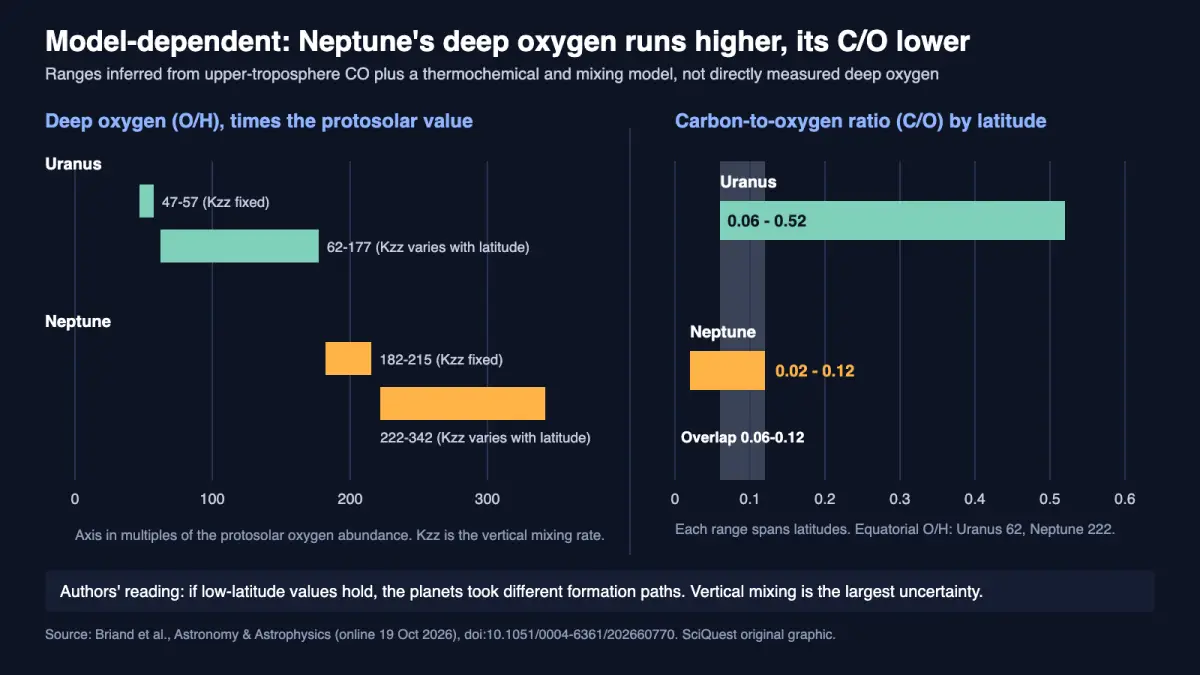
Models of carbon monoxide in the two planets’ upper air put Neptune’s deep oxygen at 222 to 342 times the protosolar level and Uranus’s at 62 to 177 times, but the result leans on assumptions about vertical mixing.
Peer reviewed · Atmospheric modelling plus telescope observations · Model-dependent inference
Neptune’s deep atmosphere appears to hold more oxygen, relative to carbon, than Uranus’s, according to a team led from Aix-Marseille Université and the CNRS. Their paper in Astronomy & Astrophysics, online on 19 October 2026, estimates carbon-to-oxygen (C/O) ratios of 0.06 to 0.52 for Uranus and 0.02 to 0.12 for Neptune. The authors read this as a hint that the two ice giants formed or evolved along different paths. Both sets of numbers come from models fitted to carbon monoxide measurements, the C/O ranges overlap, and vertical mixing is the biggest uncertainty.
What you need to know
- Finding: The modelled deep oxygen is higher on Neptune (222 to 342 times protosolar) than on Uranus (62 to 177 times), so Neptune’s C/O is lower, though the C/O ranges overlap between 0.06 and 0.12.
- Method: The team extended a 1D chemistry-and-mixing model to vary with latitude, tuned oxygen until the model reproduced the carbon monoxide seen in each planet’s upper troposphere, then compared the C/O with a protoplanetary disk model.
- Source: Briand, Hue, Mousis, Cavalié and three co-authors, Astronomy & Astrophysics, 19 October 2026 (open access).
- Why it matters: Oxygen and carbon in an atmosphere are clues to where a planet gathered its building blocks, and planets of this size are common around other stars.
- Limitation: The inferred oxygen on Uranus changes by about a factor of three depending on how fast the deep atmosphere is assumed to mix, a quantity nobody has measured on either planet.
Evidence at a glance
| Item | Assessment |
|---|---|
| Evidence status | Peer reviewed; atmospheric modelling that uses published telescope observations (including ALMA). The deep oxygen and C/O values are model-dependent inferences, not direct measurements. |
| Primary source | “Contrasting C/O ratios in Uranus and Neptune from disequilibrium chemistry: A clue to distinct evolutionary pathways?”, Astronomy & Astrophysics, online 19 October 2026, doi:10.1051/0004-6361/202660770, CC BY 4.0. The accepted manuscript is on arXiv. |
| Evidence strength | Preliminary to moderate. Neptune ranking above Uranus in oxygen holds in both pairs of runs reported in the abstract and agrees with earlier work. The size of the gap and the formation story are less certain, because they depend on mixing assumptions and a disk model. |
| Principal limitation | Vertical mixing (the eddy diffusion coefficient, Kzz). Letting it vary with latitude widens the Uranus oxygen range from 47 to 57 up to 62 to 177 times protosolar, and the true deep value is unmeasured. |
| Coverage at a glance | 1 news outlet with its own page (Phys.org, whose write-up is credited to the journal) as of 20 October 2026, 08:40 UTC. Counted: distinct publishers with their own text. Not counted: the arXiv listing and the journal page. No independent reporting found. A count is not evidence for or against the result. |
Sources: the paper and its accepted manuscript, the Crossref record, and a SciQuest web search on 20 October 2026.
Is this a big deal?
A useful step, not a settled answer. Earlier work had already suggested that Neptune holds more oxygen than Uranus. What is new is a model that lets mixing, temperature and methane vary with latitude, adds an uncertainty estimate for the chemistry, and then asks which disk conditions could produce the resulting C/O. The paper’s title ends in a question mark, and the authors say their results suggest different pathways only if low-latitude values represent each planet and mixing scales similarly in both.
What scientists found
For Uranus, the team inferred a deep oxygen abundance of 47 to 57 times the protosolar value (the oxygen content of the cloud that formed the Sun) when only the upper-air methane changed with latitude. Letting vertical mixing change with latitude widened it to 62 to 177 times. For Neptune the matching ranges were 182 to 215 and 222 to 342 times.
The oxygen ranges do not overlap in either pair. The C/O ratios, which also depend on the modelled carbon, do. Uranus comes out at 0.06 to 0.52 and Neptune at 0.02 to 0.12, and both decline from the equator toward the poles. Only the slice from 0.06 to 0.12 fits both planets.
The authors lean on one choice. They argue that low latitudes, where their model mixes the atmosphere most efficiently, are the best proxy for each planet’s bulk composition. At the equator the paper gives about 62 times protosolar for Uranus and about 222 for Neptune.
How they found it
Nobody can sample the deep air of either planet. Only Voyager 2 has flown past them, in 1986 and 1989, and infrared remote sensing sees just a few bars deep. Radio observations reach hundreds of bars. Water, the main oxygen carrier, is expected to condense into clouds far below anything visible, so oxygen has to be deduced.
Carbon monoxide offers a route. Deep in these atmospheres the heat is high enough for chemistry to settle into equilibrium, and CO is linked to water there. As gas rises it cools, the reactions slow, and CO’s abundance freezes at a level that records the deep oxygen. The team ran a model that follows this chemistry and the mixing, adjusted the deep oxygen until the model’s upper-troposphere CO matched what telescopes see, and repeated it for each degree of latitude.
The observed CO differs sharply between the planets. For Uranus the team used archival ALMA data from August and October 2022 (project 2021.1.01034.S) and derived 5.6 parts per billion at about 60 degrees latitude. For Neptune they adopted 0.20 parts per million from earlier millimetre-wave observations. That is about 36 times more CO on Neptune, a gap the model has to explain. Chemical-reaction uncertainties, tested with 1,000 Monte Carlo runs at each of several latitudes, shifted the inferred oxygen by about 10% at most.
Finally, they compared the C/O with a protoplanetary disk model: a 0.1 solar-mass disk followed for the first million years, which predicts how C/O in icy solids changes with distance from the young Sun. This is a model checked against a model, and the paper says it assumes the planets did not later change their carbon relative to oxygen.
Why it matters to you
Nothing changes in daily life. The practical value is for planning and for reading other star systems. Planets about the size of Uranus and Neptune dominate the known exoplanet population, so knowing how the two nearest examples formed helps interpret thousands of others. The paper also offers a framework for choosing where a probe on the proposed Uranus Orbiter and Probe mission should enter, and suggests low latitudes. For the physical comparison of these worlds, see gravity on Neptune and gravity on other planets.
What the evidence does not show
Think of tasting soup to guess how much salt went into the pot. The taste depends on how long it simmered and how well it was stirred, and the stirring is the unknown here. The analogy has limits: the planets’ deep layers are a layered chemistry problem, not a single pot.
The paper lists the caveats itself.
- Vertical mixing dominates the answer. At 60 degrees on Uranus, the authors’ rotation-based formulation puts Kzz about three orders of magnitude below the standard estimate of 108 cm2/s, and the inferred oxygen differs by a factor of about three between the two approaches. Mixing near water clouds could be lower still if convection is inhibited.
- Identical compositions on both planets could also fit the CO. In that scenario Uranus’s deep Kzz would be about 5,000 times smaller than Neptune’s near the quench level, though the authors add that Kzz could instead be similar and reduced only higher up, so no firm conclusion follows.
- The oxygen values at different latitudes probably bracket one deep reservoir rather than showing regional differences.
- The CO values are disk-averaged. For Uranus, the 2022 observing geometry corresponds to roughly 60 degrees latitude, and for Neptune about 25 degrees south.
- The disk model rests on assumed disk mass, turbulence and how carbon is split between molecules.
How this fits what we already knew
Earlier modelling by Venot and colleagues (2020), updated by the authors to current solar abundances, gave less than 35 times protosolar oxygen for Uranus and about 190 times for Neptune. The new paper’s abstract says its results agree with previous work on the ordering. CO in Uranus’s troposphere was detected unambiguously only recently, with ALMA, which made this comparison possible.
The formation story is the speculative part. The disk model predicts a protosolar C/O at the planets’ present distances of about 20 to 30 astronomical units (AU, the Sun-Earth distance). Uranus’s upper C/O range sits near that, which fits formation roughly where it orbits now. Neptune’s low values do not fit there. They could arise from solids gathered near the water ice line, closer to the Sun, which the authors say favours formation closer in followed by outward migration. This is a proposal that stands on the assumptions above.
Independent perspective
SciQuest found no published comment from an astronomer outside the research team as of 08:40 UTC on 20 October 2026, and has not yet interviewed one. The paper’s own discussion is the strongest outside check available: it cites recent hydrodynamic simulations of how CO moves across water clouds, and says latitude-resolved CO maps and an in situ probe are needed to test its predictions.
How other headlines framed it
Only one outlet with its own page was found, so there is little to compare. Phys.org frames the pair as planetary twins with possibly different origin stories, and says the results do not yet allow a definitive reconstruction of their history. That matches the paper’s caution, though “different origin stories” in a headline can read as more settled than a result resting on a mixing assumption.
What happens next
Three tests would sharpen the answer. Latitude-resolved CO maps would show whether CO varies the way the mixing model predicts. Laboratory and cloud-resolving studies could pin down Kzz. And an entry probe, which would likely sample down to about 10 bars, could measure trace gases directly, though it would still sit well above the water clouds. Getting there is slow: see how long it takes to get to each planet.
In one sentence
Models of carbon monoxide suggest Neptune’s deep atmosphere is richer in oxygen than Uranus’s and may point to different birthplaces, but vertical mixing, which no one has measured, could shrink the difference.
Quick check: did it click?
- Is Neptune’s deep oxygen measured directly? No. It is inferred by fitting a model to carbon monoxide in the upper troposphere.
- What is the biggest uncertainty? Vertical mixing (Kzz). Letting it vary with latitude widens Uranus’s oxygen range from 47 to 57 up to 62 to 177 times protosolar.
- Do the C/O ranges of the two planets overlap? Yes, between 0.06 and 0.12, even though Neptune’s range (0.02 to 0.12) sits lower than Uranus’s (0.06 to 0.52).
Read next
- Gravity on Neptune: how strong is it compared with Earth? The planet at the centre of this story.
- Gravity on other planets, for the physical comparison with Uranus.
- How long does it take to get to each planet? Why an ice giant probe takes years.
Sources and disclosure
- Briand T, Hue V, Mousis O, Cavalié T, Benest Couzinou T, Schneeberger A, Hofstadter MD. “Contrasting C/O ratios in Uranus and Neptune from disequilibrium chemistry: A clue to distinct evolutionary pathways?” Astronomy & Astrophysics, online 19 October 2026 (received 28 March, accepted 6 August 2026). doi:10.1051/0004-6361/202660770
- Accepted manuscript on arXiv:2609.05326, submitted 4 September 2026. Methods, tables and conclusions were read here because the journal site blocked automated access; the abstract was checked against the Crossref record.
- Phys.org, “Planetary ‘twins’ Uranus and Neptune may have different origin stories”, 19 October 2026.
Disclosure: This article was drafted with AI assistance and checked against the sources above, including the accepted manuscript. The paper’s acknowledgements list support from the French government’s France 2030 plan (A*MIDEX) and CNES. Calculations by SciQuest: 0.20 ppm of CO divided by 5.6 ppb is about 36. The oxygen and C/O ranges are the paper’s own. The graphic is a SciQuest original built from the paper’s reported values. Spotted an error? See our corrections policy.
Discover more from SciQuest
Subscribe to get the latest posts sent to your email.
Leave a comment